“The Stitched” World of Rosen Rashev – Roshpaka, Part I
Jubilee 50th Auction of Enakor Auction House – “BULGARIAN NAÏVE...

A compendium for arts and antiques enthusiast
Jubilee 50th Auction of Enakor Auction House – “BULGARIAN NAÏVE ARTISTS”, 8 October 2026

Rosen Rashev – Roshpaka is one of the best-known and most highly regarded Bulgarian naïve artists. Among his more important awards are the award for overall artistic achievement from the “Sts Cyril and Methodius” Foundation in 1994, the Grand Prize for a foreign artist at the Triennial of Naïve Art in Jagodina, Serbia in 1995 and the Grand Prize of the Union of Bulgarian Artists from the National Art Exhibition “The Land of Botev” 2006. He was born in 1970 in Vratsa and in 1989 graduated from the “Iliya Petrov” Secondary School of Art in Sofia. He began drawing in the first grade at the town children’s art school in Vratsa, then at the secondary school of art and has continued to work every day ever since. Although he has training at the level of secondary art education, he consciously did not take the path of the National Academy of Art. He says that on this matter he followed the advice of Dimitar Kazakov – Neron (Vapreki 2024, 2025). He states that folk art is “in his heart” and that academic drawing, although he masters it, does not move him as his own personal path (Vladova 2002).
His artistic path soon extended beyond the Bulgarian context. As early as 1994 he was invited by the Museum of Naïve Art in Jagodina, Serbia, where he later received important awards. There he entered an environment in which naïve art had long possessed self-confidence, institutions and tradition – in Serbia, through Jagodina and Kovačica, and in Croatia, through the Hlebine School. He himself connects this experience with the absence of a strong naïve-art school in Bulgaria and with the distrust of naïve art in this country, which according to him is often regarded as “kitsch” or as something not serious enough (Vladova 2002; Yovanovska 2011). Biographical accounts note dozens of his solo exhibitions in Bulgaria and abroad, participation in international forums for naïve and intuitive art, as well as the presence of his works in the museum in Jagodina, in the Museum of Intuitive Art in Bratislava, in the “Ivan Funev” Art Gallery in Vratsa and in numerous private collections in various countries (Sarieva 2007; Valcheva 2017; Osikovska 2023). One of the richest collections of his works is being offered in the present jubilee auction of Enakor Auction House.
Roshpaka’s attitude towards naïve art is contradictory and particularly revealing, because it is shared by many of his fellow artists. He works in a field which galleries, museums and the public consistently recognise as naïve, and receives awards as a naïve artist, yet he resists the art-historical placing of labels and frameworks upon his work within that same field. In his interview with Daniela Osikovska he insists that he does not want to be described by any “-ism” (Osikovska 2023:117). In his interview with Maya Yovanovska he goes even further: he defines himself not as a naïve artist, but as a “contemporary, individual” and even “conceptual” artist, because he constructs the idea of each of his paintings in advance. At the same time, he admits that he likes “pretending” to be naïve in order to keep his soul pure (Yovanovska 2011). In his case, naïve art is not a lack of awareness of form; on the contrary, it is a tense field between the artist’s resistance to the term and the evident belonging of the works to naïve artistic practices, especially through his long-standing connection with Jagodina.

The nickname “Roshpak”, by which the artist is known, dates from his school years. It was invented by his classmates at the Secondary School of Art because of his then shaggy hairstyle (Interview, Gallery “Paris” 2019). Thus, in the very name which later became an artistic signature, there is something of the living environment in which he was formed – school-like, colloquial, slightly rough, but memorable. Roshpaka often speaks about his work through personal memories, episodes, beliefs and stories from his own milieu. These testimonies are valuable as an entry into the world from which his images come.
Central to his artistic formation is his connection with North-Western Bulgaria – Vratsa, the Vratsa Balkan and the village of Dolna Beshovitsa. Roshpaka repeatedly speaks of Beshovitsa as a place of childhood, nature, animals, the village yard, freedom and the first images of the world. He says that he wants his paintings to convey the “magic of the land” on which he walks – Vratsa, the North-West, Bulgaria, the Balkans (Yovanovska 2011). This connection is the source of his imagery: the village, animals, oral stories, memories, evening gatherings, the local dialect and biblical parables merge into a personal mythopoetic world (Yovanovska 2011; Pavlova 2015). An important strand is his bond with the oral storytelling tradition (Yovanovska 2011). The animals in Roshpaka’s paintings, for instance, are not idyllic inhabitants of nature. They come from the village yard, from hunters’ tavern tales of wild boar, hares, pheasants and dogs, from small local stories told and retold in his surroundings. The artist says that he likes these stories very much, that they are part of him, and that this is why he paints them as lived images – images that have “passed through the heart”. His own account of setting traps as a child to catch eagles among the rocks also belongs to this world (Vladova 2002).
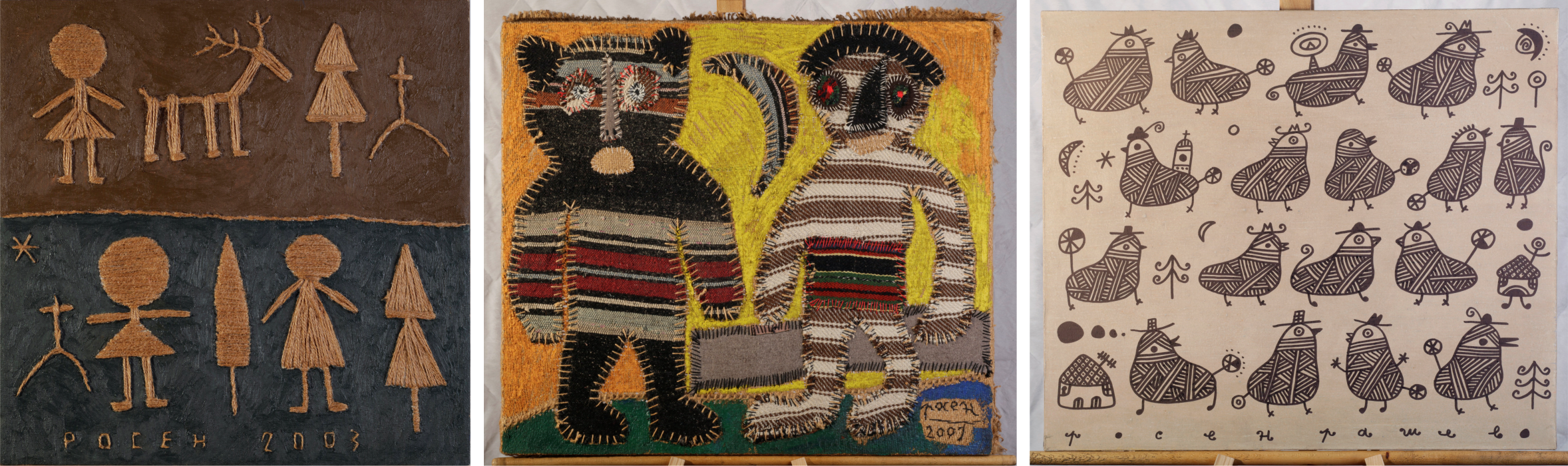
Roshpaka says that if he were to write books, he would write them “like those of Grandpa Yordan Radichkov”, and defines himself as a storyteller who began turning incidents into “picture-tales” (Vladova 2002; Yovanovska 2011). He describes Radichkov’s world as “magical realism” and uses the same term for his own imagery (Interview, Gallery “Paris” 2019). From Radichkov come not only the sparrows, but also the freedom for the animal to become a character, a sign and a bearer of human destiny. His birds are images of the human – kind, funny, vulnerable, clothed, familial, communicative and ready for flight (Vapreki 2024; Vapreki 2025). Roshpaka also speaks of the influence of La Fontaine’s fables, from which he takes the zoo-anthropomorphic form – the animal as an image of the human being (Interview, Gallery “Paris” 2019). His bird-people, sparrows with steering wheels, goats, dogs, flying fish and other creatures are his way of speaking about human life.
Although God, angels, souls, biblical motifs and saints often appear in his paintings, Roshpaka’s religious imagination is not ecclesiastical-Orthodox in character. It is closer to the broad horizon of folk Christianity, in which Christian images, the animation of nature and personal spiritual ideas may freely coexist. In the interview at Gallery “Paris”, he speaks of souls as an independent reality (and this is how he paints them), states his belief in the reality of reincarnation and sees human embodiment as a rare and great gift. He also speaks of practices of communication with trees, from which he seeks energy, recovery and healing (Interview, Gallery “Paris” 2019). His “souls” are not a poetic metaphor or a Christian motif, but part of a personal cosmology in which the human being, nature, animals and the invisible world are linked in a specifically personal way, which he experiences and carries over into his works.

Roshpaka’s positivity does not appear to be easy cheerfulness or decorative optimism. He himself describes it as an effort – one must be born with such an attitude, but one must also want to preserve it, to fight for it, and not to fall into bleakness. In this sense, making “positive paintings” is difficult for him. When he is not in a positive state, he does not paint, but returns to nature, which he calls his inspiration and healer (Interview, Gallery “Paris” 2019). This feature is essential to understanding his naïve art: the goodness in his paintings should not be taken as a naïve ignorance of evil, but as a desired visual order which the artist persistently builds through difficult struggle, discipline and personal mythology.
When Roshpaka speaks of his teachers, he names “Bulgarian artists” in whom he recognises a strong connection with the folk and the nationally rooted, with local memory, artists who make “art with roots”. Among the most important names for him are Dimitar Kazakov – Neron, Nikola Kazakov, and Lika Yanko (Vapreki 2024; Vapreki 2025; Interview, Gallery “Paris” 2019). Many commentators have noted the strong influence of Lika Yanko on the compositions, forms, images, techniques and materials in his work (Interview, Gallery “Paris” 2019; Vapreki 2024; Vapreki 2025). He does not deny this influence and formulates the difference between himself and her very simply: she glues, whereas he embroiders (Interview, Gallery “Paris” 2019). In Roshpaka’s work the image is not constructed only by adding objects and cords, but through stitch and sewing – through sustained handiwork.
One of Roshpaka’s most recognisable features is his mixed technique. He works with oil painting, stitched contour, appliqués of fabric, hessian, old rugs, threads, buttons, relief canvases, ceramics and objects. He explains this interest in making and crafting through his father, who worked with wrought iron and wood, as well as through the sewing and weaving he did in childhood and within the family together with his grandmother (Vladova 2002). Gallery texts also consistently emphasise this material line: in his work the stitch is part of the construction of the image; he links painting with tapestry work, the tradition of embroidered wall-hangings and textile practice (Sarieva 2007; Valcheva 2017; Vapreki 2024; Vapreki 2025). In the interview at Gallery “Paris” he uses the characteristic word “stitches” and speaks of his “stitched paintings”. He also recounts that he treats the thread with beeswax or varnish, and that he was drawn to the old stitched wall-hangings with folk subjects that decorated village homes. He liked running his fingers over the seams, experiencing their three-dimensionality. (Interview, Gallery “Paris” 2019). In his finest works, the stitch, the thread and the appliqué turn the simple sign into a three-dimensional object-like presence – the image is not only painted, but also sewn, assembled and constructed.

Roshpaka’s style may be defined as a fairy-tale-parabolic and mythopoetic naïve art. Unlike many Bulgarian naïve artists, he does not rely on humour, although at times there is also a smile in his images. His world is populated by Grandpa God, angels, birds, goats, dogs, fish, unicorns, dragons, children, families, bird-people and other fantastic creatures, which belong simultaneously to childhood memory, the village tale, the biblical narrative and personal vision. Gallery texts often speak of his “picture-stories”, of the village of Beshovitsa as a collective image, and of three enduring pillars – the little animals as a symbol of the human world, the family with the warm home, and the ever-present Grandpa God with the angels (Pavlova 2015; Vapreki 2024). This imagery is instructive, but not coldly didactic: it seeks to return the human being to goodness, love, forgiveness, tenderness and trust in the world (Yovanovska 2011; Vapreki 2024; Vapreki 2025).
In Roshpaka’s work, the word is inseparable from the image. Titles, inscriptions and embroidered texts do not merely explain, but complete the narratives of the paintings. In one interview he says that the paintings themselves “carry” their names – they arise from the experiences and stories which the artist tells through them (Vladova 2002). That is why titles such as “Grandpa God Welcomes Love”, “Welcoming the Wisdom of God”, “The Endless River”, “The One Who Knows Everything” or “Merry Adventures with the Yordanov Sparrows” are an unavoidable part of the meaning of the works. They introduce the viewer into Roshpaka’s world as into a fairy tale, a parable or an oral story, where word and image work together.
Roshpaka is an artist in whose work naïve mastery should be sought in the ability to build a recognisable and recurrent personal world of images. His art brings together folk-national memory, childhood recollection, folk-Christian images, personal spiritual ideas, North-Western Bulgarian oral storytelling and handcrafted materiality. It is not “naïve” as a form of unknowing, but naïve as a consistently pursued language, close to his idea of “folk art”. His works show how the irregular contour, the stitched line, the rough fabric, the strange animal or the childlike sign may become plastically necessary – not because the artist cannot do otherwise, but because precisely in this way his world begins to speak. His true strength lies in the “stitched” image – in the ability to turn the painting into a handcrafted object, close to the embroidered wall-hanging, the tapestry and the domestic village textile.
Admirers of naïve art and collectors of Rosen Rashev – Roshpaka will have the opportunity to choose their favourite stitched canvases or drawings from among more than 50 works by the artist included in the jubilee auction of Enakor Auction House. This is a rare opportunity to see Roshpaka as an entire world – a world of childhood memories, animal-characters, angels, dragons, ritual signs and woven images, in which the simple line and the rough stitch become a visualisation of our folk-national spirit.
Rossitsa Gicheva-Meimari, , PhD
Chief Assistant Professor in the Department of Arts and Design and member of the “Bulgarian-European Cultural Dialogues” Centre at New Bulgarian University
Bibliography:
Vladova 2002: Елена Владова, Росен Рашев-Рошпака: Ако седна да пиша книги, ше ги пиша като на дедо Йордан Радичков. В: Media Times Review, октомври, 2002 – http://mediatimesreview.com/october/VladovaArtoctober.php Посетена на 1 септември 2026
Valcheva 2017: Нели Вълчева, “Мирно царство” – изложба на Росен Рашев-Рошпака във Варна. В: „Културни новини“, 02.08.2017 – https://kulturni-novini.info/sections/2/news/26166-mirno-tsarstvo-izlozhba-na-rosen-rashev-roshpaka-vav-varna Посетена на 1 септември 2026
Vapreki 2024: Светът на Рошпака е изпълнен с любов и доброта, какъвто ни се иска да бъде. Във: „Въпреки“, 2024 – https://въпреки.com/post/744409128836988928/%D1%81%D0%B2%D0%B5%D1%82%D1%8A%D1%82-%D0%BD%D0%B0-%D1%80%D0%BE%D1%88%D0%BF%D0%B0%D0%BA%D0%B0-%D0%B5-%D0%B8%D0%B7%D0%BF%D1%8A%D0%BB%D0%BD%D0%B5%D0%BD-%D1%81-%D0%BB%D1%8E%D0%B1%D0%BE%D0%B2-%D0%B8-%D0%B4%D0%BE%D0%B1%D1%80%D0%BE%D1%82%D0%B0 Посетена на 1 септември 2026
Vapreki 2025: С творбите си Росен Рашев-Рошпака ни напомня какви сме дълбоко в душите си. Във: „Въпреки“, 2025 – https://въпреки.com/post/778200818119753728/%D1%81-%D1%82%D0%B2%D0%BE%D1%80%D0%B1%D0%B8%D1%82%D0%B5-%D1%81%D0%B8-%D1%80%D0%BE%D1%81%D0%B5%D0%BD-%D1%80%D0%B0%D1%88%D0%B5%D0%B2-%D1%80%D0%BE%D1%88%D0%BF%D0%B0%D0%BA%D0%B0-%D0%BD%D0%B8-%D0%BD%D0%B0%D0%BF%D0%BE%D0%BC%D0%BD%D1%8F-%D0%BA%D0%B0%D0%BA%D0%B2%D0%B8 Посетена на 1 септември 2026
Interview, Gallery “Paris” 2019: Росен Рашев- РОШПАКА: Интервю в Галерия Париж, 2019. В: Ютюб канал на галерия „Париж“ – Art Gallery Paris, 29 Oct 2019, https://www.youtube.com/watch?v=t9WrxTeSF98&list=PL-3mHNv2Qb2fYsENDOmCimu2TWMB4dVxj&index=11 Посетена на 1 септември 2026
Yovanovska 2011: Мая Йовановска, Росен Рашев-Рошпака: Искам да съхраня душата си чиста. Във: в. „Дума“, 12 Февруари 2011 / брой: 36 – https://duma.bg/iskam-da-sahranya-dushata-si-chista-n10888?h=pdfarchive&pdfarchiveId=3703 Посетена на 1 септември 2026
Kostova 2025: Анелия Костова, Нова изложба с птицочовеци открива врачанския художник Росен Рашев-Рошпака в софийската галерия “Париж”. В: Дарик радио, 18 Февруари 2025 – https://darik.bg/nova-izlozba-s-pticochoveci-otkriva-vrachans Посетена на 3 септември 2026
Osikovska 2023: Даниела Осиковска, Интервю с Росен Рашев – Рошпака. В: Маринска, Р. (авт.), Д. Осиковска (съст.), Съвременни български наивисти. София „Кибеа“, 2023, с. 116-118.
Pavlova 2015: Надя Павлова, “Пътуване до Бешовица” с Росен Рашев-Рошпак. В: „Културни новини“, 15.05.2015 – https://kulturni-novini.info/sections/2/news/21443-patuvane-do-beshovitsa-s-rosen-rashev-roshpak Посетена на 1 септември 2026
Sarieva 2007: Веселина Сариева, Росен Рашев-Рошпака. Ноевата лодка. В: „Културни новини“, 27.03.2007 – https://kulturni-novini.info/sections/2/news/3725-rosen-rashev-roshpaka-noevata-lodka Посетена на 1 септември 2026
Product has been added to cart