Dimitar Bogdanov: small scenes with large characters
Jubilee 50th Auction of Enakor Auction House – “BULGARIAN NAÏVE...

A compendium for arts and antiques enthusiast
Jubilee 50th Auction of Enakor Auction House – “BULGARIAN NAÏVE ARTISTS”, 8 October 2026

Dimitar Bogdanov is among the academically trained artists in the auction of Bulgarian naïve artists who turned to naïve art as a chosen artistic language – a way of simplifying, narrating and transforming the small everyday scene into an image with its own inner logic. Born in Sofia in 1961, he graduated from the National Academy of Art, specialising in “Conservation and Restoration” under Prof. Lyuben Prashkov (Gallery Paris; Le Papillon; ValerArt). This training may have played a role in his choice of a naïve artistic language, since it implies direct contact with older visual systems – icons, Bulgarian Revival-period art, folk imagery and various forms of artistic stylisation.
Bogdanov has his own visual position and a recognisable artistic manner. His naïve art is not noisy, not decoratively overloaded, and it does not seek ethnographic accuracy. Behind the apparent simplicity of these paintings lies a very strong culture of drawing: Bogdanov deforms his figures deliberately, with a precise feeling for character, gesture and comic situation. His colour is equally strong – soft, controlled and nuanced, with carefully placed accents that build the mood and guide the meaning of the scene. One of his strengths is his interest in character – not as psychological depth in the academic sense, but as clearly captured behaviour, mood, weakness, habit or comic peculiarity. He works with small scenes, clear signs, compact spaces and characteristic deformations through which an ordinary incident acquires meaning – humorous, morally playful or simply human. In his paintings, the Bulgarian folk-everyday environment is presented as a world of human habits, relationships, expectations, curiosities and little failings – a world in which the comic and the good-natured often stand very close to a gentle remark on human weaknesses.
In the body of works included in the auction, Bogdanov is represented by five small oil paintings from 2006–2011 – “Old House”, “Curiosity”, “Baked Quince”, “Conflict” and “Before the Feast”. They belong to an earlier line in his work, presented here through folk and everyday subject matter, and are quite different from his later romantic-fantastic and surrealistic themes. Here he is interested in the house, the yard, festive expectation, curiosity, minor conflict, and the comic or awkward aspects of human relationships. The gallery description of Bogdanov as approaching “with a smile” the life of the ordinary person, their little failings and Bulgarian manners and mores is particularly fitting for these works (ValerArt). This is a gentle, observant and lightly ironic attention to everyday situations and human weaknesses. In “Old House”, Bogdanov presents the folk theme through the image of the abandoned home. The house is placed at the centre of the composition as the main character, but no longer as an inhabited place – rather as a body in decay. Most of the roof tiles have fallen away, exposing the wooden roof beams; some of them are sagging or have already collapsed; the plaster has flaked off in places down to the brickwork; one window is missing, while the other looks as though it is about to fall out. The door is open, but not as a sign of hospitality – rather as a trace of abandonment: a small bush and grass have already grown in front of the entrance, and plants are also creeping along the walls. The naïve element here lies not in humour, but in the conditional perspective, the simplified form and the slight deformation through which the ruined house becomes a sign of a human world that has been left behind. It carries the memory of former habitation, but in its present state another movement is already visible – the slow withdrawal of the human being and the return of nature.
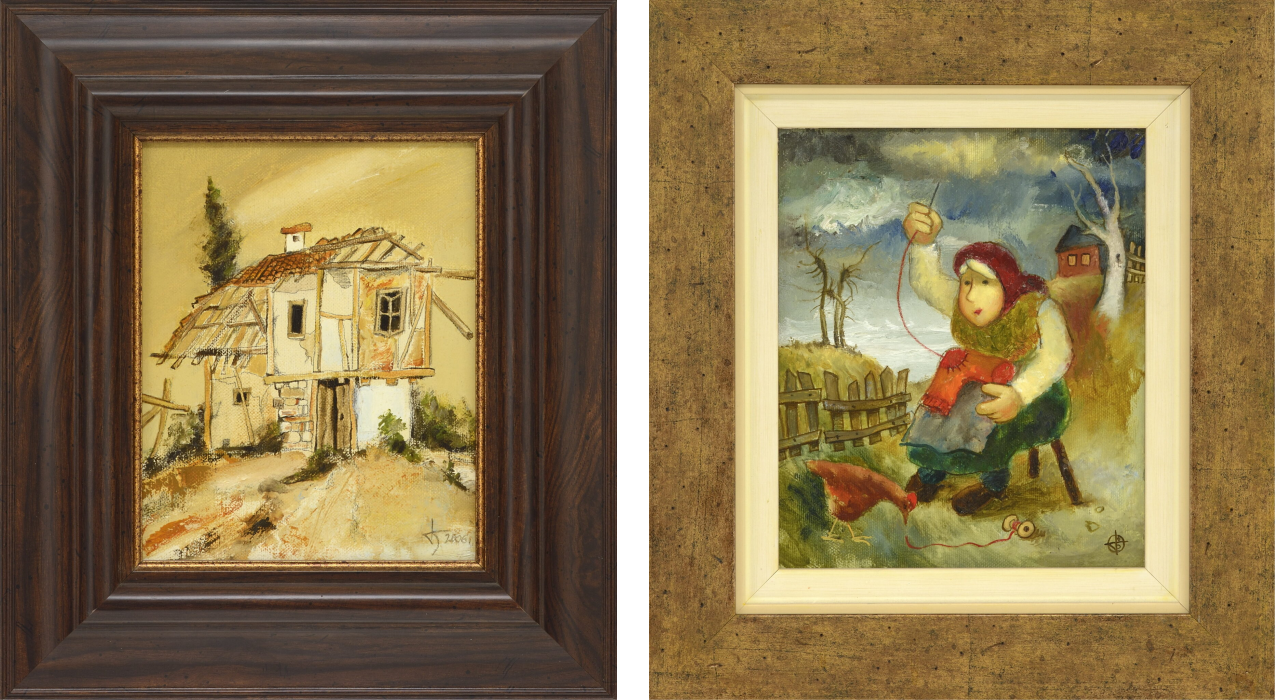
In “Curiosity”, Bogdanov turns a tiny yard incident into a complete naïve narrative. A woman, seated outdoors, is darning the heel of a thick red woollen sock, while a red thread has unwound from the spool that has fallen to the ground, and a little hen bends towards it with curiosity. The title points not to a human psychological situation, but to a comic animal misunderstanding – the bird seems to recognise something living in the thread, perhaps a worm or food. The red line connects the woman’s hand, the sock, the spool and the hen, and thus quite literally leads the narrative through the painting. The strongest deformation is in the woman’s enormous hands: one is raised with the needle, the other holds the sock, so that the whole figure is concentrated in the act of darning. The hands are not “wrong” by accident – they turn the small domestic repair into the main event of the image. The great event here is the rescue of a sock, yet around precisely this minor care Bogdanov builds an entire scene of human concentration and animal curiosity.
The naïve quality lies in the simplified forms, the conditional space and the slight deformation, but also in the choice of subject itself: the larger world is reduced to a small domestic scene in which needlework, the yard, the animal and human composure meet in quiet, good-natured humour. The stylisation of the woman’s face – oval, smoothed, with a small mouth and a focused, almost frozen expression – already suggests the characteristic treatment of female images that would later become recognisable in the artist’s more fantastic and surrealised works. Thus, in this small folk and everyday scene, one can also trace an early form of the artistic manner that Bogdanov would continue to develop.
In “Baked Quince”, the artist reduces the folk and everyday scene to the smallest possible domestic narrative. In an almost empty interior, a woman in rural dress bends over a plate with a baked quince; beneath her is a striped rug, and above the scene hangs a paraffin lamp. The space is poor in detail, but this is precisely why every sign becomes important – the fruit, the plate, the hand, the rug, the lamp. The strongest element is the deformation of the figure: the woman is bent towards the quince, her face is elongated in profile, with an enormous nose, and its yellowish tone almost brings it close to the fruit itself. The funniest and most precise naïve effect is the resemblance between the grandmother’s profile and the quince itself: the human being and her small pleasure seem to mirror one another. It is not clear whether she is looking at the fruit, smelling it, checking whether it is well baked, or already tasting it in her imagination; yet it is precisely this concentration that turns the simple baked quince into the centre of an entire domestic ceremony. The naïve quality here lies in the conditional space, the large flat hand, the sign-like figure and the artist’s ability to turn the tiniest everyday situation into an image of the old domestic world – with its poverty, warmth, smell, humour and human attachment to small pleasures.
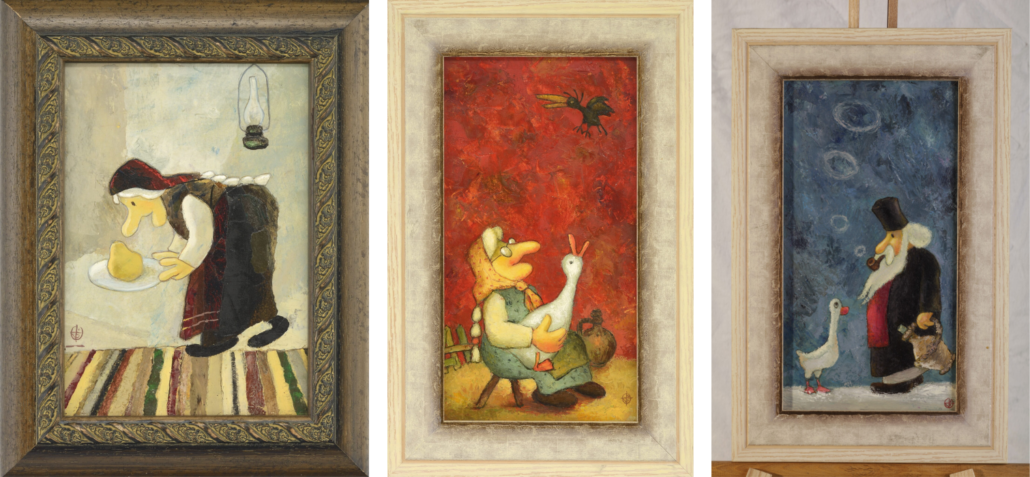
In “Conflict”, Bogdanov turns a small yard quarrel into a comic and strongly sign-like scene. A woman seated on a low stool is holding a white goose in her lap, while above them a black crow caws or swoops down with its yellow beak wide open. The conflict appears at first to be a clash between the two birds – the large domestic goose, guarded in the woman’s arms, and the noisy, impudent crow that disturbs the order of the yard. Yet the woman herself also takes part in this avian quarrel: her upturned face, with its enormous yellow nose, visually echoes the birds’ beaks. In this way, the human being, the goose and the crow become involved in a shared comic system of gazes, beaks, gestures and irritation. The woman’s large hand enfolds the goose as something that belongs to her and must be protected, while the saturated red background turns the small everyday incident into an image of heated dispute. The naïve quality here lies in the simplified forms, the flat space, the sharp deformation and the artist’s ability to turn an ordinary yard quarrel into a small theatre of human and animal behaviour.
In “Before the Feast”, the artist once again turns a small everyday moment into a comic scene of domestic irony. Opposite a white goose stands a village priest in a black cassock, a tall black hat and a white beard, smoking a pipe and holding a demijohn in his hand. The title promises festive anticipation, yet the painting does not show any solemn preparation for the feast, but rather the earthly, human and slightly sinful side of the pre-festive mood. The priest is not simply encountering the goose – he seems already to be sizing her up and wondering whether she would look good roasted on the table. The goose, however, is not passive: she looks at him with a suspicious, slightly wide-eyed expression, as though she has already guessed the direction of the priest’s thoughts. Thus the innocent animal becomes both interlocutor and future feast, while the demijohn suggests that the celebration has not yet begun, but human weaknesses are already in place. The resemblance between human nose and bird’s beak once again introduces Bogdanov’s characteristic comic link between the human and the animal, but here it is sharper: the man and the bird look at each other almost as equal characters, while the viewer understands the inequality of their intentions. The naïve quality lies in the simplified forms, the deformed profile, the almost equal scale of priest and goose, and in the artist’s ability to show Bulgarian manners and mores not as official tradition, but as a small, morally playful village comedy.
The artworks by Dimitar Bogdanov in the auction are small in format, yet very dense in observation, character and painterly culture. There is no noisy effect-seeking in them, but carefully captured states: the abandoned house that is already returning to nature; the woman absorbed in the rescue of a red sock; the grandmother who almost mirrors herself in the baked quince; the yard quarrel between a human being, a goose and a crow; the priest with the demijohn facing the suspicious goose. Behind the apparent simplicity stands exquisite draughtsmanship – precise, economical and highly expressive – as well as a masterly sense of colour, in which soft backgrounds, warm ochres, red accents and cool bluish tones build atmosphere without overloading the image. Bogdanov is able to turn the ordinary object, the animal and the human gesture into images with memory, humour and a gentle remark on human weaknesses. This is precisely the appeal of these paintings for lovers of naïve art: they are accessible at first sight, comic and human, yet with each further viewing they begin to reveal more details, more characters, more small cunning devices of the image. These are works that will easily enter the domestic space, but will not be reduced to decoration. They will begin to live there as cheerful, observant and slightly sly interlocutors.
Rossitsa Gicheva-Meimari, PhD
Chief Assistant Professor in the Department of Arts and Design and member of the “Bulgarian-European Cultural Dialogues” Centre at New Bulgarian University
Bibliography:
Le Papillon: Dimitar-Bogdanov. In: Art Papillon – https://www.artpapillon.com/en/dimitar-bogdanov-70 Посетена на 12.09.2026.
Gallery Paris: Dimitar Bogdanov – Artist. In: Art Gallery Paris – Sofia – https://gallery-paris.com/hudozhnik/dimitar-bogdanov/ Accessed 12 September 2026.
ValerArt: Dimitar Bogdanov. In: ValerArt – https://valerart.com/bg/s/artists/D_Bogdanov/ Accessed 12 September 2026.
Product has been added to cart