The Beauty of Retelling: The Icon Between Tradition and Naïve Art. Is It Naïve to Like Naïve Art?
When speaking about works created outside the academic artistic tradition,...

A compendium for arts and antiques enthusiast
When speaking about works created outside the academic artistic tradition, we most often use terms such as “primitive” and “naïve”, while their creators are described as “untrained”. Yet these definitions are far from straightforward. They require particular care when applied to religious art, where the relationship between artistic skill, tradition and established models is considerably more complex.
“Primitive” has long ceased to mean simply something rudimentary or insufficiently developed. The history of modern art demonstrates how professional artists consciously turned towards folk art, non-European cultures and forms that existed outside academic conventions. This is why Ernst Gombrich’s understanding of the primitive seems particularly apt: a concept that can express admiration rather than condescension. The same can be said of “naïve” art. Rather than a shortcoming, it can be understood as immediacy, simplification and, above all, a distinctive retelling of the familiar.
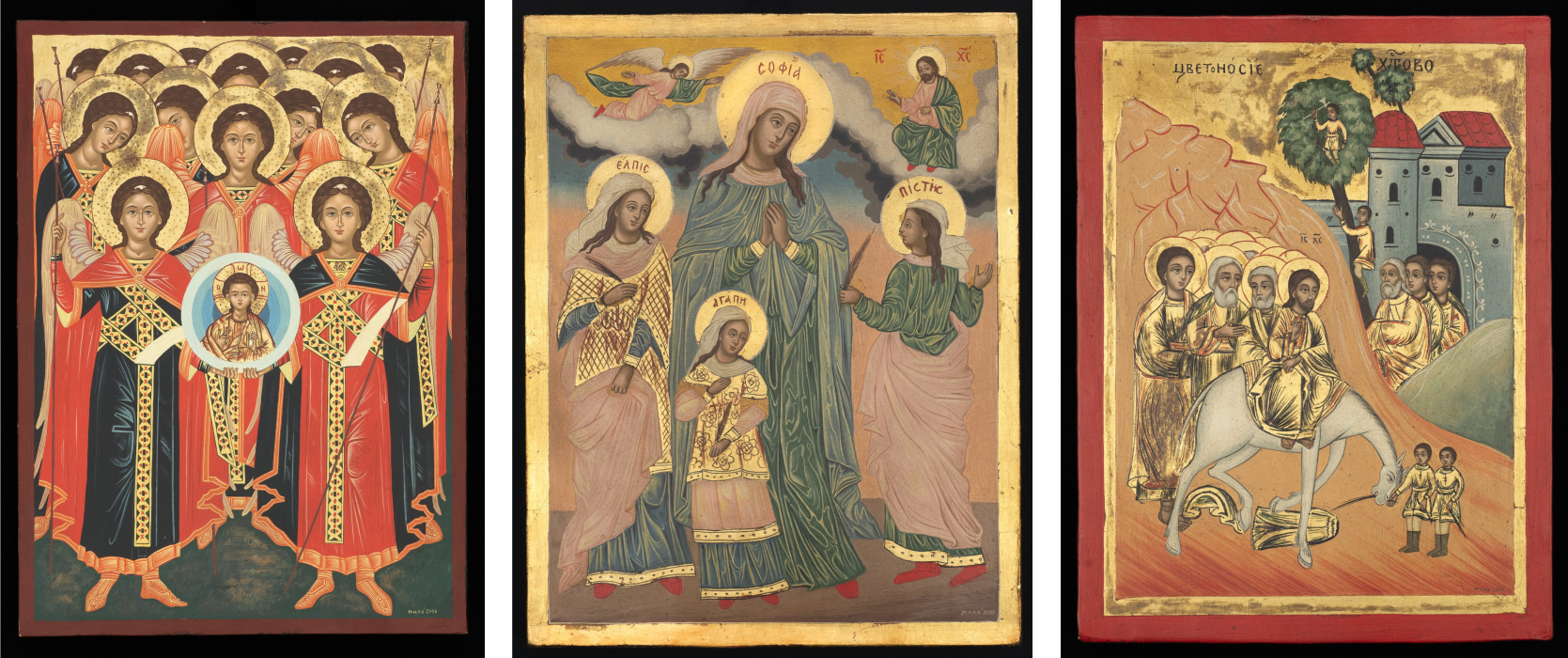
It is precisely as different forms of retelling that the works in the present collection can be viewed. Some follow historical iconographic models relatively closely. In the works of Mila Musakova, as well as certain pieces by Rositsa Manova and Plamen Kondov, the artist’s individual hand appears deliberately restrained in order to preserve the recognisability of the original. Yet even the most meticulous copy is never a mechanical repetition: it inevitably passes through the hand, choices and sensibility of the contemporary artist.
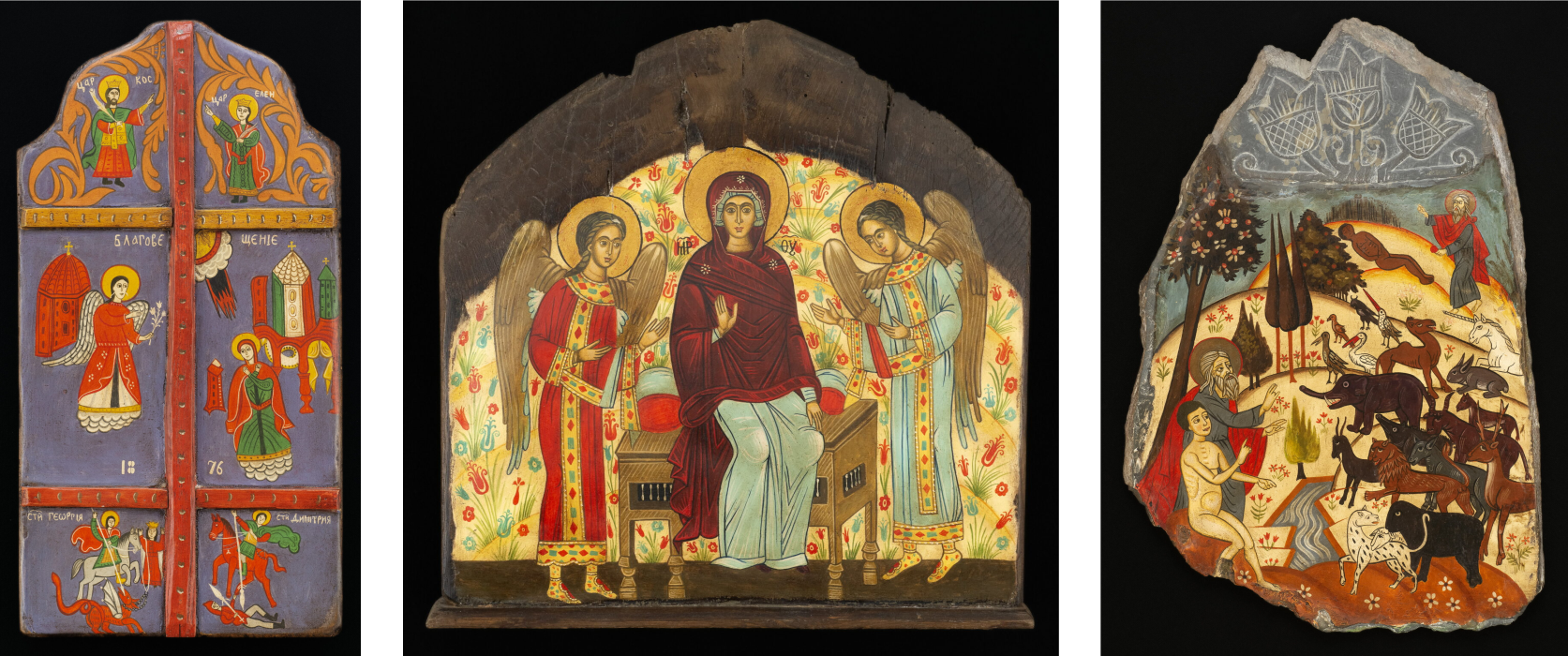
In the work of Anita Nencheva-Aspida, the relationship with tradition is freer. The iconographic model remains recognisable, but forms are simplified, proportions altered, space becomes more schematic, and the biblical narrative acquires the immediacy characteristic of naïve art. The material itself is particularly important. Stone, aged wood, irregular contours, cracks and traces of use are not concealed; instead, they become active elements of the image. The support thus ceases to function merely as a surface and becomes part of the work’s meaning.
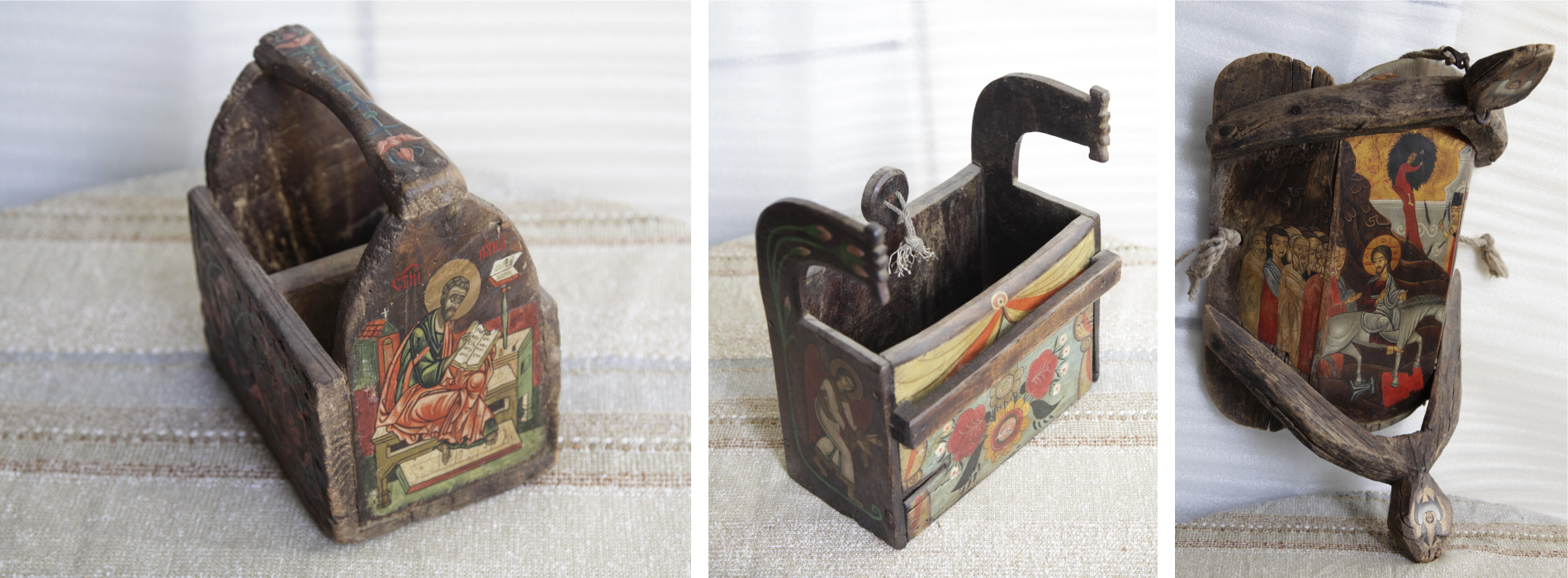
This becomes even more apparent in the work of Georgi Nenchev, where old objects are given new life through painting. Among the most striking examples is The Entry of the Lord into Jerusalem, painted on an old pack saddle. Here, the relationship between subject and support is particularly powerful: Christ enters Jerusalem riding a donkey, while the image itself is painted on an object intrinsically connected to this very iconography. The saddle is not simply an eye-catching found object; its original function becomes part of the meaning of the work itself.
Works drawing on Coptic and Ethiopian models also occupy a distinctive place within the selection. Their frontality, large eyes, strong outlines, flattened compositions and vivid colours may appear close to contemporary naïve art, yet they have their own history and their own visual system.
At this point, I would allow myself a personal note. As someone who has travelled through Coptic and Ethiopian monasteries and has long had a particular affection for Ethiopian art — an interest that has also found its way into one of my travelogues — I find it difficult to view these works simply as exotic examples. What attracts me is their different conception of beauty and of the presence of the sacred image. In a conversation with Anita Nencheva-Aspida, she herself put her motivation very simply: she makes these copies because she finds them beautiful. It is precisely this beauty — immediate, decorative and highly expressive — that naturally meets her own artistic language.
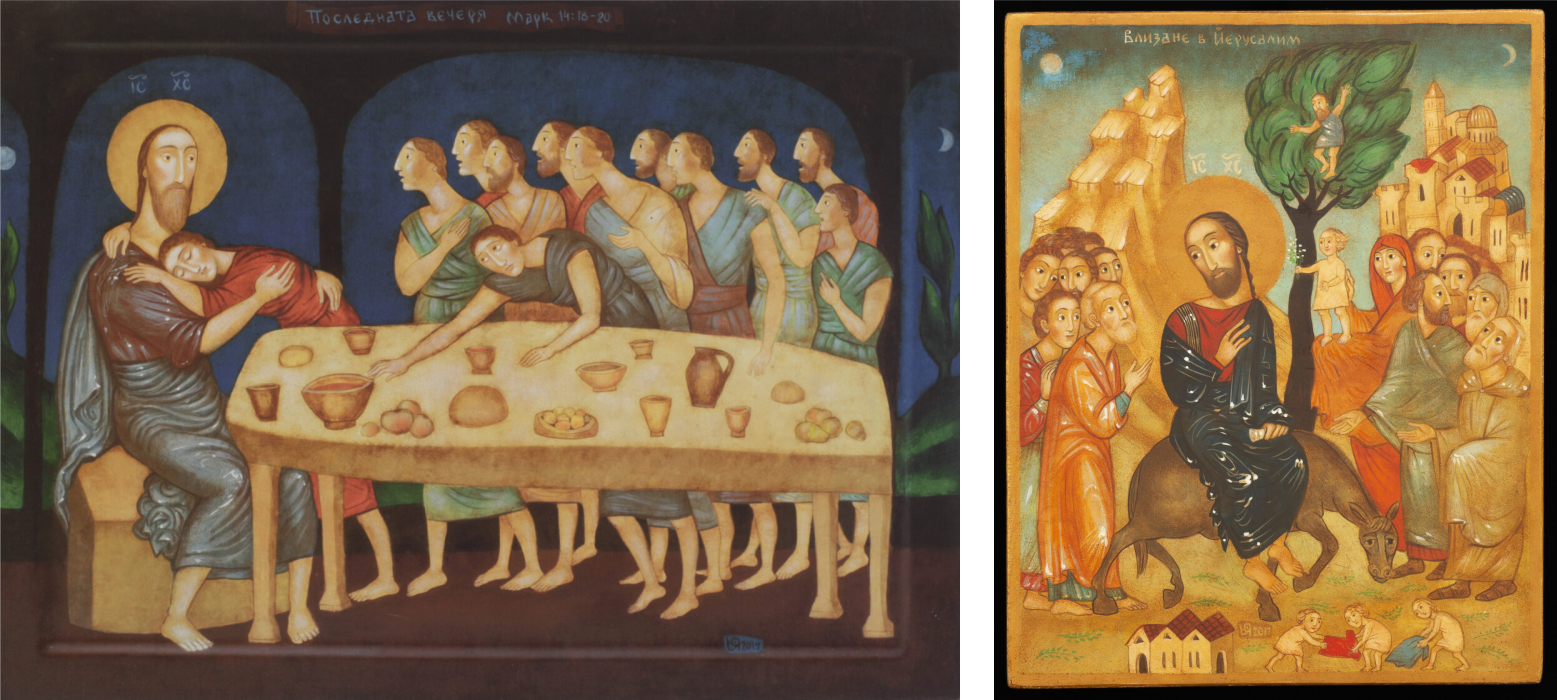
In the work of Julia Stankova, the relationship with tradition is of a different order. Here it is more difficult to speak of copying specific historical models. The biblical text and Christian iconography instead serve as points of departure for a personal visual world. In The Last Supper, The Healing of the Woman with the Issue of Blood, The Entry into Jerusalem and other compositions, the story is distilled into human action, gesture and the relationships between figures. If, in a copy, the artist moves closer to the model, here it is almost as though the model moves closer to the artist — and to the contemporary viewer.
For prospective auction participants, this selection offers not only a choice between artists and subjects, but also between different relationships with tradition. One work may appeal through its closeness to a historical model; another through the freedom of its reinterpretation; a third through an unusual material and the history embedded within it. Sometimes value lies precisely in accuracy; at other times, in deviation.
The terms “naïve” and “primitive”, therefore, can only be used here in their positive sense — not as measures of artistic inadequacy, but as ways of describing immediacy, retelling and the free transformation of familiar imagery. What unites the works presented here is not a single style, but a living relationship with tradition.
And whether it is naïve to buy naïve art is something each auction participant will have to decide for themselves.
Author: Vladimir Dimitrov, PhD
Dimitrov, Vl. The Minov Family of Icon Painters and Their Mural Heritage. Sofia: New Bulgarian University, 2011.
Kamenova, D. “Naïve Murals from the Bulgarian National Revival.” Izkustvo, 1979, No. 10, pp. 15–19.
Kraev, G. “Naïve Art.” Izkustvo, 1989, No. 5, pp. 42–45.
Gombrich, E. “The Primitive in Art.” LIK, 1979, No. 16, pp. 4–11; No. 17, pp. 4–12.
Antliff, M.; Patricia L. “Primitive.” In Robert S. Nelson and Richard Shiff (eds.), Critical Terms for Art History. 2nd ed. Chicago: University of Chicago Press, 2003, pp. 217–233.
Marinska, R.; D. Osikovska. Contemporary Bulgarian Naivists. Sofia, 2023. Compiled by Daniela Osikovska.
Gicheva-Meymari, R. “Anita Nencheva: A Humorous Anthropology of the Primordial.” Enakor Auction House Blog, 2026. Accessed 26 September 2026.
Gicheva-Meymari, R. “Mariela Dimitrova – Mara: Paradoxes, Surrealisms, Ironies.” Enakor Auction House Blog, 2026. Accessed 26 September 2026.
Product has been added to cart