Peter Dimov: the artist born of his paintings
Jubilee 50th Auction of Enakor Auction House – “BULGARIAN NAÏVE...

A compendium for arts and antiques enthusiast
Jubilee 50th Auction of Enakor Auction House – “BULGARIAN NAÏVE ARTISTS”, 8 October 2026
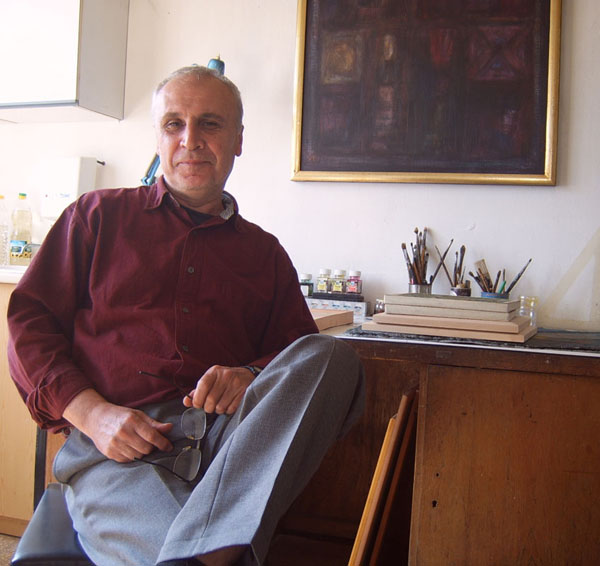
Peter Dimov says that he does not give birth to his paintings; his paintings give birth to him (Dimov 1996). Paradoxical and unexpected as it is, this statement offers a remarkably apt point of entry into his imaginative world — a world of dreams, fantastical animals, houses, journeys, symbols and personal visions. Born in Shumen in 1954, he graduated from the Moscow University of Arts and works in painting, drawing, printmaking, small-scale sculpture and ceramics. His works are held in collections in Bulgaria and abroad (Osikovska 2023: 102; Peter Dimov website; Economic.bg). Yet this is only the outward framework. Far more compelling is the inner biography in which art “ran through my whole life like a red thread” — not as a comfortable professional career, but as a parallel universe offering survival, tranquillity and a means of gathering himself together (Osikovska 2023: 102–103).
Dimov recounts his life without heroic posturing or the familiar artistic mythology of being chosen. As a child, he attended art classes and wryly observes that the prizes he won then evidently “vaccinated” him against later honours — “not that I seek them” (Osikovska 2023: 102). He subsequently worked in a succession of occupations — general labourer, stonemason, teacher in the Rhodope Mountains, advertising worker, concrete worker in the USSR, restorer and portrait painter along the promenades of of the seaside resorts of “Druzhba” and “Albena”. It is the biography of a man who carried his art through life as a private refuge and a persistent inner pursuit (Osikovska 2023: 102–103). This varied working life holds a key to understanding the academically trained artist’s deliberate naïve manner: it seems less a devised stylistic programme than something slowly shaped by life itself.
His attitude to the term “naïve art” is revealing. Dimov says that he divides art not into naïve and other kinds, but into art that moves us and art that does not, and describes himself as “naïve rather than a naïve artist” (Osikovska 2023: 103). The distinction seems slight only at first glance. “Naïve artist” is a label bestowed from outside — by critics, galleries, the market and art-historical classifications. For him, “naïve” sounds like an inner state: a way of looking at the world before it is contained within concepts, schools and definitions of style. It is no coincidence that he also speaks of making art as a solitary pursuit — “everyone tills their own field and gathers their own harvest” (Osikovska 2023: 103). The formulation is earthy and precise: an imaginative world cannot be borrowed; one must dig it out for oneself.
In another interview, Dimov gives the same outlook a more philosophical expression. In his view, paintings are not “born” in the usual sense, but seem to exist somewhere back in time, in a space without beginning or end. He compares artistic creation to children’s play: just as one cannot ask why a child plays, so one cannot ask why an artist creates. Finally, he reverses the direction of causality: he does not give birth to the paintings; the paintings give birth to him (Dimov 1996). This is more than an elegant turn of phrase. A person is formed through their deeds, and an artist through the images they manage to bring into the world. His words bear witness to his experience of creation as a reciprocal process in which artist and artwork shape one another. There is humility in this formulation, too: Dimov does not stand above his paintings as their master, but acknowledges that they have made him the artist he is.
Peter Dimov has chosen naïve art despite his command of academically honed technique. He is “naïve” because he has not allowed academic correctness to take away his freedom. In naïve art he has found a form of inner freedom that gives him the “opportunity to express myself without words”, through “things born of the spirit and the imagination”, on a level that, by his own account, remains difficult for most people to understand (Osikovska 2023: 103). It is precisely here — between children’s play, the solitary tilling of a field, a private parallel universe and the tenacious belief that an image can say more than a verbal explanation — that his artistic world begins.
In “The Barn Has Burnt Down and Now the Stars Can Be Seen”, everything around the edges has its own orientation, while the sky in the middle belongs to all. Houses, trees, people and animals enter from all four sides of the painting — each with its own “down” towards the periphery and its own “up” towards the centre. It is as though we were lying on our backs looking upwards, while the artist has unfolded the surrounding views onto a single plane, preserving entire façades and tree crowns. The device recalls Egyptian depictions of gardens with a pool in the middle and trees laid out around it, but in Dimov’s work this inward turn creates a distinctive effect: the unfolding views envelop the viewer. The flat surface evokes an interior. The world resembles a sphere inhabited from within — the ground encloses it like a protective shell, with the sky held inside. Here, “upwards” means “inwards”. Even the enclosed oval crowns of the trees repeat, on a smaller scale, this gathering of many elements within a common shell. Blue threads its way between the warm ochre walls, bringing the differently oriented inhabitants together in an inner celestial community, where there is room beside the moon even for a floating saint. The title extends this possibility of seeing: the burnt barn is absent, yet the loss seems to have opened up space for the sky. The title is probably a loose paraphrase of Mizuta Masahide’s well-known haiku, “Barn’s burnt down – now I can see the moon” (Masahide)— all the more so since it is indeed the moon that appears in the sky in Dimov’s painting, although the title replaces it with “the stars”.
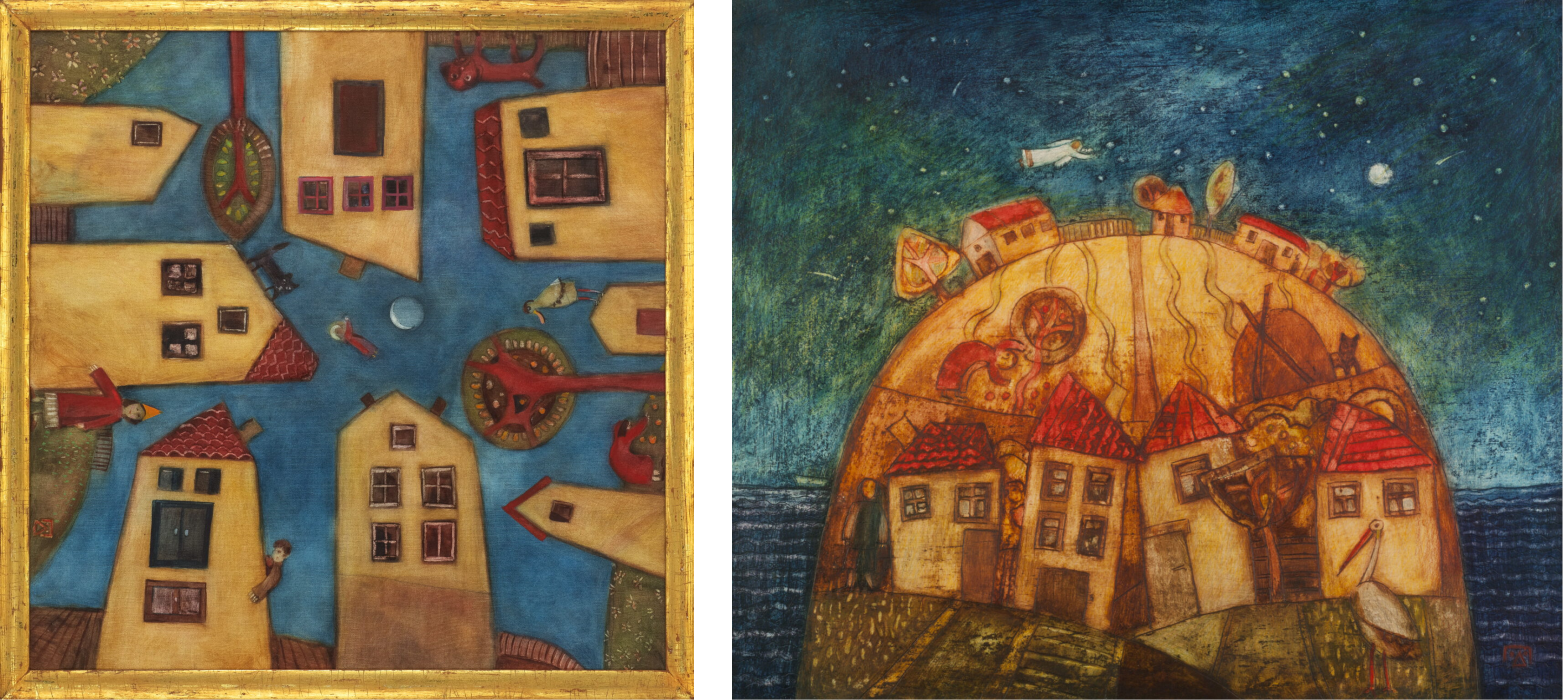
This same cosmos also appears as a world that could be built by hand. The houses are as flat as shapes cut from thin wooden boards, yet solid enough for us to imagine picking them up and moving them around. Some wear their roofs like fur hats; others are bareheaded, while leaning chimneys complete their eccentric bearing. The windows and openings resembling little cupboard doors do not make it clear how these homes are entered — some are set too high, while others may be closed shutters. The painting admits us into the shared world, yet leaves us facing the closed faces of individual houses. Meanwhile, the man below peeps out from behind one of them, and the black cat emerges between the buildings, as though waiting for their turn to step onto a puppet stage. Houses, trees, people and animals can be seen as pieces of a toy for building a world: their orientations change without their shared world falling apart. Here, Dimov’s words about creativity as children’s play take visible form. The player can rearrange everything and still remain at home — even the sky is inside. In this peculiar spatial freedom, we can also recognise art as a refuge.
In “Island”, Dimov’s characteristic encapsulated world is shown both from outside and from within. Small houses, trees and fences follow its upper curve, while beneath them the earth reveals two further inhabited storeys — an arrangement that calls to mind the tiered cosmos of Mesopotamian mythology. Here, the subterranean world is warm, ochre-coloured and inhabited: there are red roofs, animals, a human figure, fields and gardens. The two inner stretches of ground slope towards one another, the houses cluster around their meeting point, and rows in the soil lead the eye in different directions. It is as though we were looking at an opened-out toy for building worlds, its halves ready to fold back together. The small buildings on the surface and the large houses within, the bird almost as big as the house beside it, retain the freedom of a child’s arrangement. The world is enclosed for its inhabitants, but open to our gaze. Around it, the dark water and starry sky emphasise the warmth of the inhabited shell, while above it, beside the full moon, flies a slightly ungainly angel in a long white garment — with one wing seemingly on its back and the other on its chest, like another curious figurine from the same game.
In “Landscape with a Stork”, Peter Dimov’s world of play is arranged frontally, like an open doll’s house. The front wall of the little building is missing, and the small girl fills almost the entire room: her outstretched arms reach its sides, while her straight, widely spaced legs and outward-pointing feet recall a doll made to stand upright. It is as though we could lift her out of the little house and place her beside the large female figure already standing between the buildings, almost as tall as they are. Behind this row of buildings and characters, oval tree crowns enclose the scene. Above, the stork and a four-legged animal have been placed on the roof, while another animal’s head emerges from the dark opening below — every inhabitant has found a place from which to be seen. The stork and chimney are slightly askew, like parts of a toy hastily positioned by someone’s hand. Beneath the houses’ shared base, inverted roofs and walls appear, as though dark water were repeating what has been built. The little world thus has its own shadowed reflection — another place where play continues.
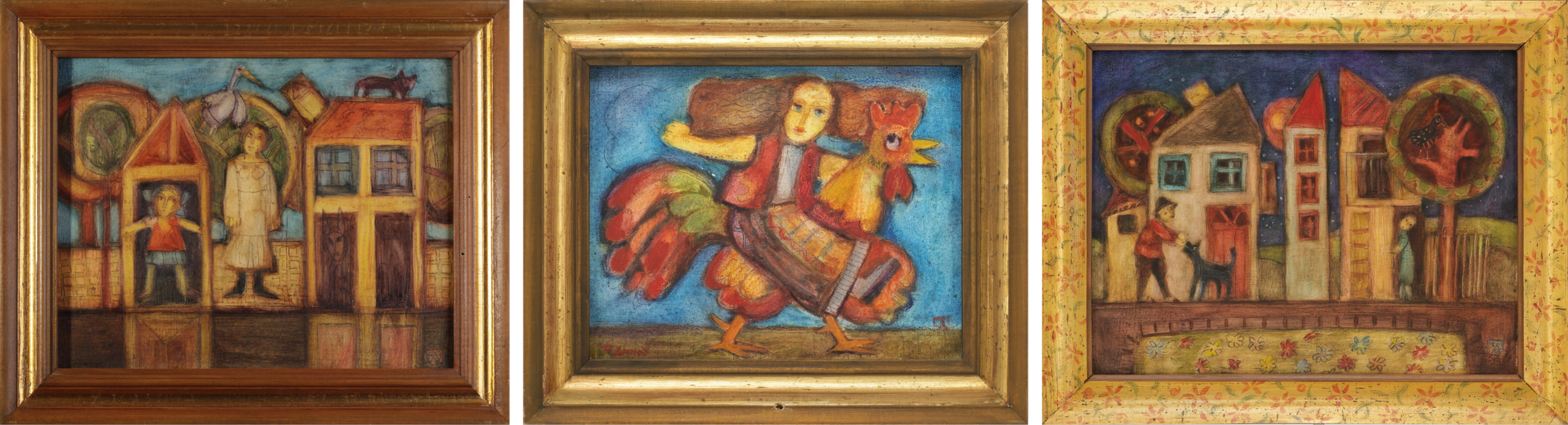
In “Play”, Dimov’s childhood world begins to move: the cockerel has grown large enough to be ridden. The girl sits on its back with her arms outstretched and her hair spread wide, her skirt covering almost all of the bird’s visible side. Her doll-like nature is most apparent in her hair streaming out in both directions, her sideways-stretched arms and the lower part of her body. Her legs project forwards at an odd angle, as though the entire figurine has been placed on the cockerel without being able to adjust its posture to the act of riding. The bird’s large, colourful feathers, clearly defined wing and comb like a cut-out crown also suggest a toy set in motion by the imagination. Now it is even crowing — its beak open, its huge eye alert. The cockerel moves to the right, while the girl looks towards us, as though showing us how natural it is to travel in this way. The red of her waistcoat links with the plumage, her patterned skirt spreads between wing and tail, and the two merge into a single colourful figure. Here, play determines both scale and possibility: if the girl is to ride a cockerel, the cockerel must be able to carry her.
In “Encounter”, Dimov’s little houses shelter a small episode that seems still to be unfolding. The man on the left steps forwards with his hands held in front of him, while the woman on the right emerges from the dark doorway and inclines her head towards him. Between them rise narrow façades with pointed roofs — there is still a distance to cross before they can meet. The black animal, however, has already welcomed the newcomer: it has raised its head towards his hands, creating its own small scene of closeness before the red door. Here, the homes have entrances that can be used, and the threshold becomes a place of waiting and appearing. A memory of the doll’s-house world remains in the closely packed buildings and tilted chimney, while the enclosed tree crowns frame the episode on either side — one bearing fruit, the other holding a bird among its red branches. The flowers in the foreground find an echo in the blossoms painted on the golden frame. The small encounter is surrounded by patterns, as though the whole painting were a domestic object in which someone had preserved a moment of welcome.
In these five paintings, Peter Dimov builds worlds whose unusual rules gradually become convincing: the sky can be gathered inside, the earth can open to reveal its inhabited storeys, and a cockerel can grow large enough to carry a girl. The freedom of play is held together by precisely judged relationships between forms. Dimov is a master draughtsman: with the tilt of a chimney, the splay of a doll’s legs, the curve of an animal’s neck or a head emerging from a doorway, he gives character and action to a simplified image. His mastery as a painter brings these curious constructions into a coherent whole: ochre walls glow amid the blue, red passes from roofs to clothing, trunks and birds, and visible brushstrokes animate the fields of colour. The different creatures and objects begin to belong to one another. His words about paintings giving birth to the artist thus find a further expression — with each work, he creates a place in which his own imagination can live.
For connoisseurs of naïve art, the five works in the “Enakor” auction offer an encounter with this rare ability to give free imagination a convincing, tangible form. At first, we are drawn to the warmth of the colours and the strangeness of the scenes; then we begin to notice how a single tilt holds the composition together, how colour links distant figures, how a small gesture turns an arrangement of little houses into a place of expectation. This is precisely what makes Dimov’s works so rewarding to live with: there is still something to discover in them long after their subjects have become familiar.
Rossitsa Gicheva-Meimari, , PhD
Chief Assistant Professor in the Department of Arts and Design and member of the “Bulgarian-European Cultural Dialogues” Centre at New Bulgarian University
Bibliography:
Dimov 1996: Петър Димов, „Художникът Петър Димов е роден от своите картини“. В: Сайт на Петър Димов – https://peterdimov.weebly.com/about-peter.html Посетена на 13.09.2026.
Economic.bg: „Мистични видения. Образният свят на художника Петър Димов“. В: Economic.bg – https://www.economic.bg/bg/a/view/mistichni-videnija Посетена на 13.09.2026.
Impressio: „Галерия „Париж“ представя „Балкански карнавал“ на Петър Димов“. В: Impressio – https://impressio.dir.bg/palitra/galeriya-parizh-predstavya-balkanski-karnaval-na-petar-dimov Посетена на 13.09.2026.
Masahide: Mizuta Masahide, „Barn’s burnt down – now I can see the moon.“ Прев. Lucien Stryk, Takashi Ikemoto. В: Lucien Stryk, Takashi Ikemoto (trans.), Zen Poems of China & Japan: The Crane’s Bill. New York: Grove Press, 1987, p. 77. Онлайн: Poetry Chaikhana – https://www.poetry-chaikhana.com/Poets/M/Masahide/Barnsburntdo/index.html Посетена на 14.09.2026.
Osikovska 2023: Даниела Осиковска, Интервю с Петър Димов. В: Маринска, Р. (авт.), Д. Осиковска (съст.), Съвременни български наивисти. София „Кибеа“, 2023, с. 102-103.
Paris Gallery: Петър Димов. В: Галерия „Париж“ – https://gallery-paris.com/hudozhnik/peter-dimov/ Посетена на 13.09.2026.
Peter Dimov website: Сайт на Петър Димов – https://peterdimov.weebly.com/ Посетена на 13.09.2026.
Wikipedia: „Петър Димов“. В: Уикипедия – https://bg.wikipedia.org/wiki/Петър_Димов Посетена на 13.09.2026.
Product has been added to cart