Mariela Dimitrova – Mara: Paradoxes, Surrealisms, Ironies
Jubilee 50th Auction of Enakor Auction House – ‘BULGARIAN NAÏVE...

A compendium for arts and antiques enthusiast
Jubilee 50th Auction of Enakor Auction House – ‘BULGARIAN NAÏVE ARTISTS’,
8 October 2026
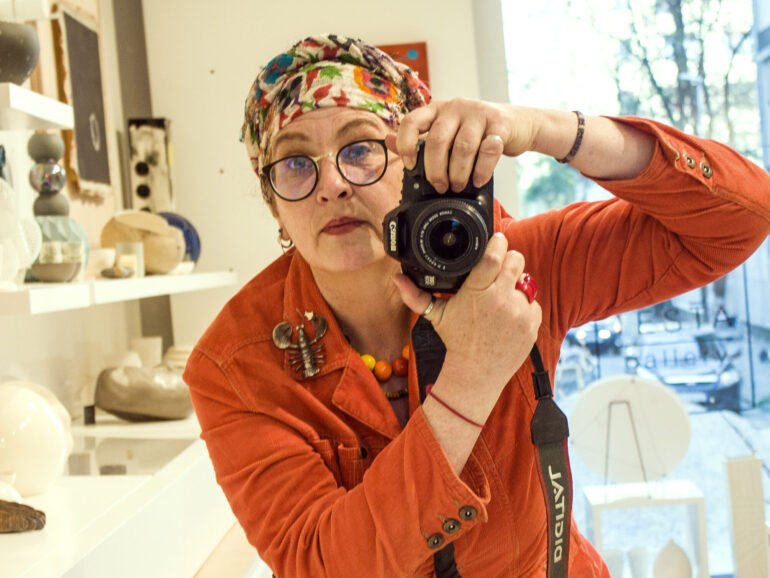
Mariela Dimitrova – Mara (b. 1967) is one of the finest contemporary Bulgarian naïve artists. I say this fully aware that I will probably annoy her, since she seems rather reluctant to be defined by the abstract stylistic label of naïvism (Osikovska 2023: 75–76). Yet I would find it difficult to identify a more accurate term for her style – not only because of its formal characteristics, but also because of her visual world, in which there is almost always something paradoxical or surreal, a joke, a provocation, irony or self-irony, and, alongside all of these, love. I consider her one of the finest because she belongs to the ranks of deliberate naïve artists – she graduated from the San Alejandro Academy of Fine Arts in Cuba, specialising in Graphic Arts (Osikovska 2023: 74); she has an exquisite feel for the surreal-comic; and, not least, she possesses a talent that she has persistently developed into artistic skill (Osikovska 2023: 74–77; Petrova 2023; Pironkova 2025). Behind the apparent freedom of her drawing, forms and spaces lies a conscious choice not to make technical skill an end in itself. The artist herself sums up one of the key principles of her approach in the characteristic phrase: ‘to turn a defect into an effect’.
In interviews and social-media posts, she repeatedly insists that she does not place herself among the great artists, describing herself instead as a craftswoman and handicraft maker (Petrova 2023). With the same irony and self-irony, she named the Facebook group she founded ‘Artists, Craftspeople and Handicrafters – No Thin-Skinned Types’ (Dimitrova FB group). She is probably right to some extent – as far as the craft aspect of her work is concerned – but perhaps not entirely, since craftsmanship clearly does not exhaust what she does. To Mara’s inconvenience, there is an artist in her as well.
For Mariela Dimitrova, the idea and the narrative come first. They may arise from a conversation, an incident, a book or a dream, but they may also be prompted by a found object, an old plank, a fragment of woodcarving or a piece of metal (Petrova 2023). She collects materials that already carry histories of their own and incorporates them into her works, often allowing their very forms to suggest the image that will emerge. The boundary between picture and object thus becomes fluid: the frame ceases to be an external surround and becomes part of the artistic situation.
Particularly important to this imagery is paradox (Osikovska 2023: 76). Mara acknowledges that ordinary subjects do not interest her – she needs some unexpected idea, a joke, a parable or a provocation. In her work, humour is not an addition to the image, but a way of thinking. It brings incompatible scales and meanings into collision, takes metaphor literally, turns an everyday action into an absurd event or, conversely, places the extraordinary within the world of everyday experience. At times this humour is sharp and satirical, while self-irony – which the artist herself calls ‘the highest form of skill’ (Osikovska 2023: 77) – is part of its inner freedom. In this sense, Mara’s naïvism is not a rejection of skill, but freedom in the way skill is used. Form is subordinate to the idea; painterly means become instruments of narration, while distorted proportions, simplified figures or apparent illogicality may prove the most precise way of expressing the conception. Yet behind this outward immediacy lies painstaking work – Mara paints slowly, reworks her paintings and even paints over entire compositions if she fails to achieve the result she is seeking (Osikovska 2023: 76; Petrova 2023).
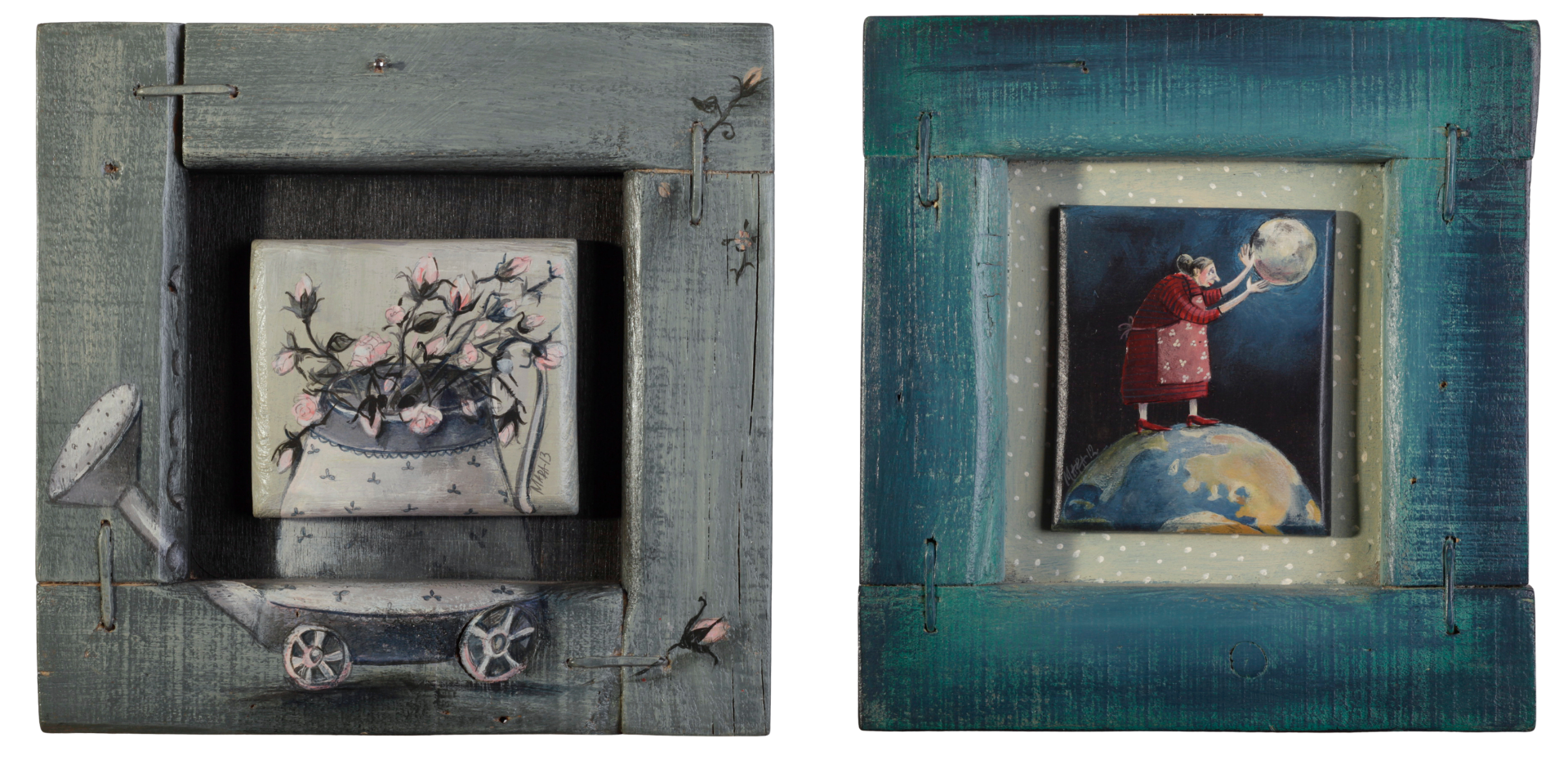
At Enakor Auction House’s jubilee 50th auction, Bulgarian Naïve Artists, you will have the opportunity to bid for two of Mara’s exquisite miniatures – Irrigation and Hanging a Lighting Body. The two works reveal with particular clarity Mara’s way of thinking and working. In them, the painted field, reused wood, metal elements and the frame itself form a single composition, while the everyday, the fantastic and the absurd flow into one another with Mara’s characteristic ease. Both works are executed in acrylic paints on wooden panel. They are set in Mara’s characteristic deep box-frames, made from reused planks joined by large metal staples, which enter the pictorial field.
Works of this kind resemble a photographic frame at the moment of capture – superimposed upon reality and breaking it apart. This technique seems to materialise the photographic gaze itself: it shows how the selected frame is separated from reality, while the unselected part of reality is left to spread around it. Photography is always also an act of selection: some things are admitted into the frame, while others remain outside it. In Mara’s work, however, what has been excluded does not disappear. The rough reused planks, metal staples and the background remain as the material presence of that part of reality which the artistic image has not ‘chosen’. The frame thus both delineates what has been selected and preserves traces of what has been left out. In Mara’s work, what lies ‘outside the frame’ also becomes part of the artwork. The comparison is not incidental: photographic thinking is also directly present in Mara’s practice, as she stages and photographs objects and incorporates photographic images into her works.
In Irrigation, the central wooden panel shows the mouth of a white jug decorated with small trefoil motifs. The jug serves as a vase for a bouquet of wild rosebuds just beginning to open, whose white and pink tones against the grey-black surroundings evoke a classic romantic mood. The three-dimensional body of the jug breaks off, bends and continues downwards in flattened, two-dimensional form and in paler tones across the black ground of the box-frame. It then rises again and comes to an end on the wooden plank of the frame. There the jug rests on a wheeled base resembling a small cart. The idea of a cart is suggested by a projection resembling its central draught pole, which, after being interrupted at the corner of the frame, turns into the spout of a watering can. And so, through the artist’s exuberant imagination and masterful play-skills, the flower vase, creeping across the background and the frame, becomes a child’s toy-cart-watering-can, which finally explains the ‘irrigation’ of the title. Yet if it were tilted to water something, the wild roses inside it would be left without water. As if all the surreal transformations so far were not enough, the cart-watering-can-vase is also shown hurtling forwards: this is suggested by the whirling wheels, the tilt and quiver of the stems, and the pink blossoms scattered backwards across the wooden frame, one of which has even become caught in a metal staple. Irrigation presents a beautifully comic childhood dream in which a sentimental scenario undergoes Mara’s characteristic surreal displacement – its ironies would bring a smile to an intelligent young lady.
In Hanging a Lighting Body, the cosmic is reduced to an absurdly mundane household task. A stooped elderly woman, her hair gathered into a large bun, wearing a red dress and shoes and an apron tied around her waist, is intently adjusting the Moon while standing on the North Pole of the globe, which has been turned into a kind of stool upholstered in ‘Earth’. The title completes the joke: the celestial body has become a ‘lighting body’, something that, after all, has to be hung. The universe has been reduced to a home, and the old woman busies herself tidying and putting things in order there as well. For a Bulgarian viewer, this elderly woman so matter-of-factly handling the Moon may also evoke a distant association with the sorcerers of Bulgarian folklore who bring the Moon down from the sky and milk it. The old woman’s domestic bustling imperceptibly approaches the realm of magic.
This transformation continues beyond the central image. The grey field of the box-frame, with its white dots, is both a starry sky and an old-fashioned pattern suited to the heroine’s domestic world, while the blue-green planks extend the nocturnal firmament. Even the large metal staples joining the frame inadvertently suggest assembly and household repair. Against this cold blue-grey setting, the dark-red figure stands out as the energetic centre of the action.
The irony, however, has a second layer. The idea that an individual’s small action might have cosmic significance is amusing – yet in a complex world, it is sometimes precisely such small actions that produce consequences wholly disproportionate to their original scale. This is also what lies behind the popular metaphor of the ‘butterfly effect’ – the idea that a small change within a complex system may trigger enormous consequences far removed from the place and moment in which it first occurred. The disparity between the minute human gesture and the vastness of the Cosmos thus ceases to be merely a cause for amusement. In Mara’s world, the little person may appear absurdly important, but is not necessarily insignificant. So perhaps the old woman who has simply decided to adjust the moon-lamp is not quite so absurd after all: someone, in the end, has to keep the Cosmos in order.
Mariela Dimitrova – Mara’s works remain in the memory for a long time because, behind their seemingly light-hearted playfulness, lies a distinctive way of looking at the world – with both a distrust of its seriousness and a love of people. They have a way of unsettling everyday logic, turning absurdity into a reason to smile, and reminding us that imagination can sometimes see more precisely than common sense. After encountering them, even ordinary objects seem, for a while, to lose the certainty of their meanings: a jug may creep out of the picture and become a toy-cart-watering-can, while the Moon may become a lamp that someone has forgotten to adjust. These are works that do not merely offer images seen by the artist, but also train perception to remain open to the possibility that the world can always be seen differently. For the connoisseur, they are the kind of works that are not exhausted at first glance – over time, they continue to tell stories, offer up new ironies and transform the space around them. This is precisely why Mara’s works in Enakor’s auction of Bulgarian naïve artists deserve to be looked at closely.
Rossitsa Gicheva-Meimari, , PhD
Chief Assistant Professor in the Department of Arts and Design and member of the “Bulgarian-European Cultural Dialogues” Centre at New Bulgarian University
Bibliography:
Dimitrova FB group: Фейсбук група „Художници, занаятчии, ръкоделци – без тънкообидни‟ – https://www.facebook.com/groups/1179557133356659 Посетена на 27 август 2026
Osikovska 2023: Даниела Осиковска, Интервю с Мариела Димитрова – Мара. В: Маринска, Р. (авт.), Д. Осиковска (съст.), Съвременни български наивисти. София „Кибеа“, 2023, с. 74-77.
Petrova 2023: Юлия Петрова, Корабът на глупците на Мара – Мариела Димитрова. В: БНР, 01.02.23, https://old-news.bnr.bg/post/101771008 Посетена на 27 август 2026
Pironkova 2025: Вида Пиронкова, „Мариела Димитрова-Мара – от социалната група на нетънкообидните“ – сп. Дива, 28.07.2025. – https://divamagazine.bg/%D0%BC%D0%B0%D1%80%D0%B8%D0%B5%D0%BB%D0%B0-%D0%B4%D0%B8%D0%BC%D0%B8%D1%82%D1%80%D0%BE%D0%B2%D0%B0-%D0%BC%D0%B0%D1%80%D0%B0-%D0%BE%D1%82-%D1%81%D0%BE%D1%86%D0%B8%D0%B0%D0%BB%D0%BD%D0%B0%D1%82/ Посетена на 26 август 2026
Product has been added to cart