
Anita Nencheva: a humorous anthropology of the primal
Jubilee 50th Auction of Enakor Auction House – “BULGARIAN NAÏVE...
A compendium for arts and antiques enthusiast
Jubilee 50th Auction of Enakor Auction House – “BULGARIAN NAÏVE ARTISTS”, 8 October 2026
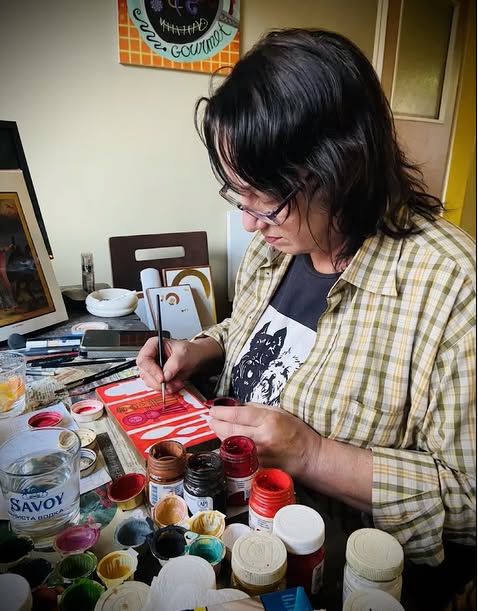
Anita Nencheva (b. 1958) is one of those artists whose biographies do not proceed smoothly or academically, but are pieced together out of deviations, refusals, resistance, difficult decisions, and gradually discovered paths. She was born in the southern Ural city of Magnitogorsk, Russia (Osikovska 2023; Markova 2016), where her parents were working under a personnel-exchange programme. After the family returned to Bulgaria, her childhood also included holidays in a village near Haskovo. Later, already in Sofia, she did not easily fit into the norms of the communist school system, changed several secondary schools, was not admitted to the art school, and graduated from BUSEMA with a specialisation in Vegetable Growing (Osikovska 2023; Salon of Naïve and Intuitive Art). In her own story, this fact does not sound like a mistake in life, but rather as part of a persistent refusal to be forced into an unsuitable frame (Markova 2016). Her attachment to Naïvism, too, probably became part of her protest against social norms.
In an interview with Daniela Osikovska, Anita says that she began drawing while still at secondary school, that drawing is her main profession, that she was originally an icon painter, and that she has been working in Naïvism for about twenty years (Osikovska 2023). In another account, she adds that she works in various genres – icon painting, stone sculpture, handmade paper, and naïvist painting. For her, creative work is “an opportunity to touch other worlds” (Association of Naive Art Bulgaria). She did not go through an academic art school – she learned through work, experience, plein-air sessions, encounters with colleagues, and her own persistent engagement with the image. For her, Naïvism is a personal path that gives her “a kind of primal idea of the world”, a path towards images that are “simple as drawings, yet complex as messages” – as she herself defines the meaning of naïve art (Osikovska 2023).
The artist’s creative path is inseparable from that of her husband, Georgi Nenchev – Zhoro, an icon painter and master of wooden sculpture (Osikovska 2023). According to Anita, she and her husband were a “tandem in painting” throughout their lives and had dozens of exhibitions together (Salon of Naïve and Intuitive Art). The story of the two of them contains much labour, poverty, risk, persistence, and mutual severity: they learned on their own through practice, worked without academic protection, sold applied objects and stone sculpture at “Crystal park” in Sofia, began making icons in the 1990s, and endured periods without commissions or money (Markova 2016).
It is precisely here that one of the most interesting moments in Anita’s story appears. During a difficult period, when commissions dried up, she invented the small-format paintings. Zhoro helped her with the mounting and the wrought iron, and in this way, they gradually found a way out of hardship (Markova 2016). This episode shows how the small painting, old wood, handwork, the object, and the painted image came together as a means of survival, concentration, and original visual creation. In their works, used household objects receive a second life – old boards, chopping boards, bread trays, kneading troughs, wooden spoon caddies, gourds, wooden grain measures, yokes, and pack-saddles. In their works, the material is not a passive support, but a bearer of memory, form, and additional meaning. Through this approach, they also became an inspiration for other naïve artists, as Mariella Dimitrova–Mara, for example, has said (Pramatarova 2022).
For decades, Anita Nencheva’s public image remained interwoven with the shared name “Anita and Zhoro Nenchevi” (Markova 2016; Osikovska 2023). This has its justification, since they were indeed a tandem in life and in art. In many publications, however, Anita somehow appears in the background of the pair (Pramatarova 2022). Today, when we look at her works independently, it is important not to dissolve her personal world into the story of their shared path. She deserves to be seen separately as well, with her individual creative path, style, and character.
Her works in Enakor’s jubilee 50th auction provide precisely such an opportunity. The naïvist section includes Being, Toilette, Samodivi, Adam and Eve, and Newlyweds – a small but revealing corpus of tempera works on wood. The titles outline her independent territories as a small folk anthropology – the human being as body, as sex, as couple, as a creature between the natural, the everyday, the biblical, and the folkloric-fairytale. She is interested in the beginning of the world, the human body, female presence and point of view, intimate and life partnership, marriage, the folkloric-mythical, and the biblical. Here, Naïvism is not only a stylistic softness or pleasing immediacy, but a way of reducing complex things, such as sex, body, myth, creation, cohabitation, celebration, and desire, to clear primal images, yet with gentle irony.
Anita’s distinctive artistic style stands out clearly from the broader picture of Bulgarian Naïvism in this auction. Her works do not rely on painterly softness, landscape detail, decorative accumulation, or stridently patriotic clichés. They are constructed graphically and minimally – through firm contours, clear colours, large single-tone fields, highly generalised geometricised forms, a characteristic stylisation, and uncluttered compositions. Her imagery recalls characters from animation: the bodies are large, the faces reduced to signs, the gestures clear and legible from a distance. Yet behind this affinity with animation lies another layer – the artist’s experience in icon painting. From it come the solemnity, frontality, closed contour, sign-like quality, and the sense that the figure is not merely a character in an episode, but also a bearer of meaning. Her small tempera works on wood appear as emblems: close to animation in their plastic clarity and stylisation of form, marked by a naïvist seriousness akin to Revival-period naïve icon painting in their frontality and the sign-like status of the figure, and by a playfulness and archaism related to folk art.
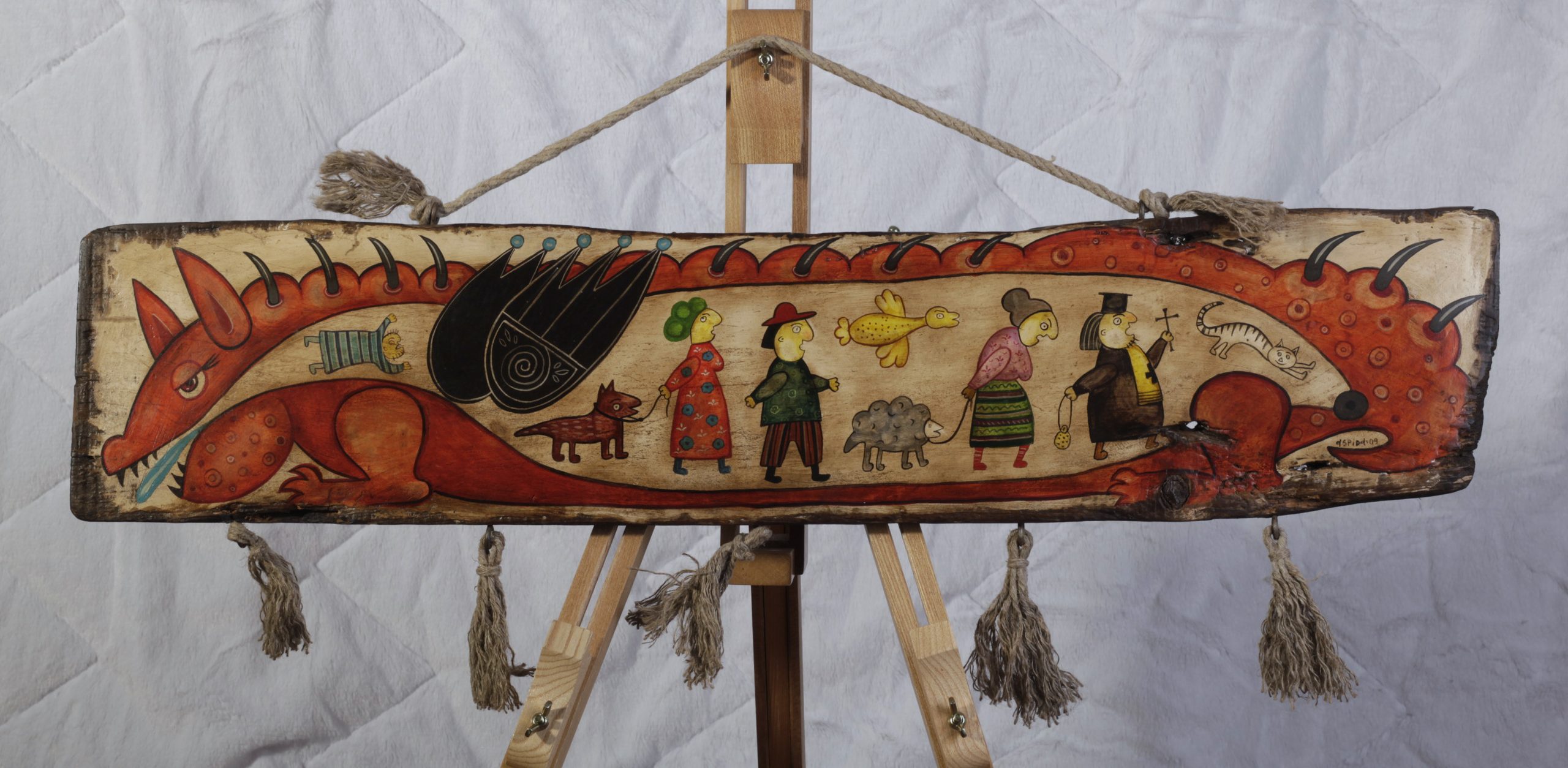
„Being“ is the most broadly developed of the five artworks – a small horizontal world contained within the elongated shape of an old board, decorated with hemp tassels. At the centre of the composition, men, women, a child, a priest and animals are arranged as though in a primal procession of all that exists, while the body of a red winged dragon around them appears as both mounting and guardian – perhaps an image of the cosmos containing being. The scene looks like a dreamlike fusion of the biblical stories of Noah’s Ark and Jonah swallowed by the monstrous fish. The humour and irony here lie in the reversed direction of the procession’s movement through the dragon’s body. In mythical thought, being swallowed by a monster usually means death, trial, or entry into chaos. Here the opposite is the case: at the beginning, the newborn child is shown not coming out of the womb, but going into the digestive tract of the cosmic dragon. Then come the young woman and man, the old woman, and the priest (who in fact leads the procession). Last of all is the cat, which has almost reached the end of life; yet this end is not presented in the usual way – as an entrance into the beyond – but as an approach to the exit of the digestive system of the cosmic red dragon.
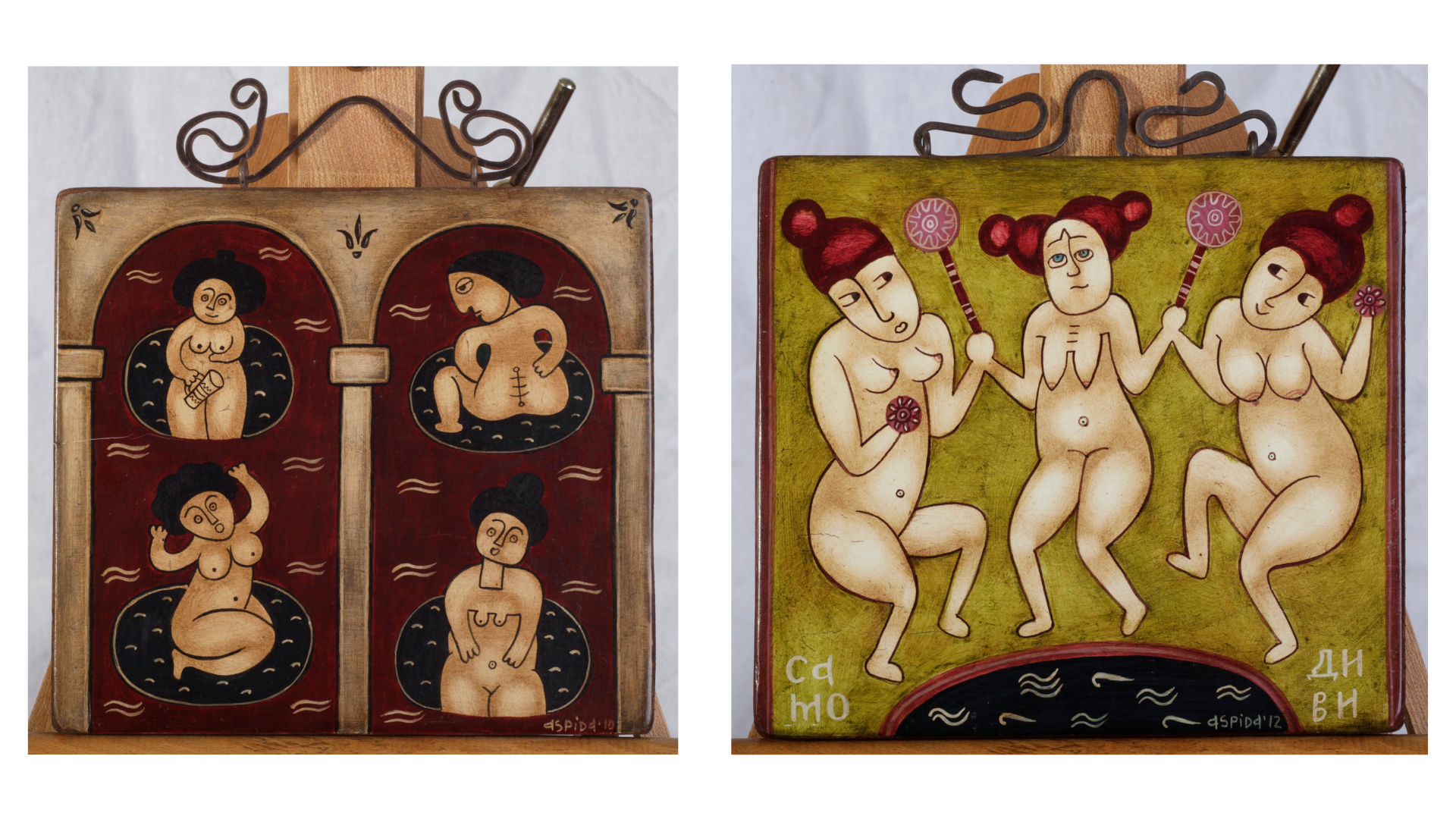
“Toilette” presents the nude female body in an enclosed architectural space, which may be read as a bath, perhaps a public one. Four figures are arranged in pairs in separate fields, as if in arched niches. Each is in a separate pool or bath, each is reduced to a sign, yet preserves a different gesture and presence. Although they closely resemble one another in their generalised forms, the female figures have distinguishing features – their poses, hairstyles, the shapes of their breasts, the presence of attributes, the mood. The painting seems to present “variations” on the theme of “the nude female body in a bath”. The theme of the toilette – bathing and bodily care – is presented neither erotically, nor sentimentally, nor voyeuristically (all the figures look the viewer straight in the eye), but with a particular mixture of bodily candour and stylised convention, typical of Anita Nencheva. The female body here is domestic, comic, natural, and almost emblematic. An additional irony arises from Anita’s characteristic icon-painting style and scheme for structuring the board, but without the suggestion of sinfulness or punishment usually associated with the nude female body in Revival-period iconography.
“Woodland Nymphs” transfers the same bodily nudity into a folkloric-mythical register. Three female figures perform a playful folk dance by a lake. In contrast to folk tradition concerning the Woodland Nymphs, they are of different ages, with enormous red hair-buns, pink flowers, and strange attributes in their hands, like rattles or magical objects. Anita’s Woodland Nymphs are not ethereal, romantic, or erotic creatures. Contrary to tradition, they have large, dense, earthbound bodies, even with a bronze tan. They also carry a slight suggestion of witchcraft. They stand strangely poised between the meanings of dance, ritual gesture, and a fairy tale told in a childlike manner. The black lake is some dark, open boundary: the Woodland Nymphs dance along its edge, as if between play and threat, between the visible body and the invisible force it carries. The lake introduces a border between worlds – between this world and the beyond – separating and protecting the viewer from that dangerous, playful female presence which folk imagination names Woodland Nymphs.
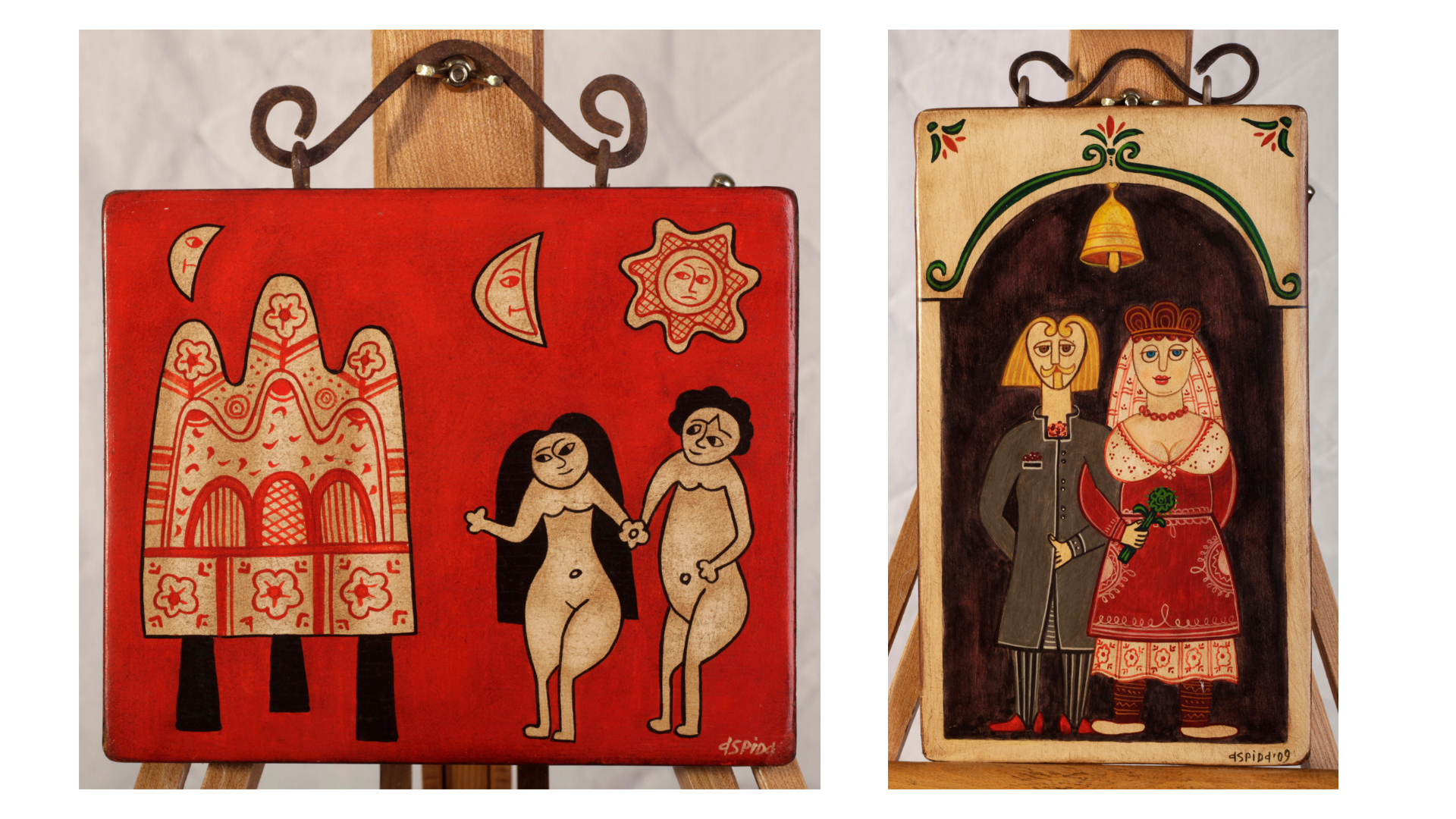
Anita Nencheva, Cat. No. 22, “Adam and Eve”, tempera on wood, 15 × 18 cm; Cat. No. 23, “Newlyweds”, 2009, tempera on wood, 24 × 14.5 cm
“Adam and Eve” reduces the biblical subject to a clear formula – the first human couple, placed against a single-tone bright red background with no indicated ground, between an architectural sign and three celestial bodies. Eve leads Adam by the hand (their intertwined hands are shaped like a flower) towards a fairytale palace with a garden, which is obviously not the Garden of Eden, while Adam pulls back slightly and looks on with furrowed, raised eyebrows. The humour lies in the detail of the legs on which the palace is set – it looks like a painting on an easel. If we allow ourselves a more personal reading, Eve may turn out to be Anita herself, showing her own Adam–Georgi her new work, while the furrowed, raised eyebrows may be the first reaction of the strict colleague-viewer. The personifications of the Sun and the Moon are strange, especially the presence of two moons – it seems that the action is not taking place on Earth, or else that Eve is showing Adam a vision of her own. The nude bodies are extremely simplified, almost childlike, and precisely for that reason the subject does not scatter into details. Anita Nencheva is not recounting the dramatic Fall; she inscribes the human beginning as an emblematic image: the man and the woman hand in hand, vulnerable, comic, serious, and already drawn into the world of signs and art.
“Newlyweds” turns the wedding couple into a solemn-comic ritual image. The man and the woman are frontal, motionless, set in an icon-like manner beneath an arch and a bell, yet the figures are presented with naïvist strangeness and lightly grotesque expressiveness. The bride is more richly adorned, in a red traditional Bulgarian costume, but with an unusually large décolletage. She wears woollen patterned stockings and traditional rawhide peasant shoes. She has a crown and a white veil, uncharacteristic of folk tradition, but stitched with red thread like a small traditional embroidered table cover. The bridegroom is fair blond, with rather long hair, carefully shaped moustaches, and a goatee. The lines of his hairstyle have given his face the shape of a heart. His heart-shaped face literalises the sign of love and adds another comic layer to the otherwise solemn scene. The bridegroom is dressed in an elegant Western European nineteenth-century suit with striped trousers and red shoes. Thus the wedding couple also becomes a meeting of two costume worlds – local-Bulgarian and Western European, folk-ritual and urban-theatrical. This strange marriage, whether between a Bulgarian woman and a foreigner, or between a patriot and an admirer of European values, is presented in a lightly caricatural way, but also as a social and ritual sign – serious-solemn, comic, folk, and slightly theatrical.
Наивизмът на Анита Ненчева не е „наивност“ в житейския смисъл на думата – самата тя казва, че „не е нужно човек да е наивен, за да рисува в наивистичен стил“ (Осиковска 2023). По-скоро при нея става дума за способност да се върнеш към първичното – към фигурата, жеста, двойката, предмета, старото дърво, телесната смешност и странната мъдрост на простия образ – и да го погледнеш иронично. Именно в малките формати и привидно непретенциозните сцени, се вижда художничка, чиито произведения имат собствен глас, собствен хумор и собствена представа за света. Първичността и мекият хумор на нейните творби имат потенциала докоснат с неочаквана сила мнозина от нас – потопените в съвременната дигитална визуалност и позабравили виталността на първичните елементи, които движат човешкото в нас.
Anita Nencheva’s Naïvism is not “naivety” in the everyday sense of the word – she herself says that “one does not need to be naïve in order to paint in a naïvist style” (Osikovska 2023). In her case, it is rather a capacity to return to the primal – to the figure, the gesture, the couple, the object, old wood, bodily comicness, and the strange wisdom of the simple image – and to look at it ironically. It is precisely in the small formats and seemingly unpretentious scenes that we see an artist whose works have their own voice, their own humour, and their own idea of the world. The primal quality and gentle humour of her works have the potential to move many of us with unexpected intensity – those of us immersed in contemporary digital visuality, and no longer quite remembering the vitality of the primal elements that move the human within us.
Rossitsa Gicheva-Meimari, , PhD
Chief Assistant Professor in the Department of Arts and Design and member of the “Bulgarian-European Cultural Dialogues” Centre at New Bulgarian University
Bibliography:
Association of Naive Art Bulgaria: Фейсбук страница „Association of Naive Art Bulgaria‟ – https://www.facebook.com/photo/?fbid=550997724394338&set=pcb.551003664393744 Посетена на 29 август 2026
Markova 2016: Диана Маркова, Анита и Жоро Ненчеви – труден, но страхотен живот. В: OFFNews, 24 септември 2016 – https://offnews.bg/litca/anita-i-zhoro-nenchevi-truden-no-strahoten-zhivot-636577.html Посетена на 29 август 2026
Osikovska 2023: Даниела Осиковска, Интервю с Анита Ненчева. В: Маринска, Р. (авт.), Д. Осиковска (съст.), Съвременни български наивисти. София „Кибеа“, 2023, с. 20-21.
Pramatarova 2022: Невена Праматарова, Изкуството на Георги Ненчев – да погледнем света с широко отворени очи, БНР, 12.11.22 – https://old-news.bnr.bg/post/101735315 Посетена на 29 август 2026
Salon of Naïve and Intuitive Art: Биографични бележки за Анита и Георги Ненчеви в Сайт на „Салон за наивистично и интуитивно изкуство“ – https://www.naiveart.eu/%D0%B5%D0%BA%D1%81%D0%BF%D0%BE%D0%B7%D0%B8%D1%86%D0%B8%D1%8F/%D0%B0%D0%B2%D1%82%D0%BE%D1%80%D0%B8/%D0%B0%D0%BD%D0%B8%D1%82%D0%B0-%D0%B8-%D0%B3%D0%B5%D0%BE%D1%80%D0%B3%D0%B8-%D0%BD%D0%B5%D0%BD%D1%87%D0%B5%D0%B2%D0%B8/ Посетена на 29 август 2026
Product has been added to cart