Aneta Yalamova: tales from a bourgeois age
Jubilee 50th Auction of Enakor Auction House – “BULGARIAN NAÏVE...

A compendium for arts and antiques enthusiast
Jubilee 50th Auction of Enakor Auction House – “BULGARIAN NAÏVE ARTISTS”, 8 October 2026
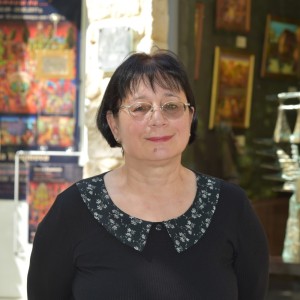
Aneta Yalamova is one of the relatively few intentional naïve artists in Enakor’s auction who, despite their academic education, have embraced the language and values of naïvism, cultivated naïvist artistic skills and applied them in a distinctive style of their own. Yalamova is recognisable by her specific simplification and stylisation of figures, her childlike and fairy-tale gaze, the fantastical transformation of reality, the joy of storytelling and the force of direct feeling. In her work, the real town, the village, the feast day and memory are transformed into retro-tales of an old Bulgaria. This choice clearly reveals her connection with her favourite Bulgarian artist, Tsanko Lavrenov, whom Yalamova herself names as an artist she admires because, as she says, “one must follow the one who stirs one’s heart” (Osikovska 2023: 13). In Yalamova’s case, this affinity does not mean imitation, but closeness in the attitude towards the old Bulgarian town – towards its dense architecture, ascending houses, radiant colour, decorative-constructive space and the sense that the town is both a real place and a fairy-tale stage. As in Lavrenov, the old town may be seen as a world with its own inner light; but in Yalamova it is softer, more nostalgic, more populated with smiling people, carriages, hats, winter slides, festive encounters and small human joys.
Aneta Yalamova (b. 1958) was born in Veliko Tarnovo – the city that remains her great source of inspiration. In 1981 she graduated in “Painting” from the University of Veliko Tarnovo, in Yanaki Manasiev’s last graduating class, and from that time onwards she has developed a recognisable style of her own – what she calls “modern art naïf” (BNR Varna 2025; Le Papillon). Her naïvist imagery is a disciplined, slowly constructed and consistently nurtured artistic system, as is confirmed in more than one of her interviews: “If you want to achieve something in art, you must become a professional artist and do nothing else. The artist’s thoughts and feelings must not be scattered, but concentrated on their work.” (Osikovska 2023: 12); “My painting is slow and laborious – done with a fine brush. Some people paint easily – I call them the lucky artists – they paint very quickly, producing several paintings a day. I, on the other hand, paint mine over months.” (Slavova 2017). For her, painting is a state of being transported into another world – “something like euphoria, something like meditation”, in which everyday trivialities, problems and illnesses disappear, and one begins to live in “one’s own worlds” (BNR Varna 2025).
Yalamova’s worlds are made of childlikeness, fairy-tale imagination and fantasy, but also of a very concrete memory of places, buildings, streets, houses, trees, steps, windows and people. Her native city of Veliko Tarnovo is the centre of this visual universe (Aleksandrova 2017). She does not love the abstract idea of the old town, but its concreteness: “the concrete tree, the concrete step, the little window with a cat in front”, because it is precisely these things that create a sense that the painting rings true (Aleksandrova 2017). Naïvist fairy-tale imagination, however, transforms reality. The real town, seen, remembered and loved, becomes the stage of a retro-fairy-tale. Her favourite period is the 1920s and 1930s – with schoolboys’ caps and berets, the slides along the Yantra and the women washing their rugs in the river (Aleksandrova 2017; Miteva 2022). In another interview she defines her favourite cities – Tarnovo, Varna and Plovdiv – as places that still carry the spirit of “true Bulgaria”, of the wealthy bourgeois and poorer houses of old Bulgaria, of people in dresses, suits and hats, with their conversations and patriarchal respect (Slavova 2017). In her paintings she artistically recreates an inherited and beloved world – that of urban and provincial Bulgaria before the socialist transformation.
This Bulgaria in Aneta Yalamova’s work is both urban and rural. She herself says that she paints while “divided in two worlds”: part of her belongs to the village, and part to the town, and this is why she paints these themes (Nikolov 2022). But the village in her work is not an ethnographic reconstruction. As she specifies: “I am not an ethnographer, I do not paint the folk costume as it is. I merely mark something like ‘folk’ in a conditional way.” What interests her is the scene – the village dance, the feast, the gathering of people, the old houses – as a spiritual environment inhabited by human beings (Nikolov 2022). Her urban landscapes – with carriages, hats, suits, umbrellas, lit windows and old architecture – and her village feasts – with sleighs, people, music and rituals – belong to one shared visual world. It is bright, colourful, nostalgic, but not sad. As she says: “It is nostalgic too, but more with a good feeling, not with sadness – rather with love and tenderness towards the memory.” (BNR Varna 2025).
In Yalamova’s work, naïvism is also bound up with a particular understanding of the child’s way of seeing. According to her, “Artists who paint in a naïvist style are like children who have never quite grown up, because they see the world in a childlike and fairy-tale way. People sense this sincerity and purity of spirit and become sympathetic to the artist.” (Osikovska 2023: 13). This is precisely where the strength of her art may be sought: it does not aspire to dramatic historical truth, but to preserved joy. “I paint only what I love and what I like,” the artist says (BNR Varna 2025). This is why there is hardly a face in her paintings that does not smile – smiles which, in her own words, she finds within herself, because “one paints with one’s inner strength, with heart and soul” (Nikolov 2022). Her retro-towns and fantastical villages from a “bourgeois age” are her chosen, beloved and festively transformed version of the world – a world in which the past continues to shine because someone stubbornly paints it as she wants it to be remembered.
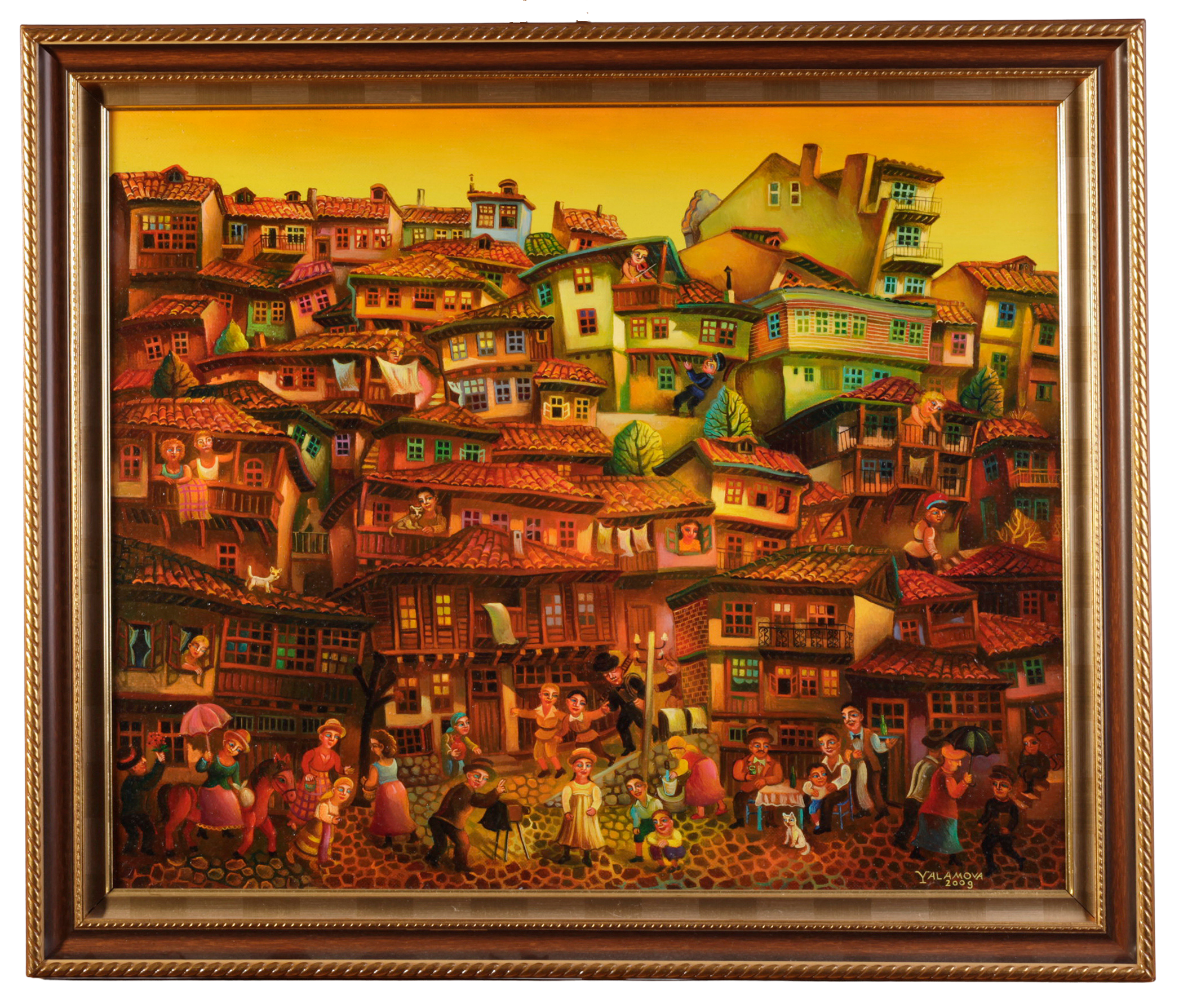
In “Old Tarnovo”, the town is the main protagonist. There are many people, but the composition is held together above all by the houses – perched one upon another, climbing upwards, tilted, overhanging, as though pressed together and at the same time animated by an inner movement of their own. Old Tarnovo is presented as a living architectural organism: the houses seem to look at one another, talk, support one another, stretch out balconies, open windows, step out towards the street and take part in the shared life of the town together with the people. Down below, this life unfolds like a small bourgeois urban theatre – around a photographer taking a picture of a young girl, ladies in hats and with umbrellas stroll by, one of them riding a little horse; gentlemen in suits, children, a chimney sweep and many cats appear in the scene. Men sit at a table in front of a tavern, while figures lean out of windows or stand on balconies.
The naïvist deformation of the human figures is very specific: the heads are disproportionately enlarged, the eyes even more so, and the “whites” of the eyes are painted bright blue. Even from a distance, we can see exactly how the characters look at one another, peep out, recognise one another, watch one another, and address one another with their eyes. This is a town of strolling, encounters, conversation and observation – close to that old Tarnovo habit of strolling along the main street, of which Yalamova speaks in her interview (Slavova 2017). In this dense, ascending architecture, the connection with Tsanko Lavrenov is also visible; but in Yalamova the town is softer, more smiling and more domestic – not so much a monumental image of Bulgarian antiquity as a tale of an inhabited, warm and animated civilised bourgeois age.
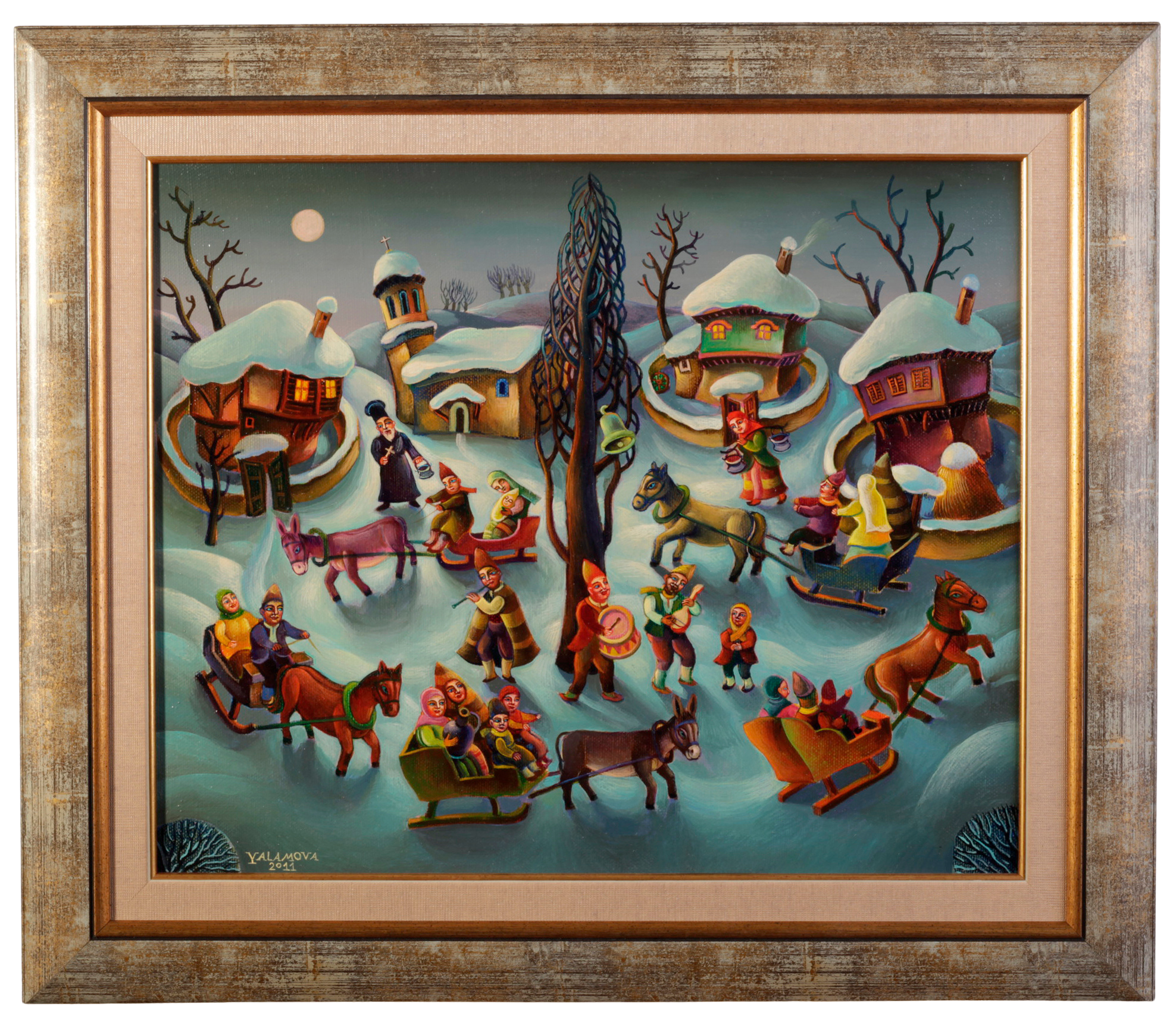
In “Winter”, Aneta Yalamova turns the landscape into a festive carousel. The scene moves in every direction – sleighs, horses, children, musicians, a priest and passers-by circle around the stylised dark tree with a bell, which stands as the axis of this entire snowy world. The tree may also be read as a memory of the ancient tree at the centre of the village – that living sign of root, kinship and community around which, in the traditional village world, people gather on feast days. The snow is not cold white, but blue-green, soft and luminous; it does not freeze life, but lets it glide across its surface. The church and the houses are perched on the hills, with enormous caps of snow, lit windows and smoking chimneys, as though they too were taking part in the winter game – looking on, warming, sheltering, sometimes leaning slightly towards what is happening. The human figures are small, but they do not disappear: their enlarged heads, bright eyes and clearly marked gestures turn them into little active signs of joy. The village is a fairy-tale winter stage – a world of sleighs, music, a bell, horses, lit houses and shared merriment, in which winter itself seems to have decided to be not frost, but festivity.
In “Christmas Carollers”, Aneta Yalamova condenses the winter village world around a ritual gathering. The title points to the Bulgarian Christmas carolling custom, yet the image quickly broadens and softens that frame. At the centre there may be a core group of carollers, but among the figures there is also a woman holding an icon and many small children – details that take the scene beyond the strict ethnographic idea of an all-male Christmas carolling band. As is often the case with Yalamova, the ritual becomes an occasion for the whole village to enter the feast. Here the snow is a living system of paths: it twists, circles, raises and lowers the gaze, gathers the people together and turns the village into one shared festive carousel. Above stands the church, slightly tilted and covered in snow, but the ritual heart of the painting is below – among the people, the bustle, the music and the encounter. Once again, the houses are not lifeless scenery: with their enormous snowy roofs, lit windows and leaning bodies, they seem to look towards the feast together with their inhabitants. Especially powerful is the figure in the peaked cap at the lower right – with a disproportionately enlarged head and raised arms, almost leaping out towards the viewer. This deformation intensifies the meaning: the man is not simply looking at the carollers, but drawing us too into the shared merriment. The painting is not a reconstruction of a custom, but a tale of community – a village that gathers to look on, sings, slides, welcomes, waves its arms and celebrates its own existence.
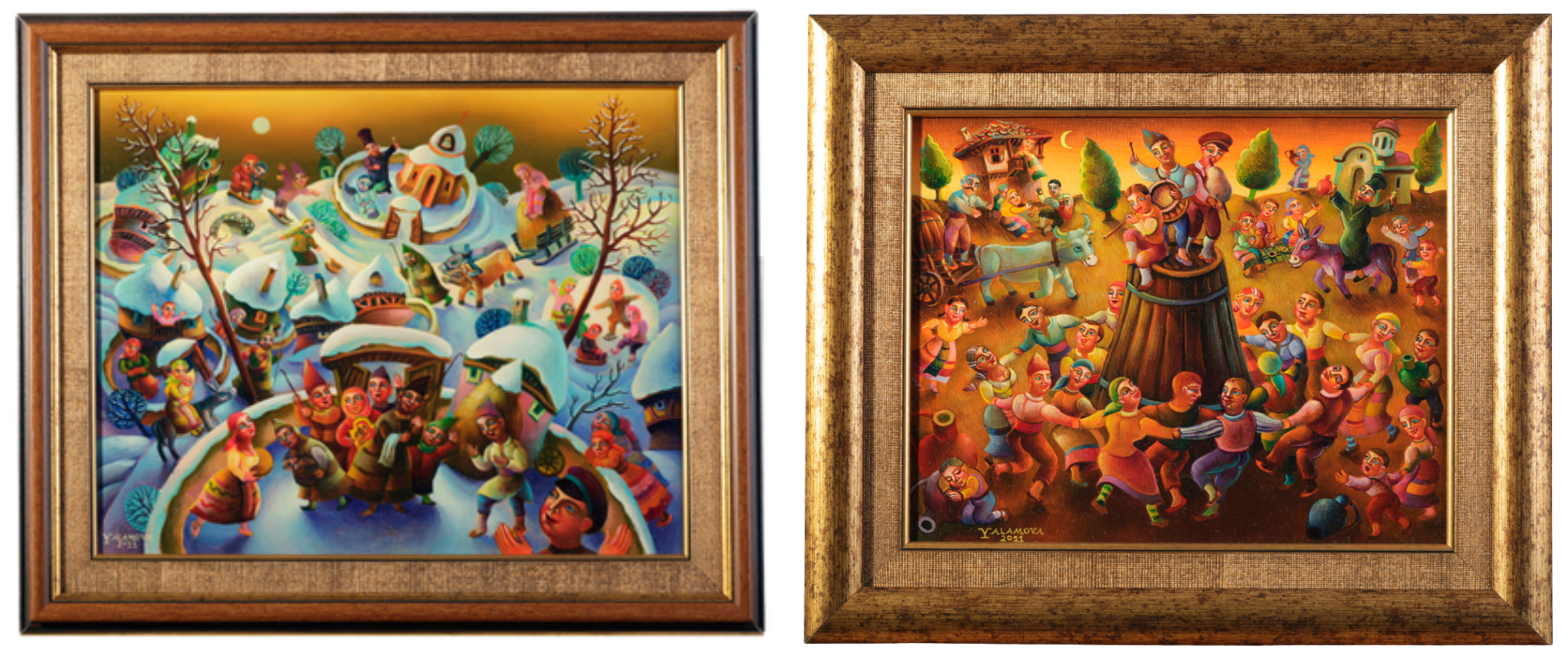
In “Village Feast”, Yalamova shows the village as a warm, noisy and slightly unruly scene of collective merriment – probably a wine feast. At the centre stands an enormous wooden vat, around which the traditional village chain dance turns, while the musicians have climbed on top of it – as if the music itself were springing from the vessel of abundance, wine and festive joy. Here, as the artist herself says, what interests her is not the ethnographic accuracy of the costume, but the scene: the chain dance, the feast, the gathering of people, the old houses, the life of the community. The figures are conventionally “folk”, but not museum-accurate – what matters is their gesture, gaze, movement and participation. The disproportionately enlarged heads and huge eyes once again turn the human faces into active signs: people look at one another, call out to one another, start conversations, flirt, laugh and draw one another into the feast. Around the central dance, small side episodes are scattered: a cart with an ox brings a new barrel, feasting families sit on rugs, and a man with a clay jug has already gone beyond respectable merriment. The funniest and most precise sign of this festive abandon is the priest on the right – mounted on a little horse, as if singing, waving a cross in his left hand and a wine flask in his right, while children jump around him. The feast is presented as a state of the whole village. In Yalamova’s work, the rural world is not poor, heavy or frozen in an ethnographic pose. It is a fantastical, colourful, noisy, generous and many-eyed world, in which the chain dance, the animals, the houses, the music and the evening itself have all joined in the celebration.
Aneta Yalamova’s works are attractive not because they offer easy nostalgia, but because they build a complete, recognisable and enduring world – retro towns, fantastical villages, lit windows, many-eyed faces, houses that seem to move and talk, feasts in which people, animals, music and space itself take part together. In her work, naïvism is not a sugary return to “the good old days”, but a skilfully crafted fairy-tale version of memory. For connoisseurs of naïve art, these are paintings that bring joy at first sight, but are not exhausted by it. The longer one looks at them, the more one begins to notice their small cunning devices – the glances, the leaning houses, the strange scales, the lights, the side episodes and the persistent determination with which the artist protects her fairy-tale bourgeois Bulgaria from disappearance.
Rossitsa Gicheva-Meimari, , PhD
Chief Assistant Professor in the Department of Arts and Design and member of the “Bulgarian-European Cultural Dialogues” Centre at New Bulgarian University
Bibliography:
Aleksandrova 2017: Сашка Александрова, Анета Яламова 25 г. рисува голямата си любов – Велико Търново. В: Борба, 14.11.2017 – https://www.borbabg.com/2017/11/14/%D0%B0%D0%BD%D0%B5%D1%82%D0%B0-%D1%8F%D0%BB%D0%B0%D0%BC%D0%BE%D0%B2%D0%B0-25-%D0%B3-%D1%80%D0%B8%D1%81%D1%83%D0%B2%D0%B0-%D0%B3%D0%BE%D0%BB%D1%8F%D0%BC%D0%B0%D1%82%D0%B0-%D1%81%D0%B8-%D0%BB%D1%8E/ Посетена на 9 септември 2026.
BNR Varna 2025: „Щастливите мигове на Анета Яламова“. В: БНР – Радио Варна, 27 септември 2025 – https://bnrnews.bg/varna/post/365000/shtastlivite-migove-na-aneta-alamova Посетена на 9 септември 2026.
Gallery “Paris” 2020: „Писма от вчера“ – изложба на Анета Яламова. В: Културни новини, 2020 – https://kulturni-novini.info/sections/2/news/31738-pisma-ot-vchera-izlozhba-na-aneta-yalamova Посетена на 9 септември 2026.
Le Papillon: Биографични бележки и представяне на Анета Яламова в сайта на Арт галерия „Льо Папийон“ – https://www.artpapillon.com/bg/aneta-yalamova Посетена на 9 септември 2026.
Miteva 2022: Виктория Митева, „Изворът на радостта“ – изложба живопис на Анета Яламова. В: Културни новини, 07.09.2022 – https://kulturni-novini.info/sections/2/news/35346-izvorat-na-radostta-izlozhba-zhivopis-na-aneta-yalamova Посетена на 9 септември 2026.
Nikolov 2022: Мартин Николов, Анета Яламова и „Изворът на радостта“. В: БНР – Радио Варна, 13.09.2022 – https://old-news.bnr.bg/varna/post/101704405/aneta-alamova-i-izvorat-na-radostta Посетена на 9 септември 2026.
Osikovska 2023: Даниела Осиковска, Интервю с Анета Ялъмова. В: Маринска, Р. (авт.), Д. Осиковска (съст.), Съвременни български наивисти. София „Кибеа“, 2023, с. 12-13.
Pavlova 2023: Надежда Павлова, Анета Яламова рисува своето Велико Търново. В: Newsmaker.bg, 24.10.2023 – https://newsmaker.bg/%D0%B0%D0%BD%D0%B5%D1%82%D0%B0-%D1%8F%D0%BB%D0%B0%D0%BC%D0%BE%D0%B2%D0%B0-%D1%80%D0%B8%D1%81%D1%83%D0%B2%D0%B0-%D1%81%D0%B2%D0%BE%D0%B5%D1%82%D0%BE-%D0%B2%D0%B5%D0%BB%D0%B8%D0%BA%D0%BE-%D1%82%D1%8A/ Посетена на 9 септември 2026.
Pavlova 2024: Надя Павлова, „Спомени и мечти“ – изложба на Анета Яламова. В: Културни новини, 02.10.2024 – https://kulturni-novini.info/sections/2/news/39891-spomeni-i-mechti-izlozhba-na-aneta-yalamova Посетена на 9 септември 2026.
Slavova 2017: Ваня Славова, „Помниш ли“… една носталгична изложба на Анета Яламова. В: БНР – Радио Варна, 19.09.2017 – https://old-news.bnr.bg/varna/post/100874717/pomnish-li-edna-priatna-izlojba-na-aneta-alamova Посетена на 9 септември 2026.
Product has been added to cart