Todor Marinov: rural idylls, festivities and passions – Part II
Jubilee 50th Auction of Enakor Auction House – ‘BULGARIAN NAÏVE...

A compendium for arts and antiques enthusiast
Jubilee 50th Auction of Enakor Auction House – ‘BULGARIAN NAÏVE ARTISTS’,
8 October 2026
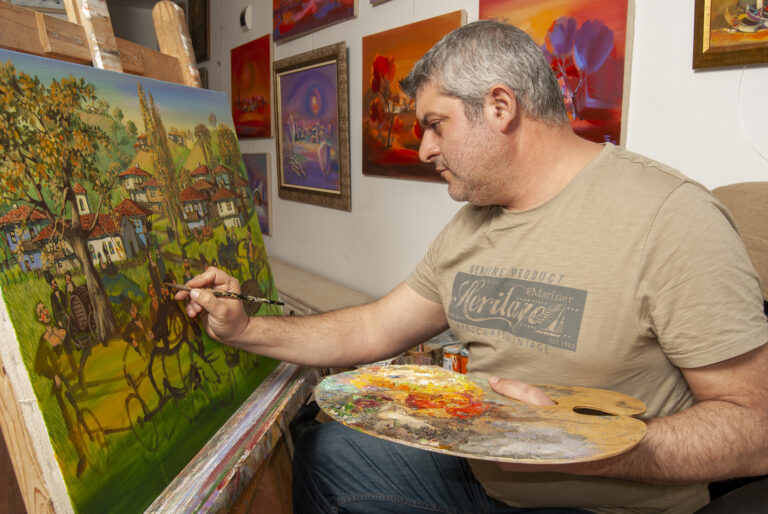
The auction corpus of Todor Marinov, consisting of twenty-five oil paintings, outlines three main directions in his world – the landscape idyll, the festive and ritual scene, and the everyday-life narrative. The landscapes introduce the pastoral setting of the village; the festive compositions fill it with music, masks, fire and communal action; while the most numerous everyday-life scenes show daily life in its calm, comic and at times turbulent manifestations.
In Todor Marinov’s landscapes, the village is seen as a pastoral setting – with hills, churches, houses, flocks, trees, snow, morning light and dusk. Here the artist is at his most lyrical: forms soften, colour takes the leading role, and the village world becomes a memory of cosiness, quietness and natural harmony. In “Winter in Violet”, the winter village is seen through a softened, almost dreamlike colour range. The forms of the houses and trees dissolve into snow, air and violet tones, while the white patches on the trees and roofs give the scene a particular tenderness. Here Marinov moves away from anecdotal narration and allows colour to build the mood. “Morning” is one of the most lyrical works in the group. The village is presented as a fragile image, emerging amidst light, air and soft greenish tones. The small houses with warm orange roofs seem to surface out of the morning dampness, and the landscape carries a sense of the softness in which the day awakens.
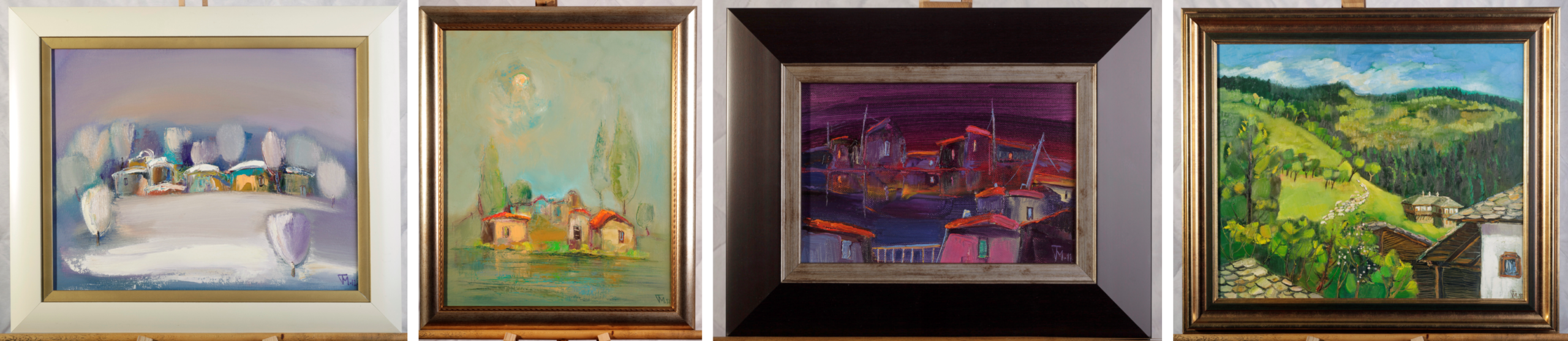
“In the Village at Dusk” introduces a denser and more dramatic tonality into the landscape group. The semi-abstract houses with red roofs and lit windows are immersed in a dark violet-purple evening environment, which turns the village into an almost theatrical nocturnal image. This work shows that Marinov’s landscapes are not only idyllic – they also contain vivid mood, colouristic intensity and drama. In “At Pasture”, the pastoral line in Todor Marinov’s work is brought out most clearly. The green hills, the flock of sheep, the village roofs and the distant mountain horizon build a peaceful image of the village as a place of closeness to nature and harmony. The human being is almost absent, but his world is everywhere – in the houses, paths, fences and animals that bring the landscape to life.
In Marinov’s festive compositions, the village becomes a lively stage for the community. Koukeri, koledari, nestinari and horsemen on St Theodore’s Day fill the space with movement, music, noise, fire, masks, animals and human clustering. The artist does not approach the rituals as ethnographic reconstruction, but as spectacular, narrative and easily recognisable scenes from Bulgarian festive memory. Here his naïvist and humorous element appears above all in the conventional space and, especially, the perspective, in attributes uncharacteristic of the feast being added, such as real knives among the kukeri, in the exaggerated gestures, vivid physiognomies and theatrical arrangement of the figures. For him, the feast is not so much a sacred act as a shared experience – an occasion for the village to gather, watch, participate and recognise itself in its own customs.
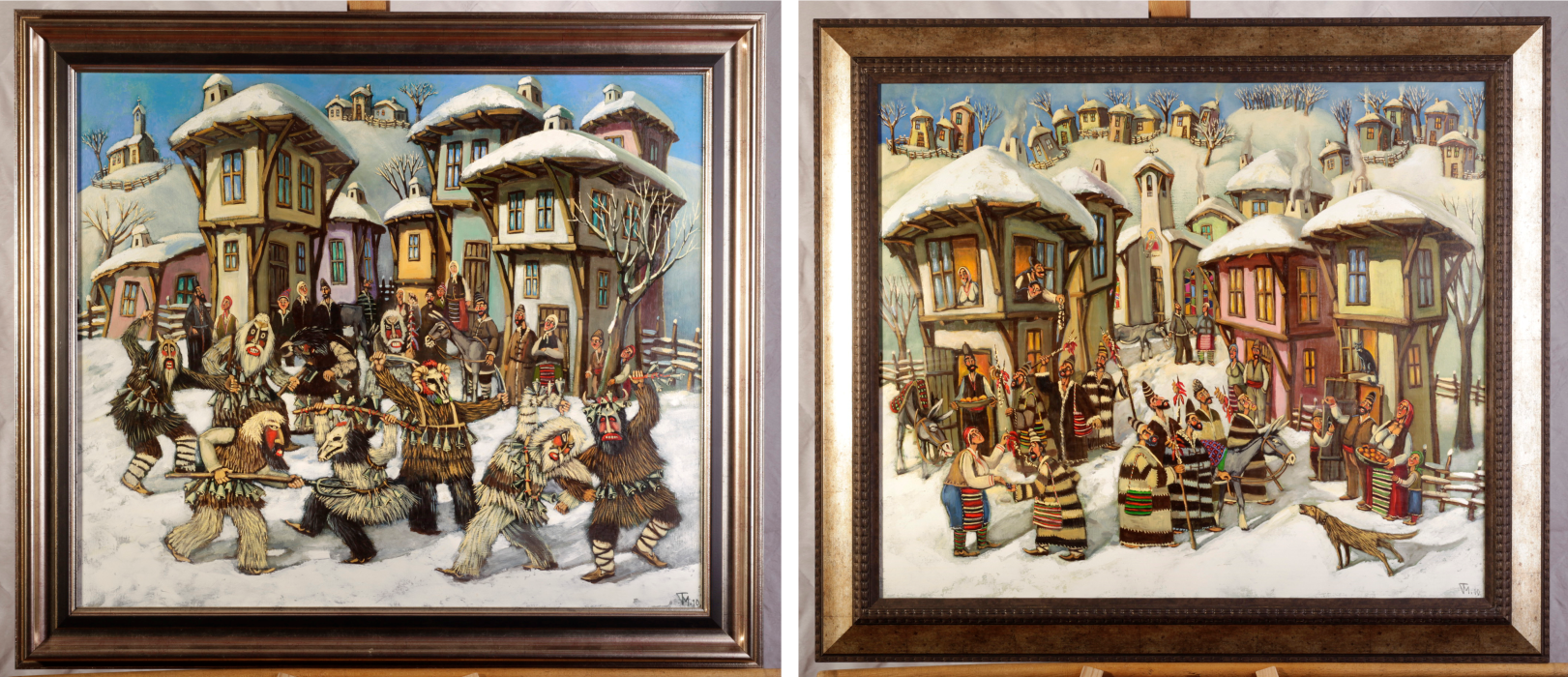
In “Koukeri”, the winter village is presented as the stage of a noisy masked procession. The large houses, the accumulated snow, the spectators at the windows and the people gathered around the masked figures create a sense of a feast that takes over the entire space. The koukeri are brought forward as the main protagonists – with skins, bells, knives, frightening faces and dynamic poses. Their fearsome aspect is turned into spectacle, while the ritual energy is conveyed through Marinov’s characteristic narrativity. “Koledari” presents the feast as movement from house to house, reception and exchange between people. The koledari group moves through the snowy village, while the inhabitants await them at thresholds, windows and in their yards. The composition is rich in small episodes – the offering of gifts, conversations, animals activities, smoking chimneys, a church and houses on the hills. Here Marinov emphasises not so much the solemnity and religious side of the ritual as its communal aspect – the feast links homes, street, church, animals and people into one noisy, hospitable village picture.
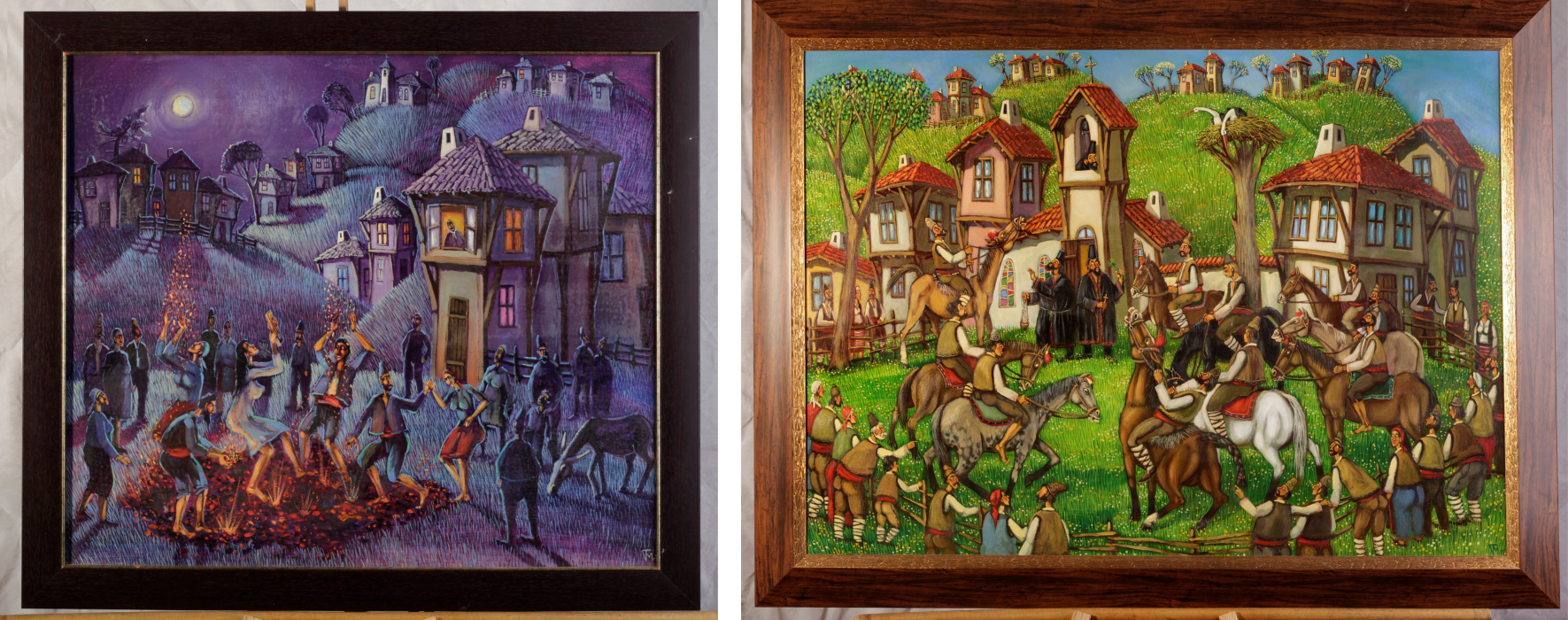
In “Nestinari”, the festive scene is more dramatic and more densely coloured. The violet night, the moon, the dark silhouettes of the village and the red-orange embers direct the eye towards the fire and the dance. The figures in the glowing embers lack the restraint and inward concentration characteristic of actual nestinari; they are shown as boisterous, wide-legged, with arms and legs flung out, and in active interaction with one another. The observers are static; the whole village seems to have fallen silent around the extraordinary action. This is one of the works in which Marinov moves away from good-natured daytime festivity and uses colour, night and gesture to recreate a more tense atmosphere. “St Theodore’s Day” introduces a spring scene, green, gleaming with light and more broadly unfolded. The horses and riders are at the centre of the composition, while the entire village community gathers around them – men, women, children, priests, spectators, people at fences and windows. The red roofs, the church, the stork’s nest and the green hills give the scene a sense of renewal and vitality. The feast is presented as a shared revival of people, animals and village – a living, crowded and colourful picture of tradition.
In Todor Marinov’s idyllic everyday-life scenes, the village world is presented through music, animals, spring greenery and the simple joys of daily life. Here the human and the animal coexist in a shared, good-natured environment – shepherds play music, flocks listen, the donkey peers in as a participant in the scene, and the village stands on the hill as the natural home of this pastoral life. These paintings show the gentlest line in Marinov’s work – a world of closeness, light humour, natural harmony and recognisable rural idyll.
In “Concert”, the pastoral scene is turned into a small village performance. The two musicians play among flowering trees, sheep, goats and a donkey, while the animals seem like an attentive audience. Behind them rises a spring village with a church, red roofs and a stork’s nest – an image of an ordered, lively and hospitable world. The painting combines idyll and humour, presenting music as a natural joy of rural life. “Sheep’s Joy” is one of the purest idylls in the group. There is no human figure in it and no narrative conflict – only sheep beneath an apple tree, a green meadow, flowers and a soft blue sky. Marinov builds the scene with clear decorative feeling and a sense of immediate delight: the sheep are funny because they are presented as strangely lively and animated, while the apple tree turns the landscape into a fairytale place of abundance. Here the rural idyll is reduced to its simplest and most attractive image – strange animals, nature and a light, smiling harmony.
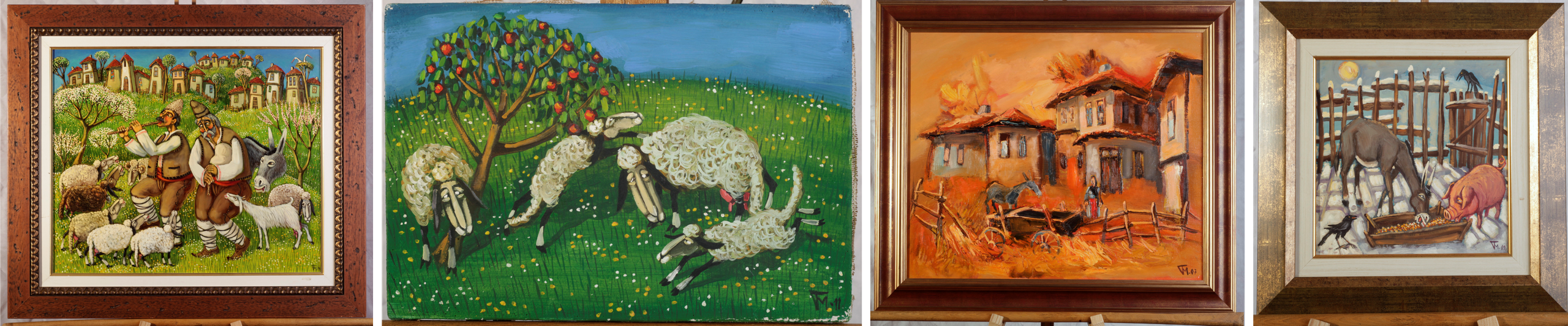
In Todor Marinov’s everyday-life scenes, the village is presented as a place of work, movement, encounters and small human joys. There is no festive solemnity here, but ordinary life – a yard, a cart, animals, fences, houses, roads, winter walks. The artist turns everyday motifs into painterly narratives in which people and animals inhabit one shared world. In “Winter Walk”, for example, the couple on the donkey carries a particular rural tenderness – two lovers setting off together on their small romantic adventure. Thus the everyday in Marinov’s work does not remain merely a description of a rural environment, but becomes a scene of closeness, mood and human warmth.
“Village Yard” is one of the most painterly works in this group. The warm ochre-orange range turns the yard, the houses, the fence and the cart into a memory of late summer or autumn light. The scene is calm – the donkey, the cart, the small human figure and the clustered village buildings create a sense of an inhabited world in which every object has its place. Here Marinov is more restrained in his narration and allows atmosphere, colour and village architecture to carry the main message. In “Friends”, the everyday village scene is transferred entirely into the world of animals. The donkey, the pig and the black birds are gathered around the food in the winter yard and are presented as a small community. The title provides the good-natured key to the painting – the animals are not merely part of the farmstead, but characters with their own presence and character. With a simple subject and light humour, Marinov turns ordinary feeding into a small everyday-life episode, in which the village yard appears alive, inhabited and humanly sociable.
In Todor Marinov’s more dramatic everyday-life scenes, the village is no longer only an idyll, but a noisy theatre of human and animal passions. Here daily life is acted out through laughter, stubbornness, teasing, awkward questions, drunken merriment and small comic mishaps. The artist observes village life as a spectacle in which people and animals are equally active protagonists, and every situation may become a scene of public amusement at someone else’s expense. It is precisely in these paintings that the humorous element in his style becomes most clearly visible – rough, direct, at times slightly indecent, but always narrative and vital.
“Sunday Scenes” presents the village as a stage of shared laughter and curiosity. At the centre of the scene is the stubborn donkey, which refuses to move on despite the efforts of the man and woman beside it. Around them a crowd gathers – people in front of the church, by the fences and in the yards, bursting into laughter at the comic struggle between human will and animal stubbornness. The painting turns a minor incident into a colourful Sunday spectacle. “Donkey Passions” introduces one of Marinov’s most characteristic lines – the comic intertwining of the human and animal worlds. The title provides the key to the scene: passions here are shown through rough rural humour, animal corporeality and the human being’s amused observation of nature. The work is more restrained in composition, but it is important because of its theme, which openly names one of the energies in the artist’s world.
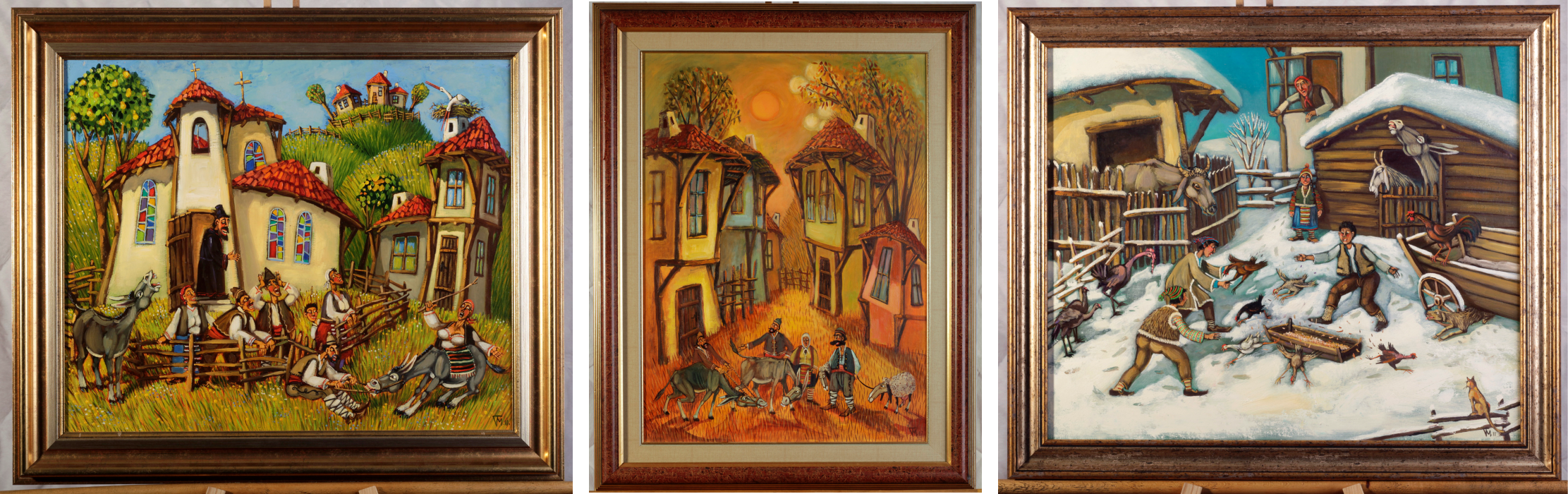
In “Clamour in the Yard”, the ordinary village yard is turned into real commotion. People chase the birds in order to catch the contents of the family meal. Chickens and turkeys fly off in all directions, while the other animals stare at the captured chicken, as though understanding what fate awaits it. In this way Marinov constructs a scene that is both funny and tense – a small yard drama in which an everyday household action becomes a spectacle of panic, movement and existential revelations. “Awkward Questions” is among the most anecdotal everyday-life scenes in the group. At its core lies the comic situation of a child’s curiosity before the world of adults and natural passions. While the male and female goat follow their natural urge, the boy has clearly asked a question that embarrasses the father and makes the others laugh. Marinov turns the awkwardness into a village comedy – noisy, direct and filled with his characteristic physiognomic expressiveness.
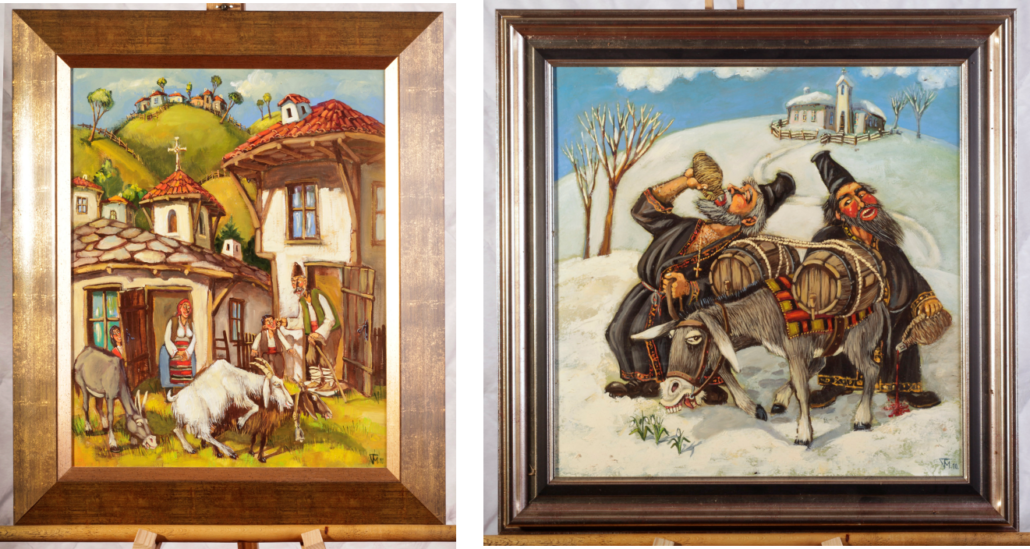
In “The Path to Truth”, the humour acquires a satirical and slightly grotesque tone. The two priests, the donkey with the barrels, the winter road and the distant church build a scene with a clear anecdotal charge. The title recalls the well-known formula “In wine there is truth”. Here, the path to truth quite literally passes through barrels, flasks and drunken merriment. The comedy arises from the discrepancy between the spiritual rank of the characters and their all-too-human weakness, while the grimacing faces and exaggerated expressions give the scene a rough, almost grotesque expressiveness. In this way, the artist turns weakness not into a moral judgement, but into a vivid everyday-life satire – direct, funny and easily recognisable.
As a whole, the auction corpus of Todor Marinov builds a colourful, noisy and recognisable image of the rural world – with its landscapes, festivities, animals, yards, romantic teasing, scenes of public amusement at someone else’s expense, clamour and human weaknesses. The artist does not seek ethnographic accuracy, but a painterly narrative in which the village becomes a stage of communal life. In this world there is idyll, but there are also passions; there is ritual memory, but there is also laughter; there is warmth, but also rough comedy, at times reaching a grotesque tone. It is precisely this combination of the pastoral, the festive and the anecdotal that makes his paintings accessible, vital and easily memorable – they present the Bulgarian village not as a frozen memory, but as a noisy, human scene filled with action. Admirers of rural idyll, vigorous festive imagery or everyday-life humour will find their own painting among them – whether as a memory of a familiar world, or as a cheerful, colourful and characteristic scene from Bulgarian folk life.
Rossitsa Gicheva-Meimari, , PhD
Chief Assistant Professor in the Department of Arts and Design and member of the “Bulgarian-European Cultural Dialogues” Centre at New Bulgarian University
Bibiliography:
Todor Marinov Website: Личен сайт на Тодор Маринов – https://todormarinov.com/%D0%BA%D0%BE%D0%B9-%D0%B5-%D1%82%D0%BE%D0%B4%D0%BE%D1%80-%D0%BC%D0%B0%D1%80%D0%B8%D0%BD%D0%BE%D0%B2/ Посетена на 5.09.2026.
Product has been added to cart