Todor Marinov: rural idylls, festivities and passions – Part I
Jubilee 50th Auction of Enakor Auction House – ‘BULGARIAN NAÏVE...

A compendium for arts and antiques enthusiast
Jubilee 50th Auction of Enakor Auction House – ‘BULGARIAN NAÏVE ARTISTS’,
8 October 2026
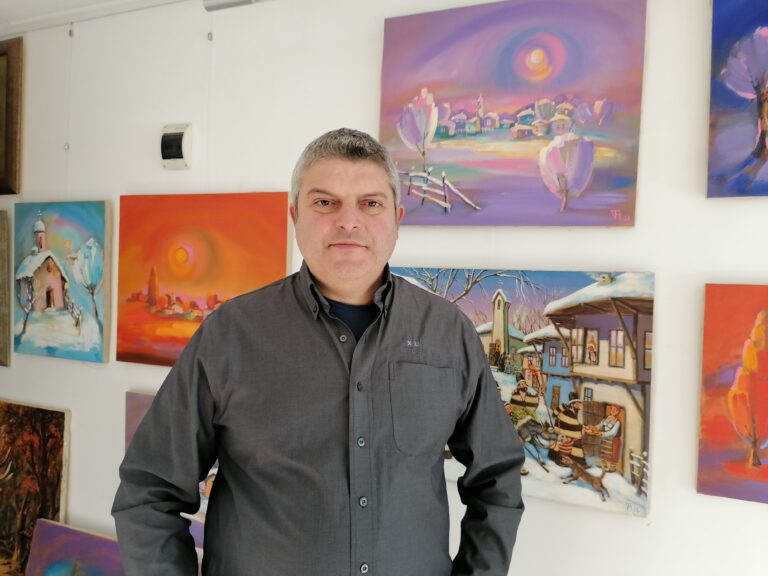
Todor Marinov is one of the academically trained artists in the auction of Bulgarian naïve artists. Unlike many of his colleagues, in his case naïvism does not arise from an inner artistic necessity, but from the central subject of his work – the Bulgarian village, with its life, customs and human character. For him, naïvist devices are a means of presenting the village world and the village person in a more convincing, more accessible and more vivid way. Marinov was born in Vratsa in 1974. He graduated from the National School of Fine Arts in Sofia and from the National Academy of Art (Todor Marinov Website; Osikovska 2025). Marinov himself explains his style through his early attraction to the visual arts, the support of his family and teachers, his academic education and his specialisation in “Children’s Design”. In his interview with Daniela Osikovska, he defines his works as “figural compositions with a naïvist and humorous element” and links his naïvist style with the child’s gaze, creative freedom and the wish for his paintings to remain close to people. As his main sources of inspiration he names nature, people, animals, Bulgarian everyday life and culture, and as his characteristic subjects – koledari, koukeri, nestinari and other Bulgarian customs (Osikovska 2025).
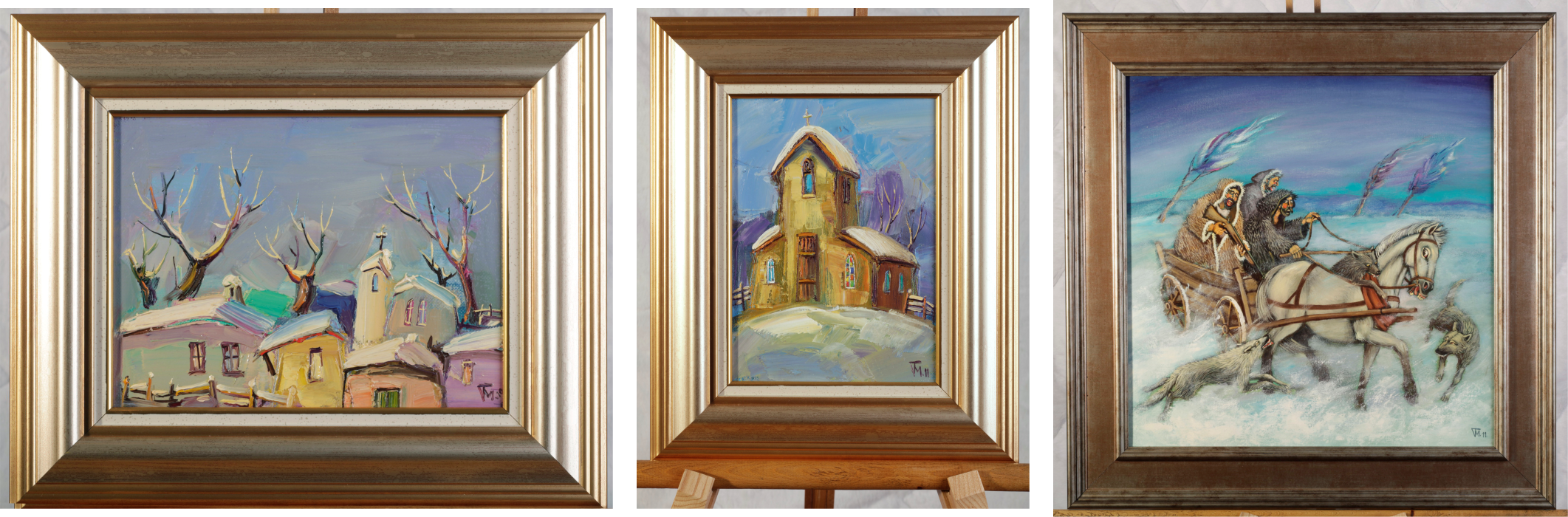
These artist’s statements are important, but they need to be qualified when we look at his works. Marinov is not a naïvist in the strict sense of the word. His style does not derive from non-academic spontaneity, nor from a childlike mode of drawing. He is a trained artist who consciously uses elements of simplification and deformation, strong narrative clarity and easily recognisable subjects. His specialisation in “Children’s Environment Design” is probably related to the accessibility of his images, to their illustrative quality and to the desire for the scenes to be readable at first glance. But this does not make his works naïvist as a whole, nor childlike in their themes, way of thinking or mood. They resemble rather painterly illustrations to rural stories for adults – with rituals, animals, gossip, gatherings, music, festivities, yards, quarrels and public amusement at someone else’s expense.
In his landscapes, for example, naïvist elements are more often absent. In his figural compositions, such elements appear rather in the conventional handling of space, in the deformed village architecture, in the theatrical arrangement of the scenes and in their accessible anecdotal narration. The human figures and animals, however, are not naïvist in construction in the strict sense – they are academically controlled, although often subordinated to caricatural-grotesque expressiveness, exaggerated gesture or a comic situation. The humour of which the artist and gallery texts speak manifests itself rather as rural grotesque, anecdotality and cheerful overcrowding of the scene. His world is not dramatic or psychologically deep, but noisy, colourful, narrative and directed towards immediate recognition.
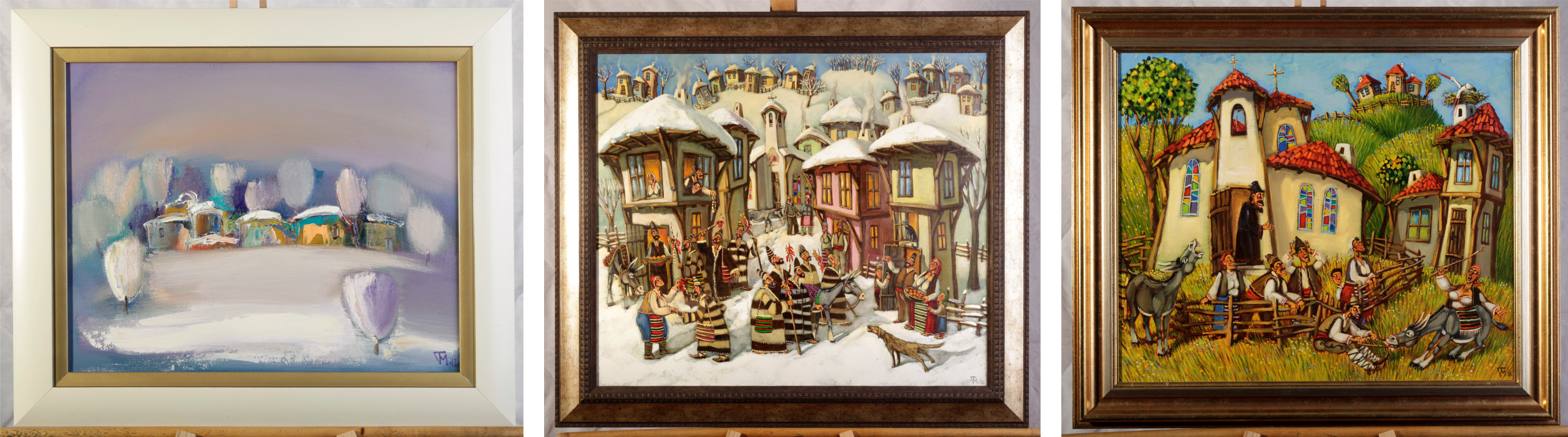
Marinov’s favourite subject is the Bulgarian village and its human community (Bistrashka, Terziev 2018). For him, the village is a stage that is rearranged from one painting to another – it may appear as a peaceful pastoral space, a festive centre, a yard, a road, a place of music, a romantic walk, a scene of public amusement at someone else’s expense, or a noisy everyday incident. This sense of staging brings together his apparently different subjects: the landscape prepares the setting, the feast gathers the community, while the everyday incident reveals the temperament of people and animals. For this reason, the auction corpus may be read as an extended village theatre – at times idyllic, at times festive, at times comic-dramatic. His kοukeri, koledari and nestinari are not treated as objects of ethnographic reconstruction or mysterial contemplation, but as painterly protagonists in a collective spectacle. The bagpiper, the concert, the Sunday scene of public amusement, the village clamour and the quarrel all build up the image of a community that exists through noisy actions, watching, commenting and participation.
In these paintings, animals are rarely merely part of the rural décor. They are often equal participants in the incident, and sometimes its true driving force. A donkey may halt the movement and provoke a Sunday scene of public amusement at someone else’s expense; sheep may become the audience at a village concert; chickens and turkeys may throw an entire yard into turmoil; the male and female goat may open up an awkward conversation between a child and adults. In this way Marinov constructs a specific comic world in which the human and the animal continually mirror one another, while the village community includes not only people, but all the living beings around them.
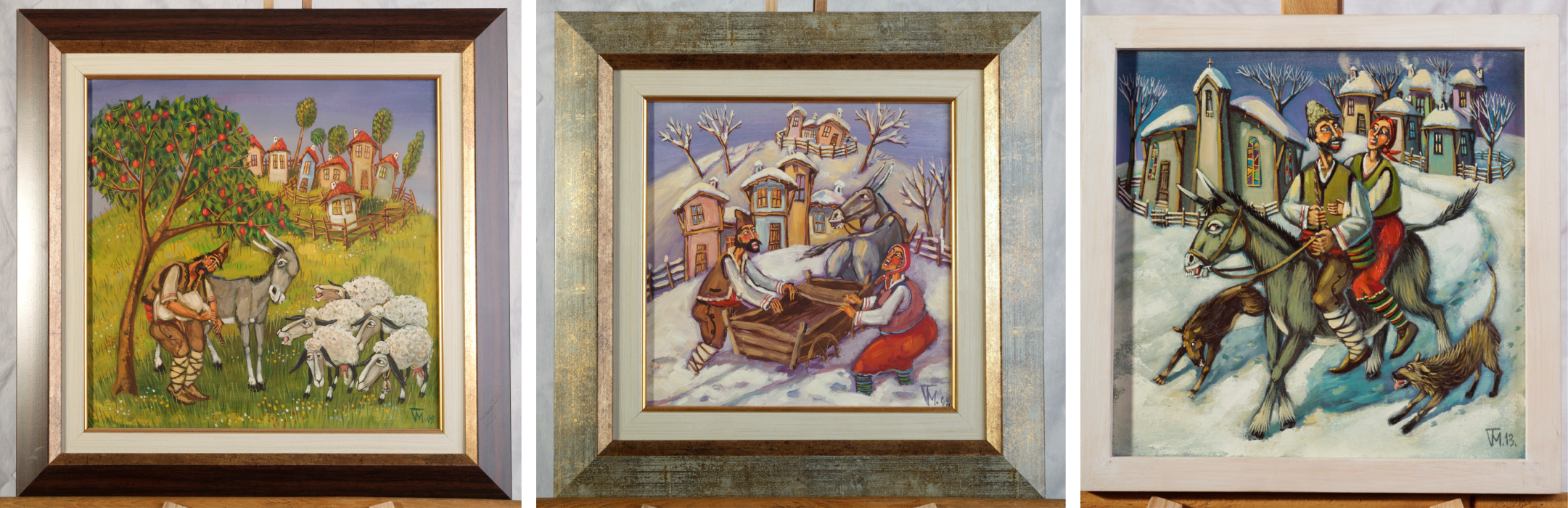
The considerable number of works by Marinov in the auction – twenty-five – presents the artist’s work from the period 2007–2012, that is, through an earlier and more restrained line, compared with the greater freedom of interpretation he has developed over the last decade or so. This line is dominated by everyday rural scenes, with or without a dramatic character, idyllic scenes with musicians, village festivities, animals, yards, and winter or summer village landscapes. Here one can clearly see the visual circle which the artist himself describes as a pastoral past, warmth, harmony and love of life. Yet on closer inspection this pastoral quality is not always, or entirely, idyllic. It is often overpopulated, slightly rough, theatrical, or even somewhat grotesque. It is precisely in this tension – between the declared good-natured pastorality and the visible everyday grotesque – that the most interesting field in Todor Marinov’s works is to be found.
Todor Marinov’s place in an auction devoted to Bulgarian naïve artists should be defined with some caution. He himself rightly does not identify directly as a naïvist, but speaks of “figural compositions with a naïvist and humorous element” (Osikovska 2025). In this sense, naïvism in his work is rather a chosen expressive approach than a complete artistic identity. The artist works both with the devices of academic training and with elements of naïvist treatment of individual images – and this predetermines the specific character of his painting in comparison with the other participants in the auction.
Marinov’s paintings do not seek a complex symbolic key, but rely on accessibility, narrative, recognisable rural motifs, and good-humoured comic or more openly satirical situations. They introduce the viewer into a world of village life, animals, festivities and human clamour – a world that creates a noisy, colourful and smiling picture of communal life. For collectors and connoisseurs, Marinov’s works offer different points of entry into this world – from the lyrical village landscape to the noisy feast and the comic everyday incident. Among them, it is easy to find a painting for someone seeking warmth, narrative, humour and a living Bulgarian character.
Rossitsa Gicheva-Meimari, , PhD
Chief Assistant Professor in the Department of Arts and Design and member of the “Bulgarian-European Cultural Dialogues” Centre at New Bulgarian University
Bibliography:
Bistrashka, Terziev 2018: Нели Бистрашка, Стоян Терзиев, „Дяков“ представя Тодор Маринов. В: БНР – Радио Пловдив, 2018. – https://old-news.bnr.bg/plovdiv/post/100948926/dakov-predstava-todor-marinov?utm_source=chatgpt.com Посетена на 5.09.2026.
Impressio 2023: Галерия „Икар“ представя изложбата „Коледни истории с Тодор Маринов“. В: Impressio, 19.12.2023. – https://impressio.dir.bg/afish/galeriya-ikar-predstavya-izlozhbata-koledni-istorii-s-todor-marinov Посетена на 5.09.2026.
Osikovska 2025: Даниела Осиковска, Интервю с Тодор Маринов. В: Николова, С. (авт.), Д. Осиковска (съст.), Съвременни български наивисти. Част II. София „Кибеа“, 2025, с. 208-210.
Petrova-Tsvyatkova 2012: Миглена Петрова-Цвяткова, „Бленувани убежища“ с художника Тодор Маринов. В: „Културни новини“, 09.01.2012. – https://kulturni-novini.info/sections/2/news/13897-blenuvani-ubezhishta-s-hudozhnika-todor-marinov Посетена на 5.09.2026.
Todor Marinov Website: Личен сайт на Тодор Маринов – https://todormarinov.com/%D0%BA%D0%BE%D0%B9-%D0%B5-%D1%82%D0%BE%D0%B4%D0%BE%D1%80-%D0%BC%D0%B0%D1%80%D0%B8%D0%BD%D0%BE%D0%B2/ Посетена на 5.09.2026.
Product has been added to cart