CONTEMPORARY BULGARIAN NAÏVE ART
Jubilee 50th Auction of Enakor Auction House – “BULGARIAN NAÏVE...

A compendium for arts and antiques enthusiast
Jubilee 50th Auction of Enakor Auction House – “BULGARIAN NAÏVE ARTISTS”, 8 October 2026
The jubilee auction of Enakor Auction House is devoted to a little-known area in the history of Bulgarian art – contemporary Bulgarian naïve art. There are quite a few artists working in this field who have admirers and collectors in Bulgaria and around the world; yet, for various reasons, Bulgarian naïve art has remained predominantly an individual effort – without schools, without centres, insufficiently studied and insufficiently understood. As Dr Ruzha Marinska writes (Marinska 2023: 6): “Only recently have these Bulgarian naïve artists begun to be included in artistic life. This has happened thanks to several galleries – such as Art Naïve – Kapana in Plovdiv, Le Papillon in Varna and Paris in Sofia – and with the support of a couple of admirers of naïve art. They have also begun to attract and, albeit only partly, to cultivate an audience of their own admirers. Most of them remain unknown beyond Bulgaria, with few exceptions, such as Rosen Rashev – Roshpaka. Yet they have created a considerable body of work, which awaits critical interpretation.”
Marinska writes this in the introduction to the first volume of the publication Contemporary Bulgarian Naïve Artists (Marinska, Osikovska 2023). Daniela Osikovska and her husband Georgi Georgiev created the first public space for Naïve art in Bulgaria – the museum display of their private collection, the “Salon of Naïve and Intuitive Art”, at the City Gallery in Belogradchik (Salon of Naïve Art website). The first volume on the naïve artists was followed by a second one (Nikolova, Osikovska 2025), by three biennials and four International Salons (Salon of Naïve Art Events). The interest in naïve art at these events proved exceptionally high. The auction of Enakor, which offers collectors a large private collection of more than 250 works by Bulgarian naïve artists, forms part of this new trend in the market for contemporary Bulgarian art.
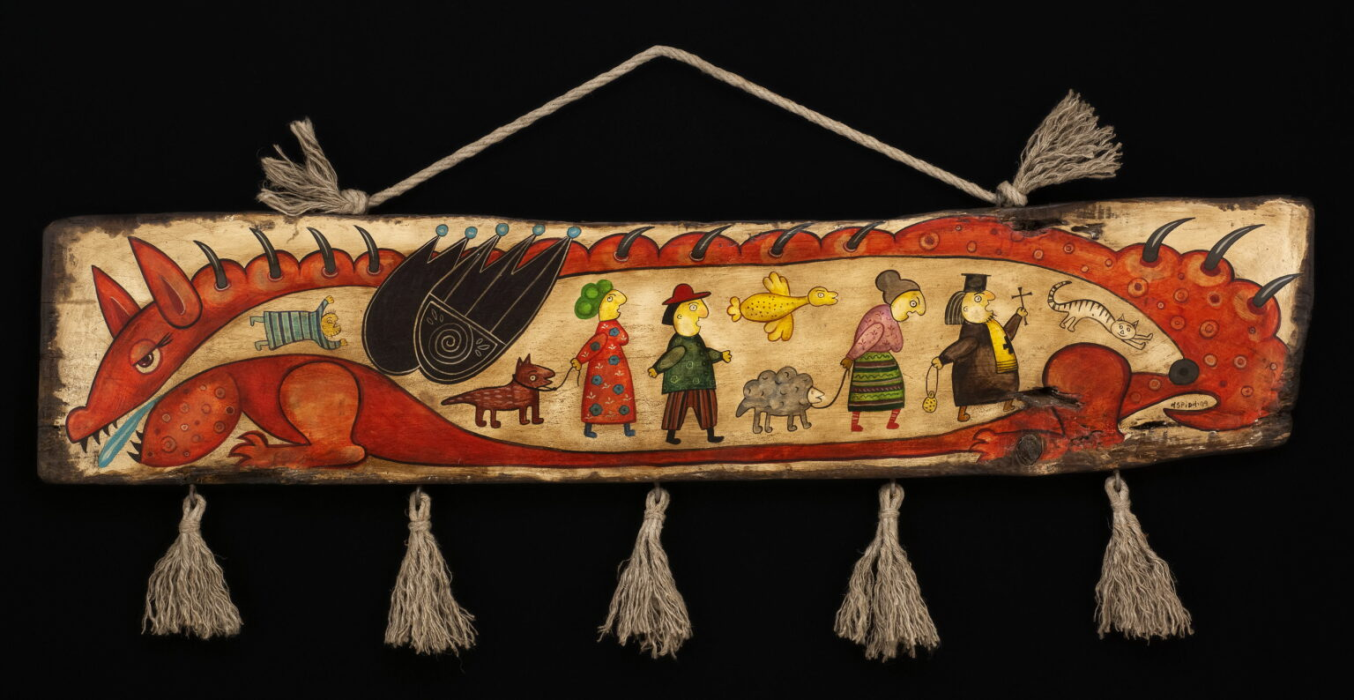
“Art Naïf” is a provisional term-concept denoting stylistic affiliation or an artistic tendency. When it emerged in the late nineteenth and early twentieth century, it was used to designate works by artists without formal academic training (Marinska 2023: 5). Later, however, many academically trained artists also chose it as an appropriate language of expression. This complicates the phenomenon: new terms emerge, and debates over the name arise (Marinska 2023: 5; Nikolova 2025: 7–9), continuing to this day. One reason why Bulgarian naïve art has not developed into a strong school is probably the lack of a calmly accepted name – for some, it sounds suspiciously close to “naivety”, “simple-mindedness”, “incompetence” or “childishness”. It is therefore important to defend naïve art as a specific type of artistic mastery, one that requires no less talent, effort and skill than any other kind of art. A particularly complex skill is the ability to make simplified form, deformation, stylisation, distorted proportion and the childlike-primary sign become plastically necessary.
Naïve art does not abolish artistic mastery, but shifts it beyond the academic criteria of correctness. It is recognised by the strength of the sign, compositional measure, plastic necessity and the ability of simplified form to carry meaning. A disproportionate body, a huge hand, a tilted house, flat space or an animal-sign are not qualities in themselves. They become convincing when they intensify the gesture, bring the world to life, transform the scene into a ritual or fairytale one, or convey character. A plastically necessary solution is one that cannot be “corrected” without the image losing its convincing power. Mariela Dimitrova – Mara formulates the principle of naïve artistic mastery very precisely: “to turn the defect into an effect” (Osikovska 2023: 75). This brief phrase contains the essential difference between inability and artistic freedom.
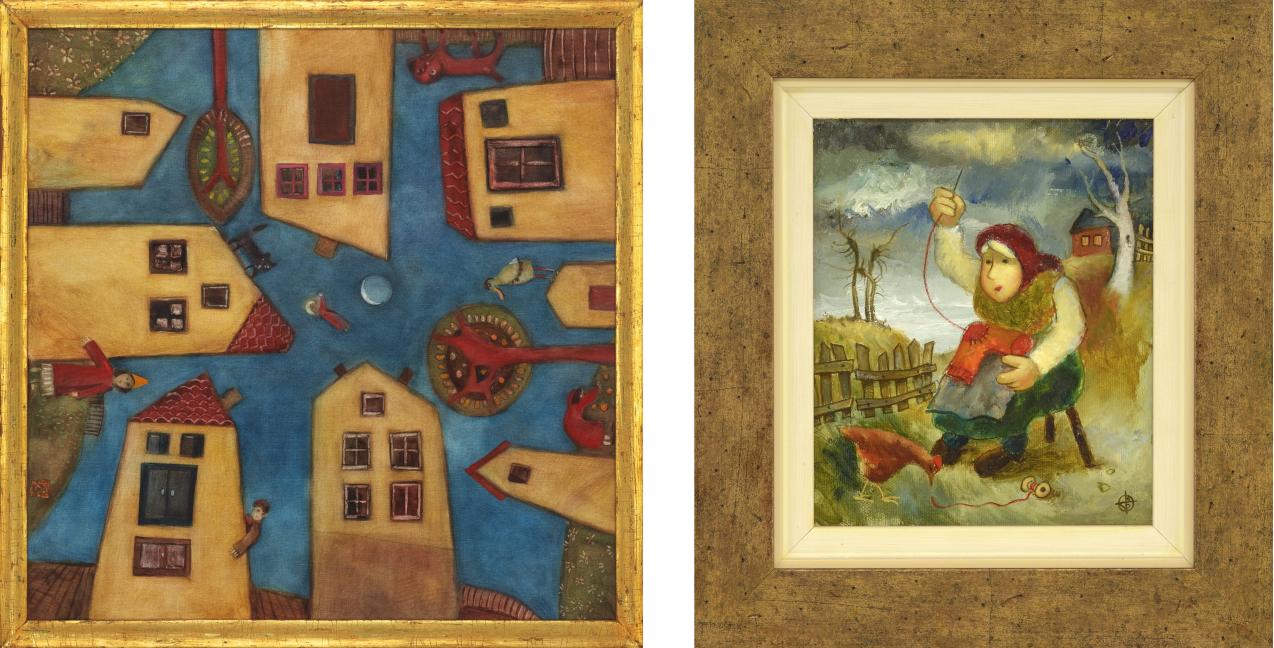
Naïve artistic mastery is not necessarily born of an academic school. A self-taught artist may achieve artistic persuasiveness when simplified form is the result of long-term effort, attentiveness, patience, repetition and a lasting commitment to the image. Love for what is being painted makes the artist look longer, correct, work on detail, invent personal means and gradually turn them into a language. Conversely, academic training in itself guarantees nothing without talent, inner necessity and persistent work. Naïve painting is not a lack of skill, but another kind of skill – one grounded in talent and developed through constancy, observation, love for the image and the ability “to turn the defect into an effect”.
Characteristics of the naïve style manifested in the art of the artists featured in the auction
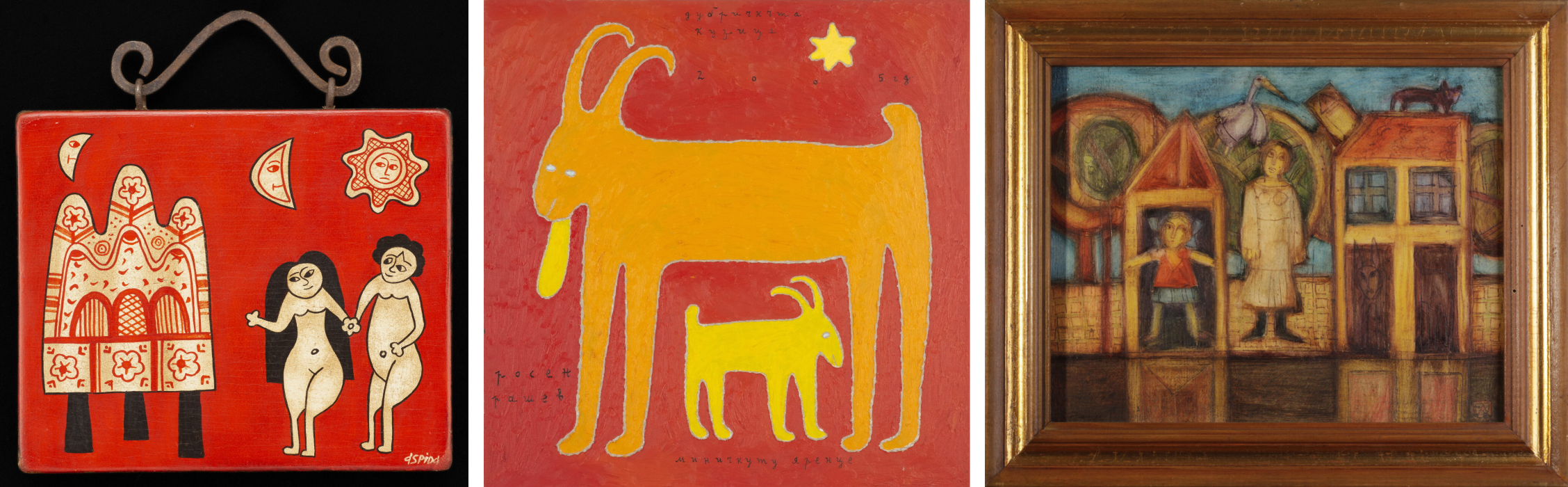
Simplification is not emptiness. The figure may be schematic, but form and line must be able to “speak”, to express meaning. Two dots for eyes, a curved arm, a tilted body, a rounded plump belly, a horn, a wing or a roughly outlined profile must be enough to convey character, gesture, attitude, fear, care or movement. The most convincing artists in this skill are Anita Nencheva, Rosen Rashev – Roshpaka, Petar Dimov, Dimitar Bogdanov and Yulia Stankova.
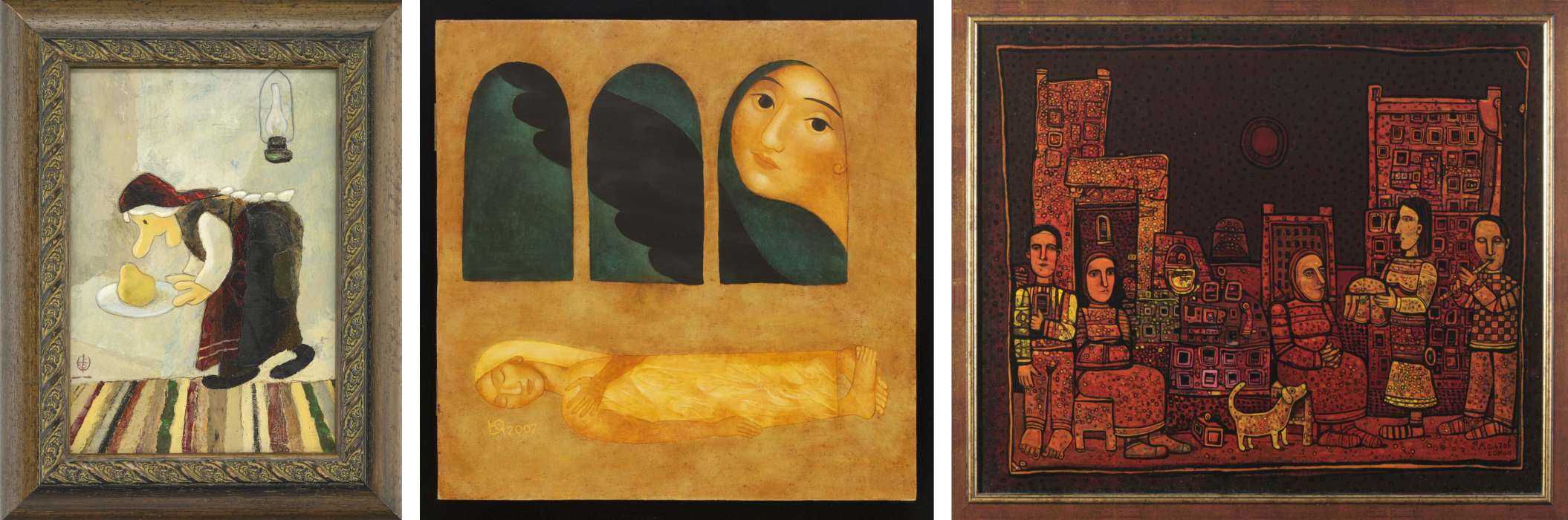
Irregularity must have a function. Distorted proportion, flat space, strange scale or reversed perspective must create a visual-semantic effect – humorous, frightening, ritual, fairy-tale, sacred or otherwise. Particularly strong in this respect are Mariela Dimitrova – Mara, Aneta Yalamova, Rosen Rashev – Roshpaka, Petar Dimov, Sevda Poturlyan and Yulia Stankova.
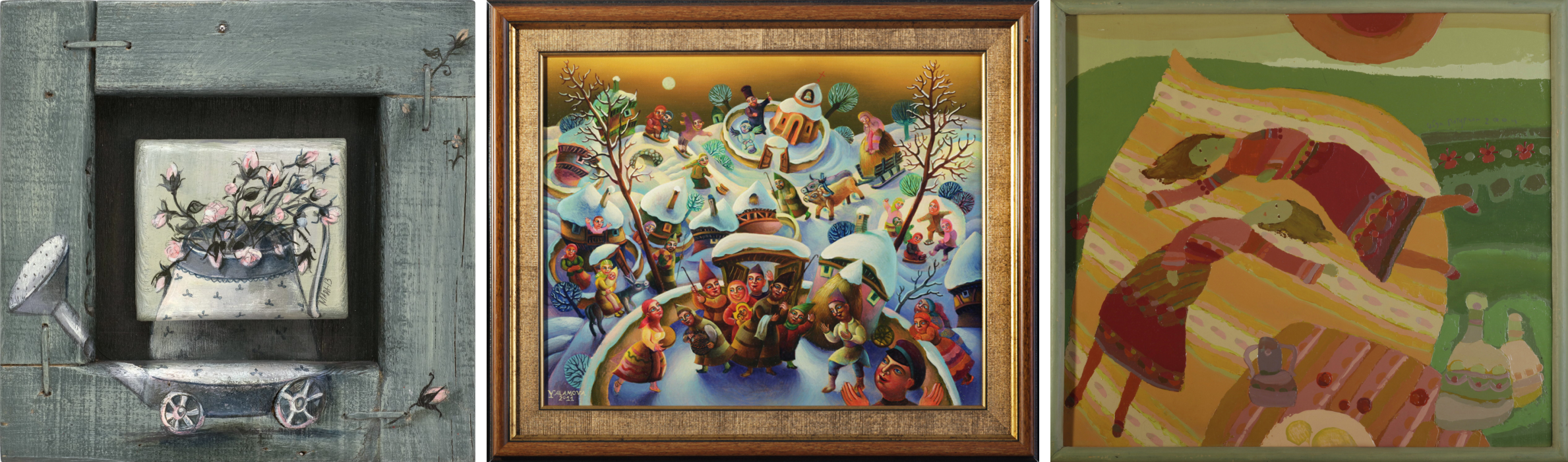
The composition must hold the world together. In a good naïve artist’s work, the composition has an inner order – rhythm, centre, balance, movement and measure. Things are not “piled up” simply to make the image colourful, but in order to express meaning. Here Aneta Yalamova, Petar Dimov, Rumen Malchev, Biyanka Nenova, Alyona Topalova and Todor Marinov stand out.
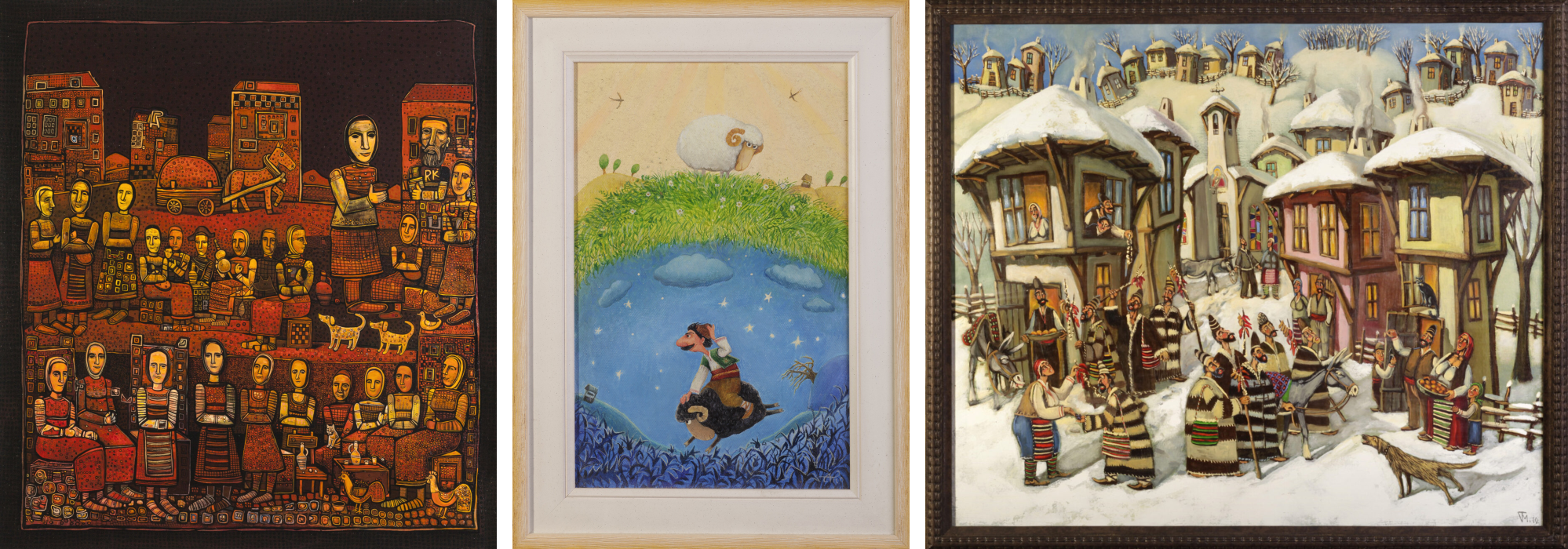
The sign must carry more than the object. A house, an animal, a tree, a saint, a kouker masked figure, a child, a sparrow, a dragon – these are not merely “themes”, but images that encode meaning. Mastery lies in making the object become a sign rather than a dry illustration. Here the leading artists are Anita Nencheva, Rosen Rashev – Roshpaka, Mariela Dimitrova – Mara, Dimitar Bogdanov, Yulia Stankova and Sevda Poturlyan.
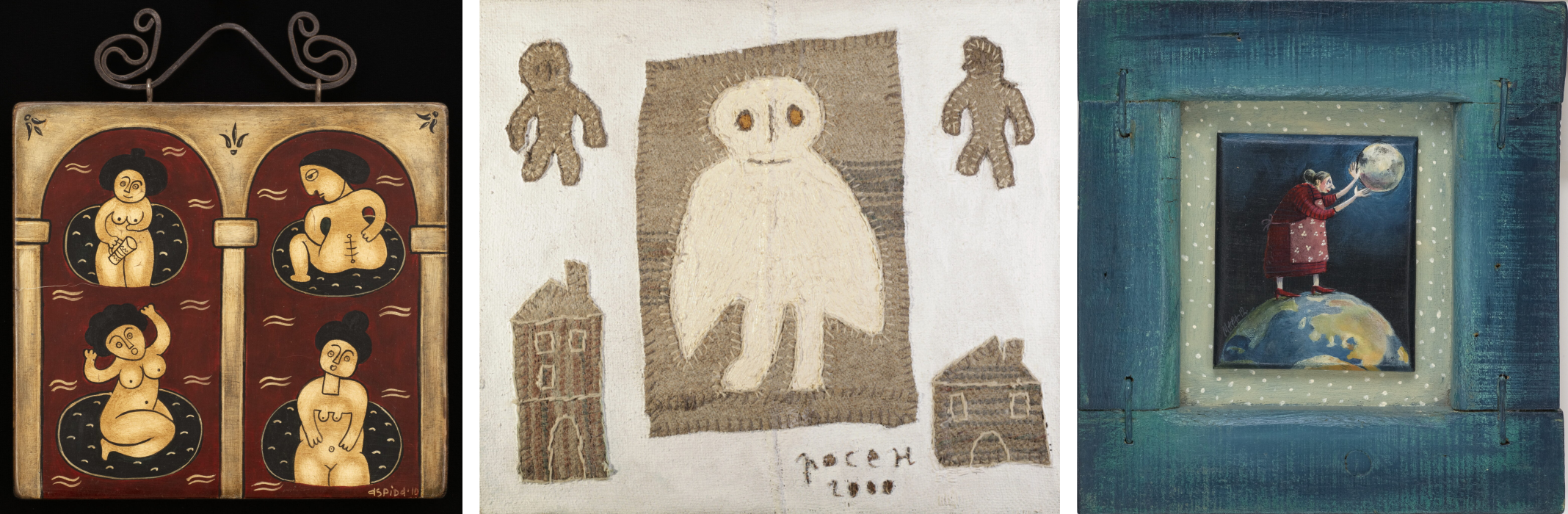
Deformation must have an inner necessity – one must feel that the image could not easily be otherwise, that precisely this form, this colour, this gesture and this scale have found their place in the construction of meaning. Among the most convincing in this skill are Mariela Dimitrova – Mara, Anita Nencheva, Rosen Rashev – Roshpaka, Dimitar Bogdanov, Yordan Dimitrov and Yulia Stankova.
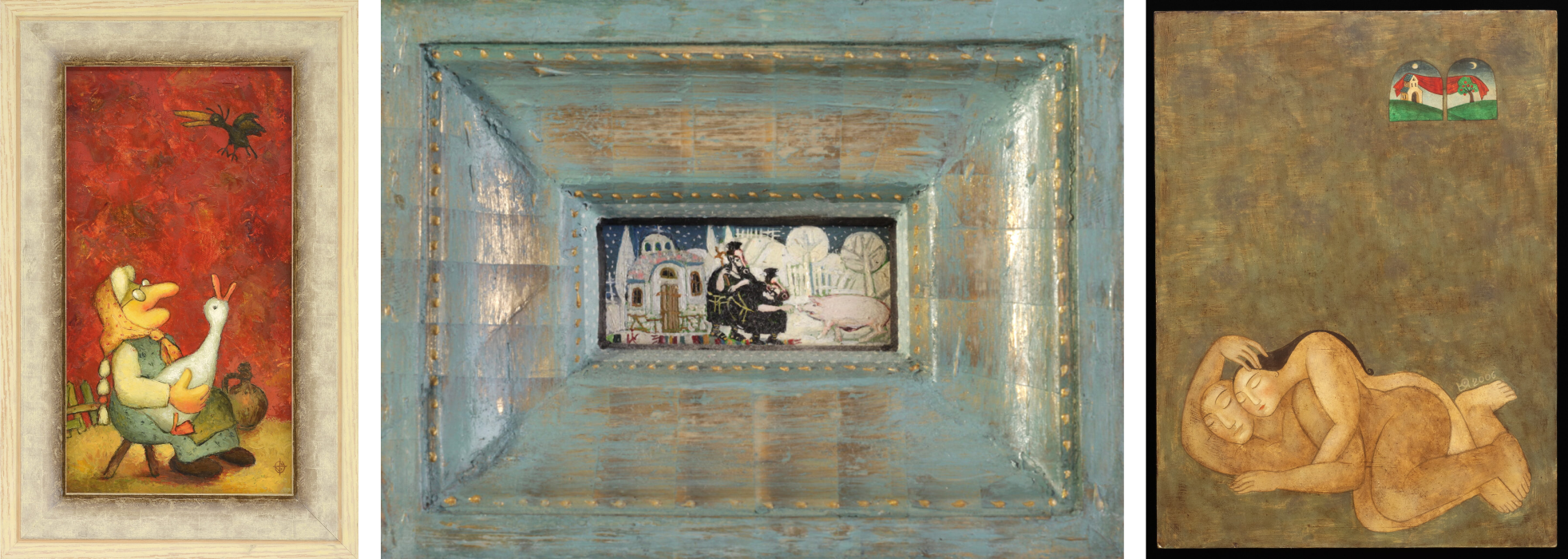
The attitude of the naïve artists in the auction towards the artistic image and towards the world
For some artists, humour is central – from paradox, self-irony and the visual joke to everyday satire and good-natured grotesque. It is characteristic of Mariela Dimitrova – Mara, Anita Nencheva, Dimitar Bogdanov, Alyona Topalova, Rosen Rashev – Roshpaka, Todor Marinov, Yordan Dimitrov and Stoyan Bozhilov.
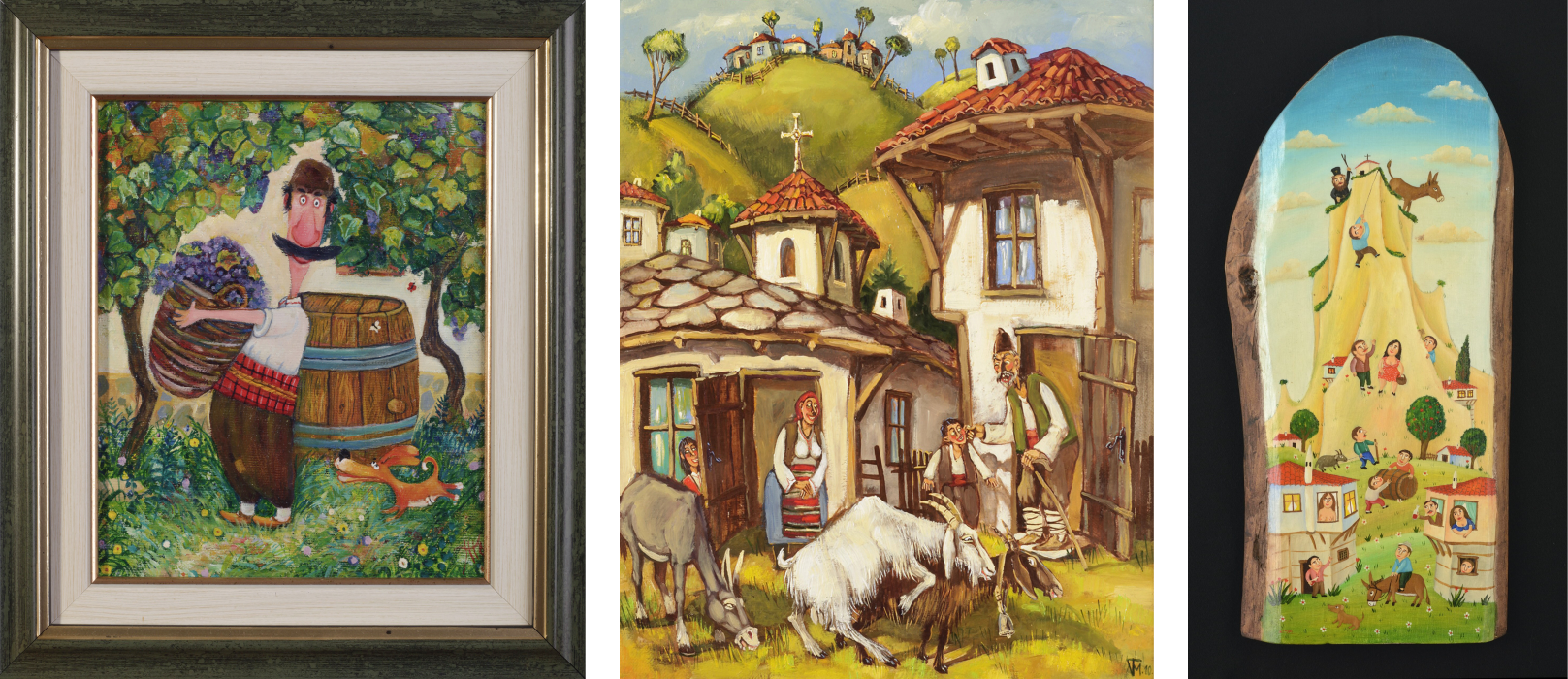
For others, the positive attitude towards the world is stronger – love for the human being, animals, the home, the feast, childhood and the simple forms of communal life. This characterises the works of Rosen Rashev – Roshpaka, Anita Nencheva, Aneta Yalamova, Petar Dimov, Alyona Topalova, Biyanka Nenova, Dimitar Bogdanov, Petar Petrov, Dimitar Vetsin, Milcho Spasov, Iriana Shkodrova, Sevda Poturlyan, Yulia Stankova, Todor Marinov and Stoyan Bozhilov.
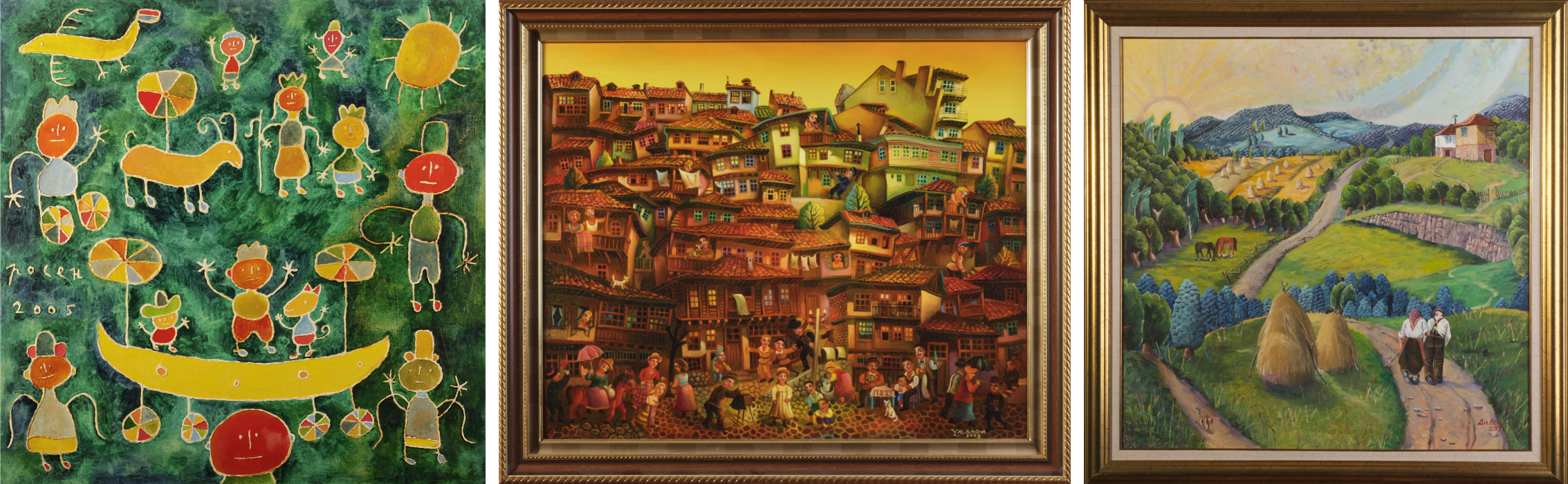
A significant part of the works engages with primary images and driving forces: the body, the couple, the family, the animal, love, sin, God. These themes are a central interest for Anita Nencheva, Rosen Rashev – Roshpaka, Alyona Topalova, Hristo Kralev, Yordan Dimitrov and Ivan Stoyanov.
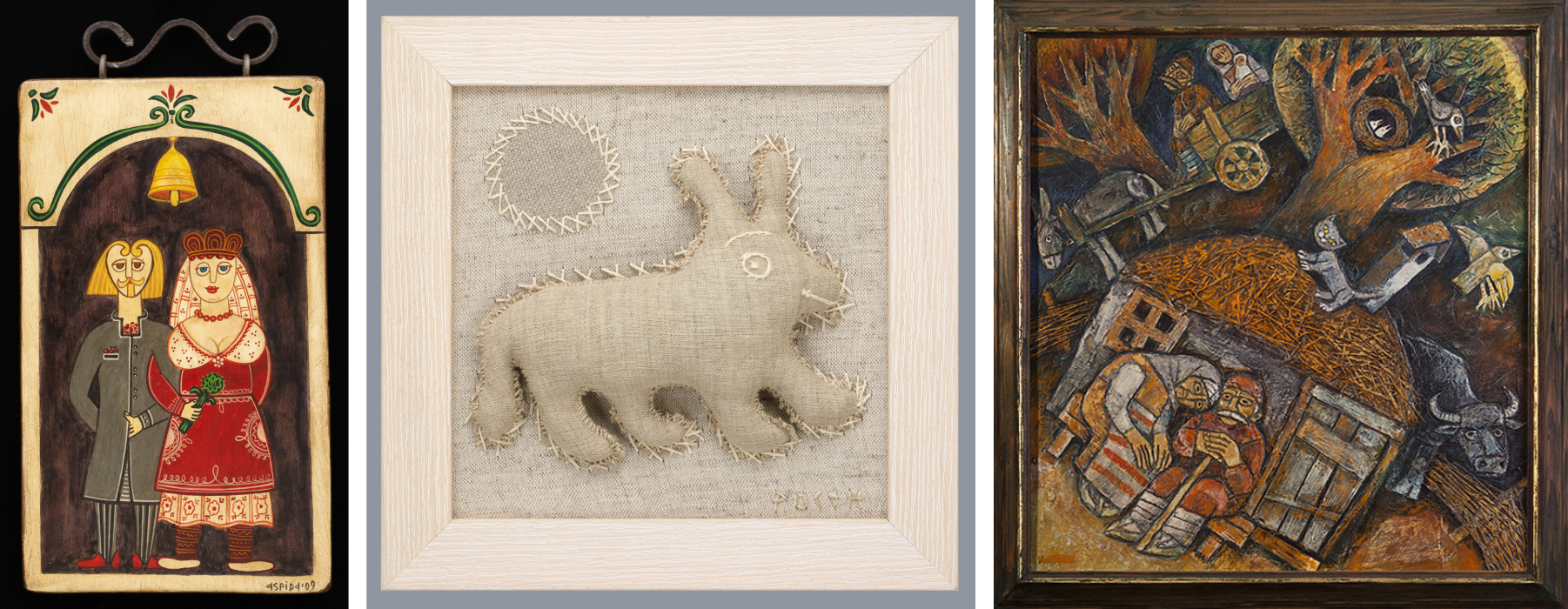
For some artists, objecthood and materiality are especially important – old wood, cloth, stitching, relief, the frame, the found object, all of which are part of the meaning of the work. These are typical of the artistic worlds of Anita Nencheva, Mariela Dimitrova – Mara, Rosen Rashev – Roshpaka, Aneta Yalamova, Todor Marinov, Iliyana Doncheva, Penka Ilieva-Choriya, Rumen Malchev – Sokop, Iriana Shkodrova, Yordan Dimitrov, Petar Dimov, Ivan Stoyanov, Rosen Krastev, Kiril Mitovski and Stoyan Bozhilov.
In other cases, the fairy-tale and the fantastic come to the fore – worlds in which childhood memories of the village, of the Bulgarian National Revival or bourgeois town, folklore, Christian symbols, animal-characters and the childlike imagination are freely interwoven. This is true of the worlds of Aneta Yalamova, Alyona Topalova, Petar Dimov, Rosen Rashev – Roshpaka, Sevda Poturlyan, Rosen Krastev, Kiril Mitovski, Iliyana Doncheva, Stoyan Bozhilov, Dimitar Kostadinov – Dyuk, Dimitar Bogdanov, Chavdar Valov and Petar Petrov. A personal mythology is built through the art of Rosen Rashev – Roshpaka, Anita Nencheva, Petar Dimov, Sevda Poturlyan, Yulia Stankova, Rosen Krastev, Kiril Mitovski and Penka Ilieva-Choriya.
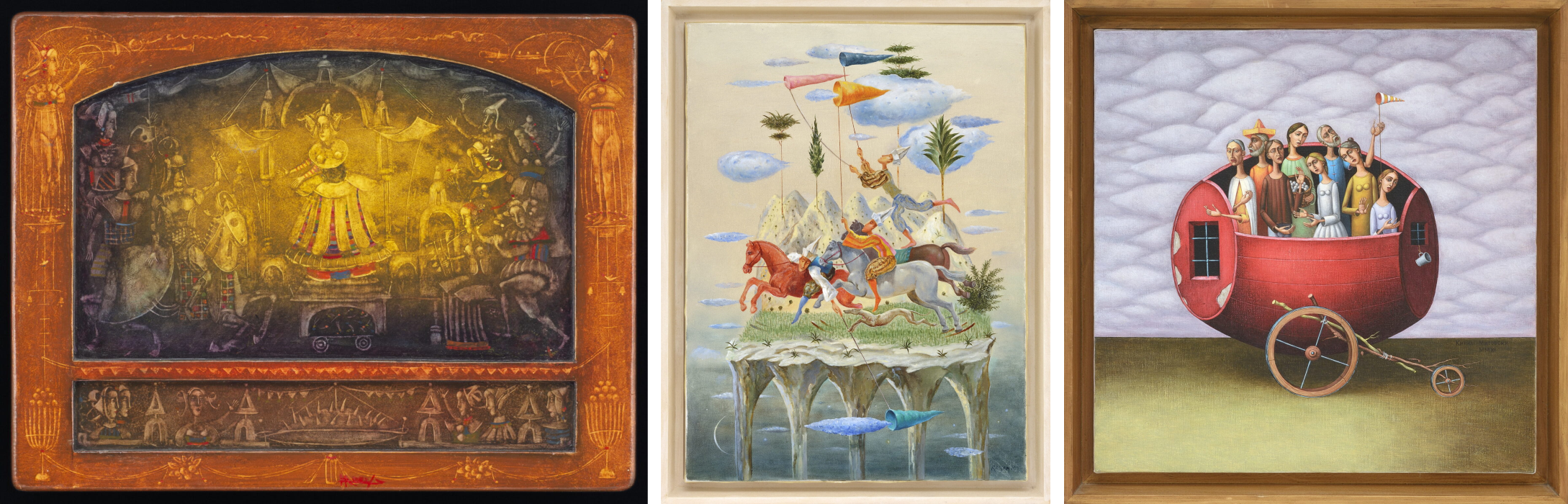
An especially strong line in the Bulgarian naïve art is the folk-national and the patriarchal – the traditional village, the home, kinship, the feast, traditional costumes, labour, patriarchal relations and an idea of communal order. These are central focus for many artists: Dimitar Vetsin, Todor Marinov, Dimitar Bogdanov, Iriana Shkodrova, Yordan Dimitrov, Stoyan Bozhilov, Ivan Stoyanov, Milcho Spasov, Sevda Poturlyan, Zhivko Donkov, Rumen Malchev – Sokop, Alyona Topalova, Aneta Yalamova, Yordan Angelov, Nina Ivanova Donkovska, Nayden Mirkov, Boncho Asenov and Rosen Rashev – Roshpaka.
Christian subject matter is present not only through saints and biblical narratives, but also through folk-Christian ideas of protection, faith and invisible presence. Outside the corpus of icon painting in the auction, the topic engages Anita Nencheva, Yulia Stankova and Rosen Rashev – Roshpaka.
Bulgarian naïve art, as showcased in Enacor’s jubilee auction, reveals itself as a vast visual landscape – between humour and faith, memory and fantasy, the folk-national and the personal.
Naïve art is attractive because of its accessible and, at the same time, multilayered nature. It does not require the viewer to enter it through a complex theoretical door, yet it is not exhausted at first glance. In good naïve works there is narrative, humour, memory, a fairy-tale quality, love for the human being and for ordinary things, which often prove to be the most enduring. For collectors and connoisseurs, a naïve painting may be a joy to look at, a living part of the domestic space and a small world with its own inner logic. The works in this auction offer the possibility of a personal choice – an encounter with images that do not cease to tell stories, to make us smile, to console us and to awaken our childlike way of looking at the world.
Rossitsa Gicheva-Meimari, PhD
Chief Assistant Professor in the Department of Arts and Design and member of the Bulgarian-European Cultural Dialogues Centre at New Bulgarian University
Bibliography:
Marinska 2023: Ruzha Marinska, Contemporary Bulgarian Naïve Artists. In: Marinska, Osikovska 2023: R. Marinska (author), D. Osikovska (compiler), Contemporary Bulgarian Naïve Artists. Sofia: Kibea, 2023, pp. 5–7.
Marinska, Osikovska 2023: R. Marinska (author), D. Osikovska (compiler), Contemporary Bulgarian Naïve Artists. Sofia: Kibea, 2023.
Nikolova 2025: Suzana Nikolova, Contemporary Bulgarian Naïve Artists. In: Nikolova, Osikovska 2025: S. Nikolova (author), D. Osikovska (compiler), Contemporary Bulgarian Naïve Artists. Part II. Sofia: Kibea, 2025, pp. 7–11.
Nikolova, Osikovska 2025: S. Nikolova (author), D. Osikovska (compiler), Contemporary Bulgarian Naïve Artists. Part II. Sofia: Kibea, 2025.
Osikovska 2023: Даниела Осиковска, Интервю с Мариела Димитрова – Мара. В: Маринска, Р. (авт.), Д. Осиковска (съст.), Съвременни български наивисти. София „Кибеа“, 2023, с. 74-77.
Salon of Naïve Art website: Website of the “Salon of Naïve and Intuitive Art” – https://www.naiveart.eu/ Accessed 7 September 2026.
Salon of Naïve Art Events: Events of the “Salon of Naïve and Intuitive Art” – https://www.naiveart.eu/%d1%81%d1%8a%d0%b1%d0%b8%d1%82%d0%b8%d1%8f/ Accessed 7 September 2026.
Product has been added to cart