Taner Mert: the art therapy of resounding painting
“Sofia–Istanbul: bridge of art. Artworks with Stories”,an exhibition by Enakor...

A compendium for arts and antiques enthusiast
“Sofia–Istanbul: bridge of art. Artworks with Stories”,
an exhibition by Enakor Auction House
4 Dec 2025 – 3 Jan 2026 at the Union of Bulgarian Artists Gallery, 6 Shipka St.
Tanerism: the joy of the visible
Taner Mert paints the way children love life – with brightness, sincerity, and delight in every dot. His colours hide nothing, his forms do not pretend to be anything else, and the surface makes no effort to create depth. Everything is visible – and precisely for this reason, it is powerful. Tanerism is painting without doubt, without theoretical noise, without the need for justification. This art wants to be beautiful and bring joy – without apologising for it. The artist’s hand does not follow an academic model but paints as the heart wishes – intuitively. His technique, based on fine relief and the use of the palette knife’s tip, creates a vibrating surface that resembles textile – as if each painting were embroidered with dots, threads, and pulses. This textile effect lends a decorative quality and a certain corporeality to the images: the surface of a flower becomes skin, a cat – living flesh, a window – a warm facade that has breathed in the sun.
In addition, although Taner Mert describes himself as a commercial painter, he creates a world where the market does not displace art but lets it shine through what is beloved. This is possible because he relies on perception rather than concept, code, or complexity. This is art for the eyes, the hands, the taste, and the pleasure – for what needs no explanation. It can be appreciated just like that – without defence, without intellectual scaffolding. That takes no less courage than any radical avant-garde.
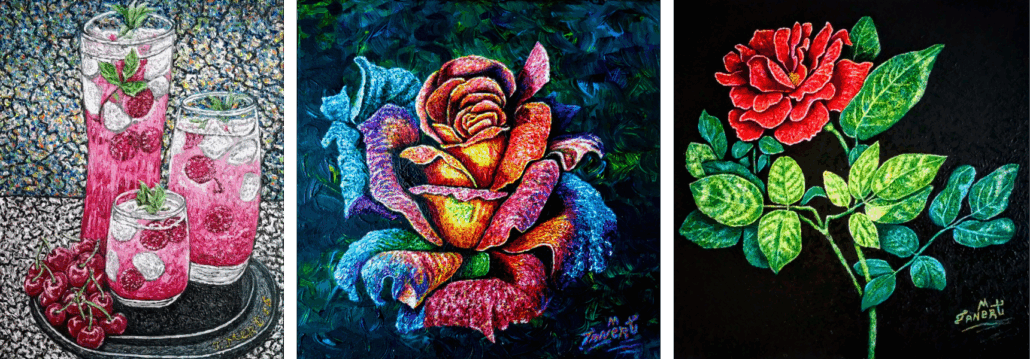
“Cherry lemonade freshness”
In this small painting, Taner Mert creates a poem of taste and light. The cherries are not just fruit – they are emotion. Arranged as if on the edge between a table and a dream, they emit a fragrance that can be seen, and a colour that can be heard. Each one shines with its own light – like a tiny bulb filled with sweetness, yet not sugary.
The background is no less captivating than the cherries. The table looks like stony skin – grey and wrinkled, cut through with black contours, like a fragment of earth or an old mosaic touched by time. The wall is more colourful: blue, yellow, and white blend in palette-knife strokes, with orange accents flaring like sparks. It too appears wrinkled like stone, yet also like living tissue – organic, pulsating. This chromatic vibration in the background makes the cherries shimmer, as if they crunch even before being touched. There is no heaviness, no shadow, no nostalgia – only pure, fresh joy from the here and now. In this way, the “still life” stops being a frozen arrangement on a table and becomes a whole world of surfaces poised between the mineral and the organic. Within this environment, the glasses filled with cherries, ice cubes, and mint leaves are more than a drink – they are an alchemy of the senses: taste, touch, coolness, aroma.
Taner’s technique – pointillist, almost textile-like – brings the surfaces to life. Each cherry is a structure made of light and time. That makes the composition not a still life in the classical sense, but a painted portrait of pleasure – of a summer that has not been described, but devoured. The canvas is like a toast to life. There is nothing here to interpret – and that is the secret. This is a painting that does not ask to be understood, but invites you to taste it and then to say: “One more, please.”
The two roses
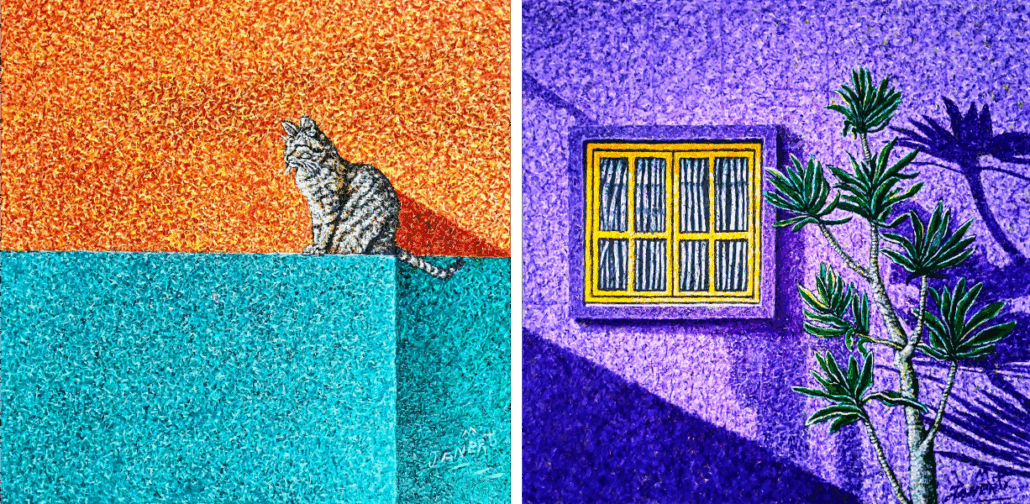
“The rose of dreams” is not from a park, but from a dream. It has bloomed not in soil, but in memory. Taner Mert transforms the flower into an essence that vibrates beyond botany. There is no stem here, no leaves, no vase. There is a form floating in colour, like a dream remembered only through the senses. Its centre is warm – orange, yellow, red, shifting into purples and violets, while its edges fade into blues and greens – like a flower recalling the rainbow. Taner does not aim to depict a botanical rose, but an emotional one – the kind that appears behind your eyelids when you are in love or returning to something lost. Its petals seem made of light, as if glowing from within, layered like memories you do not wish to disturb.
The background is unusual for Taner’s style – not built from pointillist marks, but from broad, rectangular, and curved brush movements. The colours are dark – deep blues and almost blacks, dark greens, with rare flashes of yellow-green that create a sense of depth. This background evokes a nocturnal atmosphere, like an inner garden that opens only when the eyes are closed. The rose is not part of a bouquet, nor placed in context – it stands alone, central, dreamt. There is something utterly simple within it: a gesture of affection. The flower is a message, offered with all the colourfulness of someone unafraid of being liked.
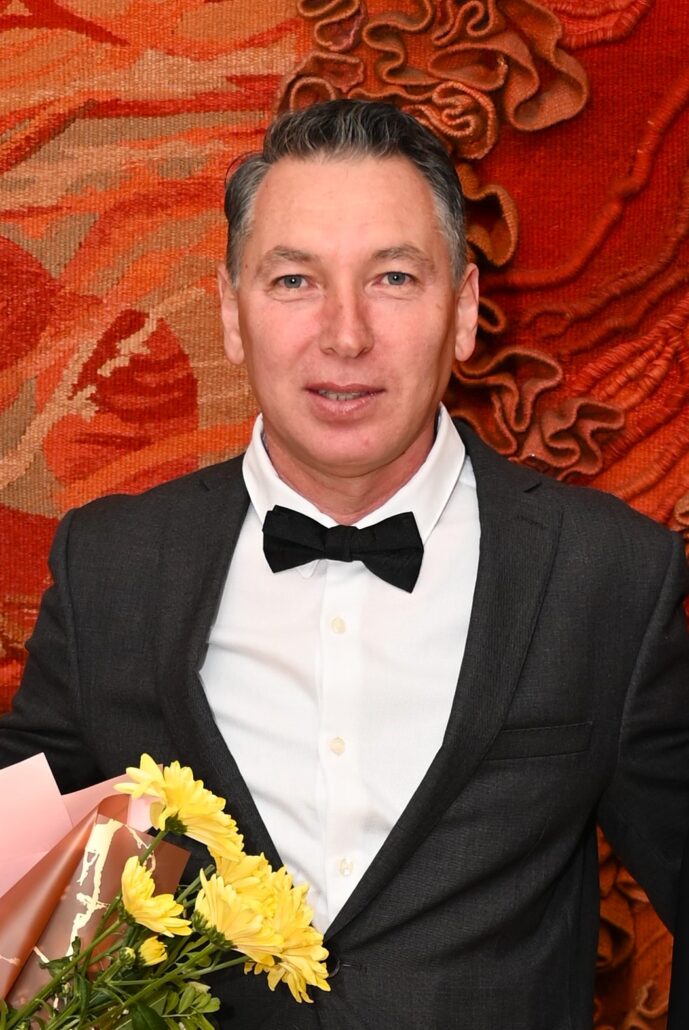
Another rose appears in the exhibition – “The secret of the red rose”. It is the other side of the dream: clearer, more literal, more forceful. Painted in saturated red and surrounded by well-defined green and blue-green leaves, it has a stem, leaves, and a stark black background – like an emblem, a sign. If “The rose of dreams” is an inner image, “The secret of the red rose” is an icon. There is a space unfolding between the two paintings – stretching from lived experience to imagined presence, from the soft to the definite. Within it, Taner places the viewer to choose the rose that resembles them.
The rose is among the oldest symbols across cultures, eras, and beliefs, most often associated with love and immortality. In contemporary art, it frequently echoes as a multivalent symbol, one that may refer to, contrast with, or transform these traditions. In ancient mythology, it is the flower that sprang from the blood of Adonis – a sign of love that surpasses death. In Thracian mystery cults and funerary rites, it is linked to the transition to the afterlife and the idea of immortality. In Christian tradition, the rose is dedicated to the Virgin Mary, combining purity and suffering, earthly love and heavenly grace; the red rose symbolises Christ’s blood, the white – death and virginity. In Byzantine and Orthodox contexts, it weaves into the iconography of virginity and mercy.
In Islamic culture (which is especially significant for the artists in this exhibition) and particularly in Sufi poetics, the rose is regarded as an expression of Divine love, spiritual beauty, and even as an image of the Prophet, encompassing his presence, spirit, and fragrance. It is called the “flower of heaven” not only for its beauty, but for its role in expressing the unseen through the sensory. In Taner Mert’s roses, this profound symbolism is refracted through a childlike gaze and a naive sensitivity, becoming a sign of sincerity, joy, and intimate spirituality.
“Shadows and feline reflections”
At first glance, this is simply a cat against a two-colour background. But what a cat – and what a background! Sitting right on the boundary between two colours – hot orange and cool turquoise – the cat is not only observing, but dividing the worlds, οr perhaps uniting them.
The background is built entirely of Taner’s dots – hundreds, thousands, millions, like pixels on canvas that create a sense of light, flicker, clicking. The upper half is bright orange, full of sun, life, noise, and warmth. The lower half is in blue tones, from pale turquoise to deep sea green, evoking silence, trembling water, and coolness. In this texture there is life, vibration, energy – as if the painting itself quivers and breathes.
The grey cat is the only figure painted with strokes as well, which makes it appear even more real and alive. It sits on the edge between two colour realms – like a sage, a meditating soul, a boundary philosopher who understands both sides but belongs fully to neither. Sitting in perfect stillness, facing the sun, it is not merely watching – it embodies observation itself, poised between warmth and chill, between sleep and wakefulness. It seems to know it is the centre of the world and has no need to prove it.
Its shadow – long, reddish, diagonal – is no less important a character in the composition. It does not indicate the time of day, but the inner time of contemplation. The shadow says: there is a cat here, but there is also thought. Moreover, that thought stretches, reflects, and becomes presence. It is unclear whether the cat is thinking, dreaming, or simply existing, but Taner has captured it in this precise threshold moment of absolute self-sufficiency. The artist does not construct a plot, but leads into a state of mind, where the spirit has feline whiskers, a diagonally hanging tail, and a shadow that philosophises. The painting does not tell us what to feel – it invites us to sit a while with the cat, to fall silent, to perch on the edge, and to contemplate.
In Islamic tradition, the cat is considered ritually clean and is allowed into homes and even mosques. It is associated with blessing and with the example of the Prophet Muhammad, as told in stories of his gentleness and respect for his beloved cat. In Istanbul, this connection has evolved into a shared sentiment – cats are not seen as stray, but as fellow citizens. Charitable foundations for their wellbeing have existed since Ottoman times. They are a symbol of compassion and urban memory, deeply embedded in the setting of the Old City – its streets and mosques. Taner Mert’s cat stands with the same dignity that Islamic culture has granted the cat in homes and mosques – with self-possessed calm that seeks no attention, but always receives it. Just as in Islamic tradition, the cat peacefully inhabits sacred space, so in Taner Mert’s work it appears as a natural dweller in the childlike universe – gentle, alert, and full of mysterious life.
“Melody in yellow and purple”
What is a melody in a painting? Perhaps this: repetition with variation. In this composition, Taner Mert explores rhythm through visual elements – curtains, lines, shapes, shadows – that play like a visual score, performed with a light and precise hand. The yellow window is the central instrument. It is made up of rectangles repeated with almost mechanical precision – yet inside them, the black-and-white lines of the curtains vibrate like strings set in motion by light. All the folds are even and parallel – except one, which is slightly tilted. And in that tilted “D”, the painting begins to sing. That is the note that makes the composition musical – the improvisation that gives it life.
The entire surface of the wall is covered in Taner’s dots, vibrating in shades from violet to purple, creating both depth and lightness. Upon this sounding wall falls a deep triangular shadow, like a diagonal chord that divides the canvas into a light and a dark zone – two different tones entering into harmony.
In addition, the palm is the counterpoint – green, rhythmic, organic. Its leaves are curved and spread in different directions, yet all obey an inner order, like a conscious improvisation. The trunk and branches evoke drumbeats or the whisper of percussion, and their shadow on the wall echoes their movement like the reverberation of a musical phrase. It is not a background but a reply in dialogue. This painting does not tell a story – it plays. There are no figures, no drama, no message – only sound in colour, repetition and deviation, discipline and freedom. And a small “D” in the curtain that turns geometry into life.
The bridges of Taner Mert
In Mert’s paintings, the senses and the arts intertwine with ease – not as a demonstrative idea, but as a natural gesture of perception. His colours resonate; vibrate in rhythm and pulse, in melody. Curtains have tones, shadows carry soundwave lengths. His roses have fragrance, his cherries crunch, the background is a texture one wants to touch – and sometimes even to taste. This art does not settle only for being looked at, because it is felt with all the senses. Here, taste is not just a metaphor, but also a real path to perception – cherry, lemonade, summer. Music is built into the composition – in the rhythm of the dots, in the repetition of forms, in the variation that brings life. Taner Mert does not “illustrate” music – he recreates it through painterly gesture.
For Taner, painting began as art therapy and has remained so to this day. He paints every afternoon and late into the night, with headphones and a palette knife. He cannot work without music. He loves French chansons, Italian songs, and remixes of classical music – not just as background, but also as tempo. The tempo sets the speed of the hand, the sound shapes the movement of the paint. Moreover, it shows. His compositions contain rhythm, repetition, improvisation, and emphasis – just like music. His acrylic technique allows for fast drying and an oil-like visual effect, while the pointillist texture created with the palette knife gives the illusion of fabric, light, and vibration. Each painting happens in real time, with its own rhythm – like a live performance, where the painter is both author and conductor. For Taner, painting is an event – a moment of joy lived through the body, through hearing, through the hands. It is an experience that must reach the other in time – hence acrylic, hence the palette knife, hence music. His art thus becomes not just an image, but a gesture of communication – manual, rhythmic, sensory.
In Taner Mert’s work, the sensory becomes meaningful, and the simple becomes transmittable. His paintings do not merely experience the world – they build bridges to it. The flower, the food, the animal, the window are visible signs that lead beyond themselves. The rose, laden with symbolic meaning in Islamic and Christian traditions, becomes in Taner’s hands a gesture of affection – a dreamt image carrying within itself a cultural memory, transformed through personal experience. In compositions like “Cherry lemonade freshness”, food appears as a bridge between cultures – at once Turkish sweetness, childhood memory, and sensory poetry. The space in his still lifes is not a backdrop, but a lived place – a vibrating fabric of light, colour, and matter that remembers. In this sense, Taner also takes part in the exhibition’s theme of cultural memory of space – with close attention to the rhythm of surfaces, to light, to the living architecture of colour. He does not build the world as a symbolic décor, but as a habitat for sensitivity.
The powerful role of light in his painting – as radiance in the roses, as pulsation in the dots, as deviation in the curtain – can be read as an ethical orientation, though not in a dramatic register, but a joyful one: light as pleasure, as generosity, as presence. The musical structure of many of his canvases – rhythm, repetition, improvisation – is not merely a visual analogue of sound, but an inner experience of musicality as an idea. In this sense, Taner Mert is not so much a musical synaesthete as an ideasthete – an artist who does not see music, but thinks through it. This makes his painting part of the theme of interwoven arts – painting, rhythm, gesture, and sound fused into one.
In the exhibition, Mert is a bridge of all senses and perceptions – but especially of taste, scent, colour, and the tactile feel of pleasure. He links art with what is often undervalued – the joy of looking, the delight of living, the humour in objects, and the beauty of the obvious. In a world where contemporary art often insists on being complex, Taner insists on being loved. He does not seek conceptual overload, but sensory and emotional clarity – and for that very reason, his bridge is strong. He connects people to art the way cherries connect to summer, roses to love, and cats to contemplation. His art does not require effort, but response. In his world, bridges are not hard to cross – they are colourful, fragrant, delicious, and tactile. They invite us to cross them with a smile and a melody.
Rossitsa Gicheva-Meimari, PhD
Senior Assistant Professor in the Art History and Culture Studies Section and member of the Bulgarian-European Cultural Dialogues Centre at New Bulgarian University
Biography of the artist
Taner Mert was born in 1972 in Balchik. In 1989, during the so-called “Revival Process”, he emigrated to Turkey with his family. In 2005, he returned permanently to Bulgaria. He lived in Sofia until 2013, after which he settled in Samokov, where his main creative work now takes place.
His path into art began after taking courses in interior design, when he found inspiration in pop art and the work of Andy Warhol. His first oil painting was sold just 15 minutes after being posted online – a moment that motivated him to devote himself entirely to painting. In his pursuit of a distinctive identity, Mert developed a personal technique of painting with the tip of a palette knife on fine-textured relief, which he calls “Tanerism”. His style is often compared to pointillism and evokes the works of Sisley and Seurat.
To date, Taner Mert has held more than 25 solo and group exhibitions across Bulgaria, including in Samokov, Sofia, Plovdiv, Burgas, Ruse, Sliven, Blagoevgrad, Vratsa, Balchik, Peshtera, Dupnitsa, and others, as well as a presentation at the Hilton Hotel in Sofia. His paintings are part of private collections in the USA, Italy, the Netherlands, Switzerland, Qatar, Germany, Austria, Hungary, and Turkey – some of which belong to well-known individuals. One of his most dedicated collectors in Germany owns about 20 of his works, while a collector in Italy holds over 15.
His artistic ambition is bold – to become a Bulgarian artist whose paintings are valued in the millions on the international art scene.
A story from the studio
I don’t paint without music. It’s part of the process itself – just like the paints and the palette knife. I listen to all sorts of music, but never pop-folk, Serbian turbo-folk or anything like that. I love French chansons, old Italian songs, and above all – classical music in contemporary remixes. They give me energy and set the mood. If I need to work fast, I pick something with a higher tempo – it literally speeds up my hand.
I usually paint in the afternoon and continue late into the evening. For the past few years, I’ve used only acrylic paints. They dry quickly, which helps me not keep people waiting when they want to purchase a piece. I have a favourite brand – Reeves. The effect is similar to oil paints, but the texture is better suited to the palette knife I work with.
Lately, I can hardly keep up. Almost everything sells immediately – this month I finished three paintings, and they’re already gone. In addition, my technique is not a quick one. I typically complete three canvases per month, around 50×70 cm each.
Taner Mert
Product has been added to cart