Pavlina Kopano: the fragment as memory
“Sofia–Istanbul: bridge of art. Artworks with Stories”,an exhibition by Enakor...

A compendium for arts and antiques enthusiast
“Sofia–Istanbul: bridge of art. Artworks with Stories”,
an exhibition by Enakor Auction House
4 Dec 2025 – 3 Jan 2026 at the Union of Bulgarian Artists Gallery, 6 Shipka St., 2А
The paintings of Pavlina Kopano do not tell stories. They remain silent. But it is not an empty silence—it is a heavy, material silence, the kind that remains when life has passed through and left its traces: pressure, stains, holes, edges, flaking, fractures—layers of voiceless memory. There are no figures, no narrative, no action, and yet there are traces of inhabitation—of people, of time, of hands we do not remember by name or face, but feel through the matter itself. Something important once existed in these works, something that has now departed, leaving only the surface it once occupied. These are remnants of a life not painted but preserved. This is painting that engages in the archaeology of surface and fragment: accumulations of colour, traces of brushwork, a grainy texture that evokes not a picture, but an object—a piece of reality torn out and held up for contemplation.
The painter works not with sound, but with weight; not with motion, but with touch. Her colours are earthy and corporeal, though at times they shimmer in blue tones. Her forms are strictly geometric—within the spheres they are centred and monolithic, while in other works they are segmented, rhythmic, constructed from intersecting planes and straight lines. Yet this geometry never serves a decorative function. Within the forms, one recognises fragments of interiors: the edge of a table, a metal handle, a floor surface, a beam, a stage-like space, a frame—but not as whole objects, rather as structural fragments. They are hinted at through parts—pieces, edges, lines—seen up close, as if the artist zooms in on the very substance of the object without revealing it entirely. This is painting of the fragment that does not lead toward the whole, but deliberately conceals it—leaving it as a mystery that keeps the essence inaccessible.
Kopano treats the fragment as a form of memory—not as deliberate reconstruction, but as reconstitution through touch and trace. In her painting, matter is stronger than image. She works with what remains when the stories have left—but the surface still remembers.
This act of remembering is no coincidence. Pavlina Kopano is an artist with a dual biography—a Bulgarian who met her future husband (a Constantinopolitan Bulgarian) in Istanbul and through him discovered the existence of an ancient, quiet, yet still living Bulgarian community in Turkey. At the same time, she encountered numerous Turkish families exiled from Bulgaria who continue to preserve the language, songs, and love for their homeland. From this bidirectional memory arose her series: The Sphere, Silence, and others. They are not merely abstract images, but traces of places marked by the footsteps of both communities—boats, docks, façades, remnants of shared life, in which ethnic identities shifted, but homes, objects, and gestures remained.
Her poetic language becomes especially clear in her Sphere series—metallic, heavy, almost sculptural forms that neither fly nor shine nor move, but sit anchored to a base. They resemble bronze handles, remnants of machines, buttons, and faceless bodies—objects whose purpose is unclear, but whose necessity to someone, once, is felt.
In “The Sphere I” and “The Sphere II”, we see precisely such fragments—iron or bronze balls, heavy and motionless, fixed to a rusted base. From Kopano’s own story, we learn that they originate from the port of Terkos or Kayaköy. They were likely used to moor boats, yet within the painting they are no longer recognisable—abstracted into weighty forms, thick with memory. Each layer of paint on them was not applied by the artist, but by someone who once lived by the sea—someone who battled the elements, repainted, repaired, worked, unaware that they were leaving a mark for the future. In this way, Kopano does not invent form—she extracts presence. Through the accumulation of colour, she restores the silence of ordinary life, with its quiet labours and everyday gestures.
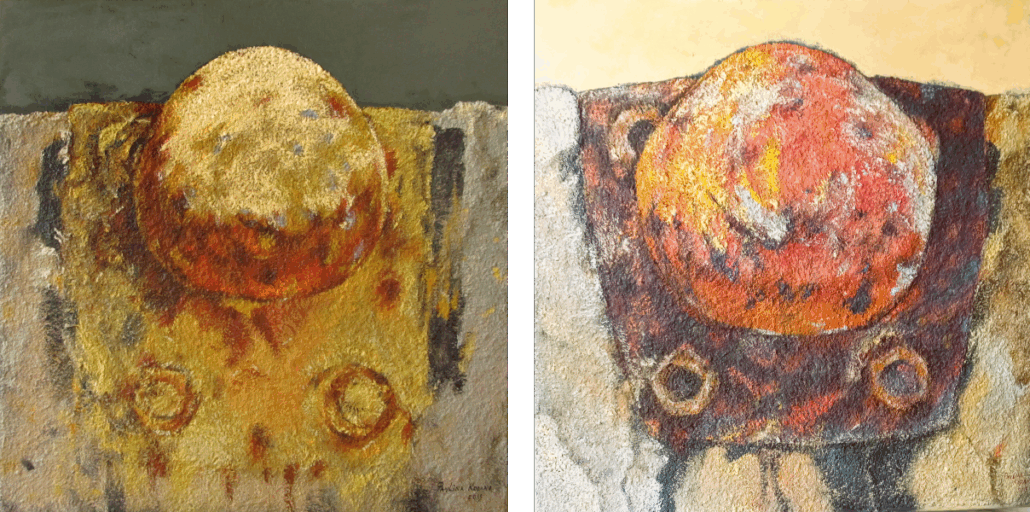
As Kopano herself evocatively recounts: “Old boats, passed from owner to owner, each leaving their mark upon them. The old dock, battered by wind and sea, yet maintained by all the people who lived there and made their living from the water. It didn’t matter what their ethnicity was, it didn’t matter what twists of fate they had endured—they lived in those same places, in the same homes, making a living in the same way, and the traces of their lives are still there. The memory of them is still alive, on both sides of the border.”
“Silence” brings another degree of absence. At first glance, we see a simple composition – a horizontal line, a vertical beam, a dark foundation. However, behind this structure—likely a boat at dock—stands something more. It is a symbol, reduced to its essence: a sign of a place where something once happened, as if a stage set for silence. A black dot in the upper part appears like a memory of an unexpected movement or a lost fragment. The lines are simplified, yet charged with a sense of time—as if the space is now empty, but still remembers the bodies that once inhabited it.
Kopano explains what draws her to these fragments, almost like an archaeologist: “Although they may seem completely abstract, they are in fact real objects I found at those harbours—layers of paint on boats and harbour structures, applied over decades, maybe more. Each layer carries the memory of one of their owners—the touch of the brush and the hand that held it. They speak of the endless, ongoing struggle with the elements for survival—everyday life filled with hard work and small joys, lived by different peoples at different times, in the same homes and on the same boats, at the same dock. And just as the layers of history reveal themselves to us—sometimes even out of sequence—so too does the lowest layer of paint suddenly emerge, revealing the trace of the person who laid it down with care.”
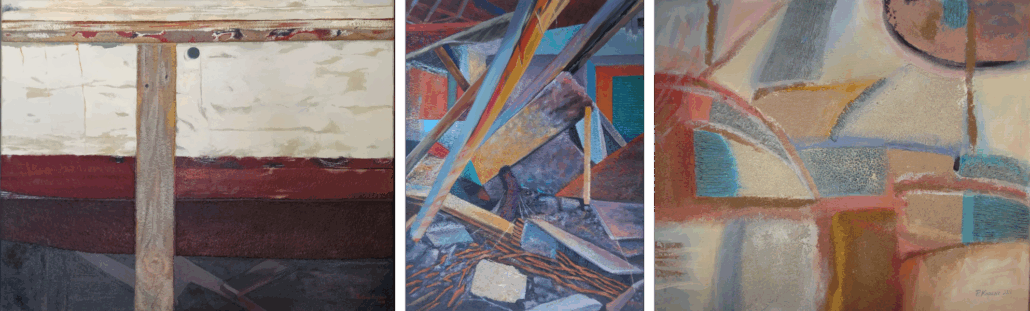
In “Fragments of Forgotten Memories”, the space is no longer a boat or a dock, but a ruined or abandoned interior—perhaps the attic of an old house, with supports, scattered beams, loosened frames, and remnants of hand-painted surfaces. Yet this is not simply a scene of decay, but one of layered lives—traces of presence accumulating one over another. Every tilt, every line speaks of former use, a past arrangement now lost, but still present in the marks left behind.
On the floor lie dried branches, perhaps once grapevines prepared for planting—for new life. It is as if the house, though empty, still remembers the rhythm of the seasons, the care for the garden, the preparations for spring. This detail transforms the scene from static to ritualistic: not just a place, but a bridge between generations—between those who once planted and those who now try to remember.
The painting does not depict a specific house from Kopano’s narrative—such as the “Bulgarian house” in Terkos, now inhabited by Bulgarian Turks displaced from their homeland—but it carries the same spirit. The spirit of a place inhabited by different people at different times, yet preserved whole in memory. In such a place, it no longer matters who lived there last—what matters is that everyone left something behind, and the artist has captured it: in a fragment, a colour, a beam, a branch.
And once again, we return to Kopano’s moving personal story: “But my first encounter with this history was in Terkos – it shook me deeply. I, a Bulgarian from Bulgaria, met in Turkey, on one side, a still-preserved Bulgarian community, and on the other – a large number of Turks from Bulgaria, displaced at various times, who continue to cherish memories and love for Bulgaria and pass them on to their descendants.”
In “Nocturne”, geometry becomes music. The forms are precise, almost architectural, yet they do not compose a structure—they compose resonance. Every shape here resembles a musical value: square, triangle, arch, a shadow of colour—not arranged into a motif, but forming a rhythm of absence. The surface evokes a stone pavement—perhaps of a square, an inner courtyard, or an altar-like space once walked upon by people, bearing light, words, silence. However, it could also be a temple wall—Byzantine, worn by time and prayer—where colour speaks without images.
The title “Nocturne” suggests night music, which is not performed, but is remembered by the space itself. It is not heard, but felt—as an inner symmetry between forms, colours, tonalities, and pauses. In this painting, Kopano reaches the most abstract form of memory—not a story, not a dwelling, but a structure of presence, in which sound, space, and silence coexist.
The following excerpt from Kopano’s personal story resonates with “Nocturne”: “The traces left by ordinary people are not grand stone constructions, but small remnants of a stone fence, the next layer of paint on a boat, and the memories passed down to grandchildren: the words, the names of songs inherited from their ancestors or the old homeland.”
Kopano’s paintings inscribe the fragment into the exhibition’s concept as a particular form of memory-bridge. However, this is not a bridge toward wholeness, nor toward the future—it is a bridge to what once was, to the traces of life that have left their imprint in matter. Her works do not describe a world, but preserve the secret of what has already passed—through the fragment, through the surface, through the weight of silence. Though they may appear voiceless, they pulse with the muted music of absence. In this way, the fragment becomes a bridge to the inaccessible—a gesture of remembering without explanation. A bridge not between the viewer and the viewed, but between peoples, cultures, times, and hands. The paint on the boat becomes an archive, the metal—a voice, the quiet surface—a fabric of memory. Pavlina Kopano does not reconstruct the past—she touches it like an archaeologist, layer by layer, and lets it speak without words.
Alongside the themes of memory and fragment, Kopano’s work also embodies other lines of the exhibition’s conceptual map. One of them is the dwelling as bridge—not only because “Fragments of Forgotten Memories” evokes an abandoned attic filled with remnants of lived life, but also because the artist herself discovers real Bulgarian houses in Turkey—inhabited by others, yet still bearing the traces of those who came before. These homes belong to no single nation. They are guardians of human presence that flows across generations. As a painter, Kopano does not depict these places directly, but embodies their layered memory.
Another essential theme is the woman as a cultural mediator. The artist not only lives between two cultures, but also teaches—passing on knowledge, sensitivity, and art. She inhabits a role in which she does not merely preserve memory, but activates it, transmits it, transforms it into a living gesture. In her paintings and in her life, one senses that quiet yet profound connectedness among the peoples of the Balkans—who, despite political borders and historical traumas, remember the same land, sing the same songs, and look with love toward the places they came from, regardless of which side of the border they were born on.
The boat—one of the recurring figures in the exhibition—appears in Pavlina Kopano’s work not only as an image in her paintings, but also as a symbol of her own path. She does not paint boats that sail, but ones that are anchored, repaired, worn down—yet still capable of connecting. Here, the boat is a bridge of hands—between the hand that once painted it and the hand that now paints its memory; between the person who battled the elements, and the person who now preserves their trace in colour and silence.
Perhaps this very silence carries the ancestral voice — passed down not through words, but through memories, songs, and the gravity of fate. Unknowingly, the artist retraces the steps of her great-great-grandfather: travelling to Istanbul, living between cultures, learning and teaching, walking the same invisible paths. In this sense, her work becomes a continuation of a movement begun long ago—a movement that cannot be contained in a single name, but gathers within it many human names, fused in memory. In this way, ancestral repetition becomes responsibility: to remember, to preserve, to pass on.
Rossitsa Gicheva-Meimari, PhD
Senior Assistant Professor in the Art History and Culture Studies Section and member of the Bulgarian-European Cultural Dialogues Centre at New Bulgarian University
Biography of the artist

Pavlina Kopano was born in 1969 in Dimitrovgrad, Bulgaria. She graduated in Printmaking from St. Cyril and St. Methodius University of Veliko Tarnovo in 1992. Since 2008, she has lived and worked in Istanbul, Turkey.
She has held solo exhibitions in Sliven, Dimitrovgrad, Stara Zagora, Svilengrad and Plovdiv (Bulgaria), as well as in Istanbul (Turkey) and elsewhere. Kopano has also participated in numerous group exhibitions in cities across Bulgaria, including Sofia, Plovdiv, Veliko Tarnovo, Stara Zagora, Haskovo, Razgrad, Sevlievo and others; as well as in Istanbul and Ankara (Turkey); Barcelona, Pasai, San Sebastián and Arguedas (Spain); Monção (Portugal); Hendaye (France); Eisenhüttenstadt (Germany); Shrewsbury (United Kingdom); South Korea, and more.
Stories behind the Works
Story 1
Stories always intertwine and flow into one another. One leads to another, even if it happens much later.
I begin my story with how a chain of coincidences led me to Turkey. While visiting friends in Istanbul, after a long delay at the border, the bus refused to drop me off at the agreed location where I was to be met. I ended up at the bus station, waiting for a friend of my friends—an entirely unfamiliar person to me. That is how I met my future husband, a Constantinopolitan Bulgarian. I had no idea there were still Bulgarians in Istanbul, people who had lived there since Ottoman times. My husband’s family has been in Istanbul for more than 150 years.
He is one of the few members of the community who knows the history of the Bulgarian population not only in Istanbul, but also in Turkish Thrace. It was inevitable that his interest would shape my time in Turkey as well. Whenever possible, we travel to places where Bulgarians once lived. On one such trip to Terkos (a village near Istanbul, on the Black Sea), we decided to ask whether any houses from those times still remained. In the village shop, as soon as they saw us, they said, “The Bulgarian house is up that street,” pointing the way. Clearly, people like us come often. We recognised it immediately—the only old building still preserved. A Turkish woman, a migrant from Bulgaria, greeted us. The house, typical of the early 20th century, had a vegetable garden and was neat and well kept. The woman told us how her family, arriving from Bulgaria, had been settled in the house of the Bulgarians who had emigrated. She went on to say that, descendants of the former Bulgarian residents often came to visit—to see the place their ancestors had come from. In fact, many of the people now living in the village are migrants from Bulgaria. The older generation still speaks Bulgarian. As we walked through the streets, when people heard us speaking Bulgarian, they would invite us into their courtyards to talk. The connection to their homeland was still very strong.
The same thing happened in many other places we visited—nostalgia and a deep warmth toward Bulgaria, passed down even to the next generations.
But my first real encounter with this history was in Terkos—and it moved me profoundly. I, a Bulgarian from Bulgaria, found myself in Turkey, meeting on the one hand a still-existing Bulgarian community, and on the other—a large number of Turks from Bulgaria, who had emigrated at different times but still preserved memories and love for Bulgaria, passing them on to their descendants.
As we walked along the harbours of Terkos and Kayaköy, the idea came to me to create a series of paintings dedicated to those traces of people who had once lived there—traces of times gone by that still remain. Old boats passed from owner to owner, each one leaving their mark; the old dock, weathered by sea and wind, yet maintained by all the people who had lived there and made their living from the sea. It did not matter what their nationality was, nor the twists of fate they had experienced—they had all lived in these places, in the same homes, making a living in the same way, and their traces are still there. The memory of them is still alive—on both sides of the border.
Three of the paintings in this exhibition are from that series: The Sphere I, The Sphere II, and Silence.
Although these works may appear completely abstract, they are based on entirely real objects I discovered at those harbours—layers of paint on boats and harbour structures, applied over decades, perhaps even longer. Each layer carries the memory of one of their owners—the touch of the brush and the hand that held it. They speak of the unending struggle with the elements for survival—of daily life filled with hard work and small joys, lived by different peoples, in different times, in the same homes and on the same boats, at the same dock. Moreover, just as the layers of history reveal themselves to us—sometimes even out of sequence—so too does the lowest layer of paint suddenly emerge, exposing the trace of the person who laid it down with care.
The traces left by ordinary people are not monumental stone constructions, but small remnants: a stone fence, another layer of paint on a boat, and the memories passed on to grandchildren—the words, the names of songs handed down from their ancestors or from the old homeland. It reminds me of an old man selling herbs near the Dupnisa Cave who once said to us: “We came from the Rhodope Mountains at the start of the last century, the whole village. The old ones still speak our way; the young ones no longer know the language, but they sing the songs and dance the dances.” He told us how there used to be a Bulgarian village near the cave, but his people settled higher up in the mountains. All that remains of the old village are a few moss-covered cornerstones, hard to find. Yet, the traces preserved in family memory are passed on through the years.
Story 2
Over the years, while researching the history of my family from the Rhodope Mountains—from the village of Dolno Raykovo—I discovered that my great-great-grandfather, who was a fabric merchant, used to travel regularly to Istanbul and even reached Izmir. A member of our family who graduated with honours from the Bulgarian High School in Edirne became a teacher at the Bulgarian School in Constantinople. Later, he also taught in Thessaloniki. Strangely enough—or perhaps as fate would have it—I seem to be following in his footsteps. Perhaps it is some unfinished mission. Today, I teach visual arts at the Bulgarian Sunday School in Istanbul. Even without knowing it, we walk in the footsteps of our ancestors.
In the Balkans, destinies are so deeply intertwined and interconnected. The peoples of the region have lived together for centuries, in the same places; cultures have blended without losing their identities. Despite the upheavals of history, goodwill has endured among ordinary people—perhaps because, at some profound level, we know that we are all children of the same land, inheritors of many shared histories before us.
Pavlina Kopano
Product has been added to cart