Ferit Yazıcı: sculptures of stripped identity
“Sofia–Istanbul: bridge of art. Artworks with Stories”, an exhibition by...

A compendium for arts and antiques enthusiast
“Sofia–Istanbul: bridge of art. Artworks with Stories”,
an exhibition by Enakor Auction House
4 Dec 2025 – 3 Jan 2026 at the Union of Bulgarian Artists Gallery, 6 Shipka St.
The sculptures of Ferit Yazıcı are internal architectures – tense constructions of forms, materials, and ideas that give shape to states of mind. Although he is a sculptor by education and by way of thinking, his master’s and doctoral research is dedicated to the relationship between sculpture and architecture. As a natural consequence of this, his works resonate with architectural principles – balance, tension, and spatial wholeness. His interest in design and scenography is evident in his precise compositional thinking. Yazıcı thinks with the logic of an engineer but works with the sensitivity of a philosopher. His pieces are conceived as systems in which every tension, every rope, and every surface matters – not only aesthetically, but also existentially. They do not seek beauty, but truth: about the limits of the mind, the strength and fragility of desire, the tensions between dream and reality. Their rational geometry shelters an unexpected contemplative and psychoanalytic depth. This is art that does not speak loudly – yet it is full of hidden voices.
“Dream I”
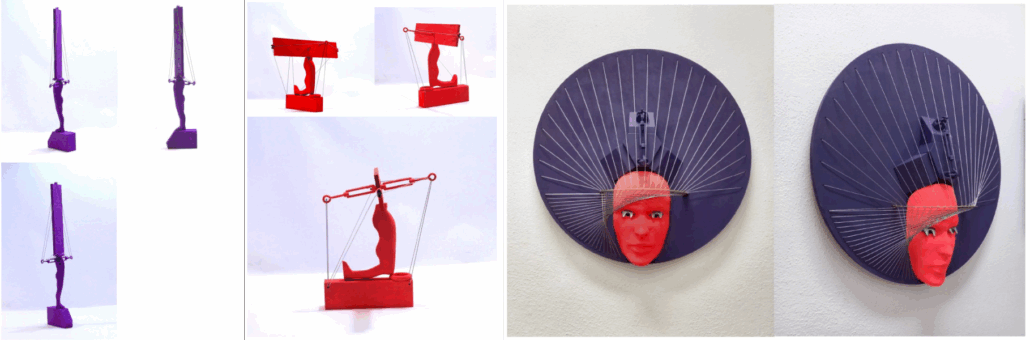
In this sculpture, the face is absent, but the idea is present. The head is replaced by a tall, narrow block – a “mast” pointing upwards, which the artist defines as indicating “the horizon of the mind.” The body stands still, arms outstretched like metal chain prostheses, in a pose reminiscent of a crucifixion. Instead of expressing momentum, the figure is frozen between two forces – the idea of rising upwards and the reality of being bound to the polygonal base block. If it moves forward, it will collapse down the slope.
The ropes play a central role: they connect and hold the elements in this pose, yet lead nowhere. The dream the artist speaks of is not present as lightness or flight. It is halted in the structure, immobilised in a fragile balance. The higher the mast, the more unattainable becomes the dream “to be captain of the seas hidden within myself.”
Here, the dreamer is not sailing. He hangs with terrifying weight, and the dream leaks away. “The firmer my mast, the more fluid my dream.”
“Dream II”
The figure in “Dream II” carries no trace of movement, but rather of submission and humiliation. The head is absent, replaced by a horizontal wooden plank bound with ropes – a form that may also evoke a medieval pillory, a typical punishment device forcing the body into degrading immobility. The arms are also missing. The chains from the previous sculpture are positioned perpendicularly to the plank, as if nailing it in place.
The body’s posture may suggest kneeling or sitting, yet neither interpretation is unambiguous. The feet are bent and twisted backwards in a way that makes walking impossible and calls the figure’s stability into question – as if the dream itself were misconstructed. The lifebuoy beneath the figure signals the theme of the sea but offers no escape. It is merely a cushion to soften the weight, not a vessel for sailing.
The ropes bind the body, the head, and the base in a static equilibrium that allows no movement. If in “Dream I” the dream of being captain of one’s inner seas is immobilised, here the hope “to be captain of the strength hidden within myself” is suffocated, crushed under excessive construction.
The tension between the “rigid plank” and “hope” is resolved in favour of the former – hope leaks away: “The firmer my plank, the more fluid my hope.”
“Oracle II”
This sculpture now has a face. Shaped like a woman’s mask, it appears both human and inhuman — as if it has assumed a foreign role or is performing in front of a mirror. The face becomes an image of the inner self: “every rope, every form reminds me of my inner balance and conflicts… a space that reveals the map of my inner world.”
The metal grid that once covered the eyes is now lifted like a curtain. We see the face — but it does not see us. From its eyes emerge spikes resembling masquerade fangs — a parody of vision: not an inward gaze, but blades turned outward.
A spherical crown weighs on its head, reinforced at the centre with blocks and chains — reminiscent at once of a pharaoh’s crown and a technological interface. It is both crown and helmet — as if the face is plugged into a control system. The shape of the central structure resonates with the geometric blocks and shackles from “Dream I” and “Dream II”, but here we see not a shackled body, but a shackled head — with ropes extending from it like mental threads, pulled taut in tension around the entire circle of the crown-helmet.
If “Dream I” and “Dream II” present a monochrome, vertical, faceless body viewed in profile, “Oracle II” shows a two-toned frontal composition — a face within a circle — which, like in dreams, remains silent: “its mask whispers a silent secret.” We look at this silent oracle, yet its mask does not listen — it sees with sharp fangs and murmurs secrets. It holds no answers — only emanation, transmission — like an echo of inner tensions whose meaning remains hidden, as with every oracular prophecy. The mask is a transmitter — a relay — with spikes instead of vision and a crown instead of a mind.
Half a Man – the Whole Truth
The figure modelled by Ferit Yazıcı is always partial – without a face, without hands, or without a torso. It is a “half-man” – an image of the artist’s own sense of rupture after being displaced from his homeland. Migration and emigration, he says, are experiences that erode one’s sense of belonging. In these sculptures – carved as an “architecture of absence” – it is precisely this feeling of forced disconnection and severed identity that is conveyed to the viewer. It is conveyed not through blame, but through the empathy of “sharing and confronting the feeling of incompleteness”.
Those of us who are older know that this is about the rupture of belonging caused by the policy of expulsion, carried out by the communist state in the late 1980s, which marked over 300,000 Bulgarian Turks – our fellow citizens. The figures of Yazıcı have no hands – and it is precisely through this absence that they reach out to us. Not to point a finger, but to offer a bridge – extended like a hand that does not exist. We ought to recognise it as a bridge extended towards acknowledging our collective guilt, and towards the possibility of healing the wounds it has left behind.
The artist shares that his solo exhibition, titled “Veni Vidi Mansi – I Came, I Saw, I Stayed – The Echo of Silence”, which he had been preparing for opening in his hometown of Razgrad this autumn, was an attempt to return not to a geographical place, but to a state of belonging. It was created in the hope that “no one will ever again be forcibly torn from the city where they were born, from their friends, from their memories, and from the values that shape them.”
Ferit’s exhibition in Razgrad, conceived as a return to belonging, was suddenly cancelled just before its opening. Thus, even the silence promised by its title was not experienced as contemplation, but as refusal – and once again – as rupture. This new rejection only confirms the interpretations of Yazıcı’s sculptures in our exhibition: that the return to belonging remains a dream – stretched to breaking point between hope and denial.
In “Sofia–Istanbul: bridge of art”, Ferit’s figures will build their own space and find voice to speak their truth – quietly, yet powerfully: through absence, voids, and removed fragments of the body that carry memory. As the sculptor says: “Every form or void is an echo of what was once abandoned, but never forgotten.”
Ferit Yazıcı’s sculptures highlight a distinct dimension of the themes in our exhibition – the dimension of inner bridges. They do not link cultures and styles, but layers within the self and its deepest fractures., Their bridges are made of ropes, chains, silences, weights, tensions, and absences; they connect the visible with the invisible, the idea with the structure, matter with thought, the pain of trauma with the effort to express it. His bridges are made of missing hands – reaching out with hope toward lost belonging.
While some artists in this exhibition build bridges through colour, sound, or movement, here the bridge is invisible but taut – like a rope holding the balance between “soulful” structure and bodily vulnerability. Ferit Yazıcı’s sculptures are intimate topographies of tension – secluded spaces where the viewer not only observes, but also feels with the entire body in space, because the body in space is a bearer of cultural memory. As the artist says: “Sometimes a person does not return… but the forms return, the voices return, the memories return.”
Rossitsa Gicheva-Meimari, PhD
Senior Assistant Professor in the Art History and Culture Studies Section and member of the Bulgarian-European Cultural Dialogues Centre at New Bulgarian University
Biography of the artist
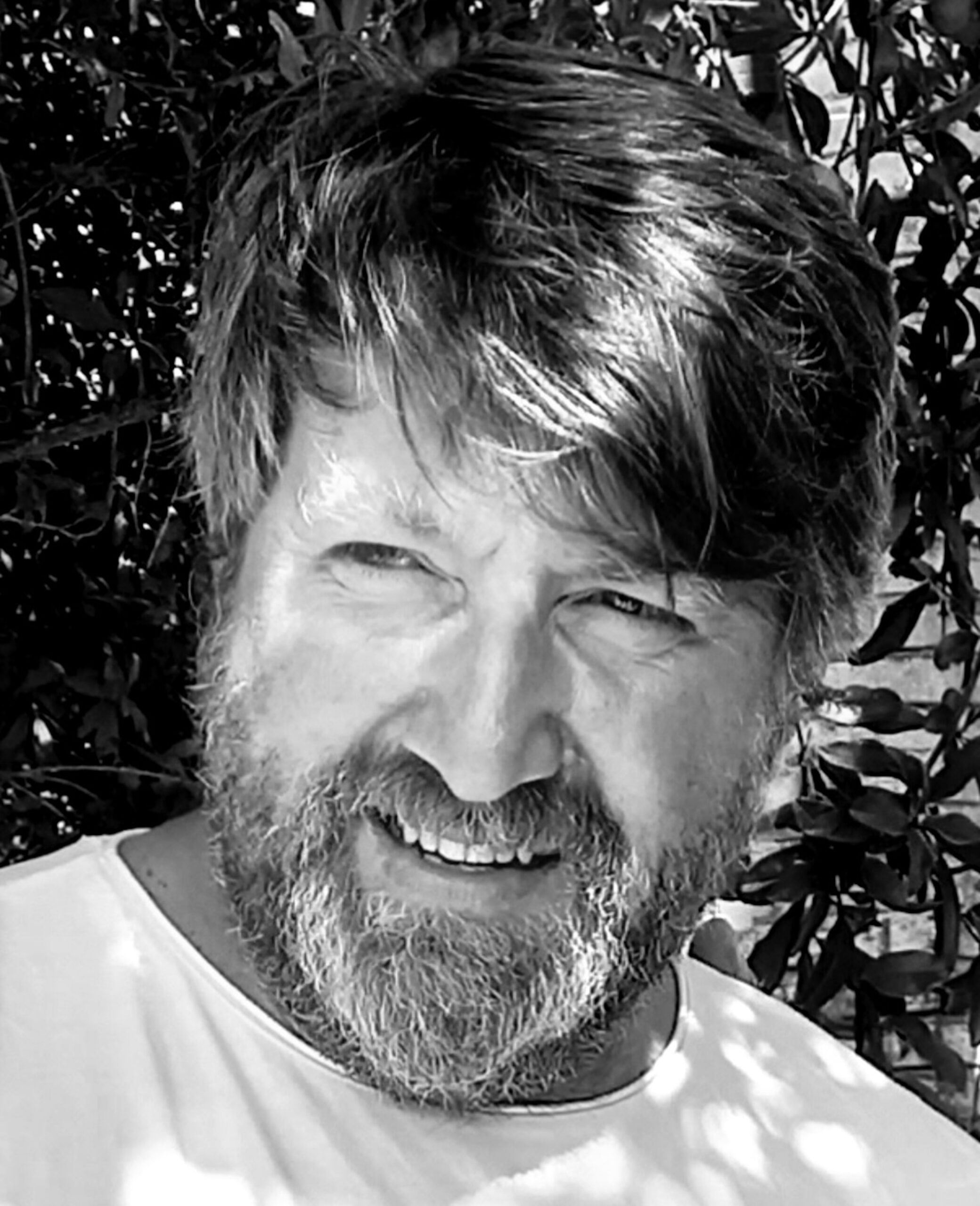
Ferit Yazıcı was born in 1972 in Razgrad, Bulgaria. In 1999, he graduated with a degree in Sculpture from the Faculty of Fine Arts at Hacettepe University. In 2001, he began working as an assistant in the Department of Sculpture at Akdeniz University. In 2008, he completed a master’s thesis titled Constructing Space and Its Relationship with Architecture in 20th-Century Sculpture at Mimar Sinan Fine Arts University. In 2016, he obtained a doctoral degree in Art with the dissertation Architectonic Sculpture at the same university. He is the author of six solo exhibitions and participated in the AMFEK programme in Seoul under the patronage of the Ministry of Culture of South Korea. He has received 15 awards in national art competitions, and his works are permanently exhibited in Turkey, Mexico, South Korea, and Uzbekistan. He is currently an Associate Professor in the Department of Sculpture at the Faculty of Fine Arts, Trakya University in Edirne.
Stories Behind the Works
“Dream I”
Every journey begins with a spark. Mine was the dream of becoming a captain – without ever having set sail. The block rising like a mast pointed to the horizon of my mind, and my body – thin and fragile – longed to be a compass among the waves. The ropes both weighed me down and made me buoyant. Without them, the dream would scatter, the path would be lost. Each time I set off from a different harbour – sometimes it was called childhood, sometimes memory, and sometimes simply an ordinary day. Even if I didn’t know which shore awaited me on the horizon, to venture into unfamiliar waters was the truest form of dreaming – even while awake. “Dream I” is an attempt to be the captain of the seas hidden within myself. The stronger my mast, the more fluid my dream.
“Dream II”
Every journey grows through trial. Mine this time continued with learning how to find strength on my knees. A red slab, fallen from the sky, hovered above my head like a sign offered by fate. The ropes wrapping around my body were no longer an obstacle, but a source of balance; my invisible ties were now a framework of safety. Each time, I detached from something – sometimes fear, sometimes habit, sometimes my own shadow. I didn’t know which direction would open on the horizon, but taking root while on my knees became another name for progress. “Dream II” is an attempt to be the captain of the strength hidden within myself. The stronger my slab, the more fluid my hope.
“Oracle II”
When I stand before “Oracle II”, its mask whispers a silent secret to me. The rising forms exist outside of time, while the taut ropes materialise the tension in my mind. As I gaze at the mask, I become aware of both my hidden and revealed sides; the voids feel like invitations to the unknown. Each rope, each form reminds me of my inner balance and conflicts, starting a dialogue with my soul as I observe. This relief is not merely an object; it is a meditative space that maps the terrain of my inner world. With each new glance, a different story unfolds – I embark on a journey between past and future, the visible and the invisible. “Oracle II” offers me a reflection of my own identity and the many layers of my consciousness.
Ferit Yazıcı
Product has been added to cart