Fahriye Kamber: the choreography of the bird’s gaze
“Sofia–Istanbul: bridge of art. Artworks with Stories”,an exhibition by Enakor...

A compendium for arts and antiques enthusiast
“Sofia–Istanbul: bridge of art. Artworks with Stories”,
an exhibition by Enakor Auction House
4 Dec 2025 – 3 Jan 2026 at the Union of Bulgarian Artists Gallery, 6 Shipka St.
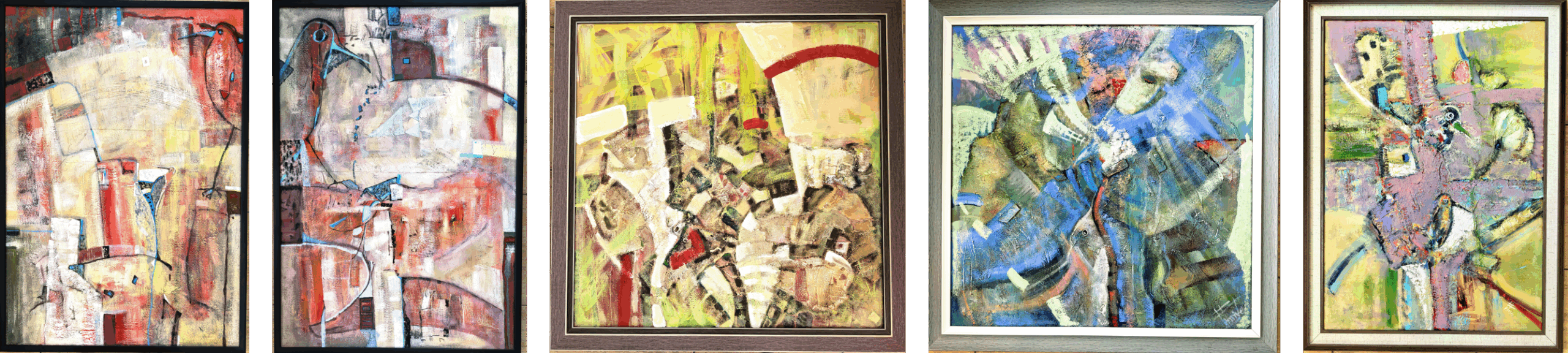
Fahriye Kamber creates abstract art with a recognisable artistic hand – a characteristic perspective experienced as a “bird’s-eye view” of the landscape. Born in Momchilgrad and based in Kardzhali, she draws inspiration from the natural world of the Rhodopa Mountain and the scattered villages nestled within it. In her paintings, familiar terrains are refracted through an inner rhythm and transformed into spaces of ancestral memory, bodily sensation and motion.
In her work, the high viewpoint is not merely a visual or abstract device – it is also poetic, for it sees and acts at once. In the first two paintings of the diptych “Hope I” and “Hope II”, the composition carries discernible traces of landscape – outlines of houses, roads, and fields. In the upper part of the paintings, birds appear looking downward – just as the viewer does: both as an external observer and as a participant.
The Hope series was prompted by the strong earthquake in southern Türkiye – a context that lends the images a deeper resonance. The birds shift from symbols of lightness and freedom to signs of the fragile boundary between ruin and resolve. Hope here is a way of seeing – it envelops everything. Even when the birds are no longer present, their perspective remains. The world we are looking at is a world that still breathes.
Her bird is not merely an image or a metaphor. The artist does not paint it as a witness, but as a messenger – a bearer of something that cannot be expressed in words. In the days following the devastating earthquake, she could not be there – but she could paint. Therefore, she did. In her paintings, the birds look down upon the earth – not to abandon it, but to bring hope to it. Hope that flies beyond borders, beyond language and pain – with eyes of light and wings of tenderness.
In “Gaze“, the birds are no longer present – but their visual perspective remains. Geometric outlines, small squares and arcs create a sense of structure – of a world built from memory and movement. It feels as though we are looking not at a specific place, but at an experience – a space where life has left its imprint. Here, Fahriye moves closer to a more legible vision: a mountain village with clearly recognisable rooftops, narrow streets and courtyards. The main road winds along the terrain and some of the houses turn towards us – as if showing their faces. Above this scene descends a second, contrasting plane made up of long, smooth, light-toned brushstrokes, resembling a curtain being drawn aside to reveal the village. Tied with a red string, it lends material weight to the gesture. The painting acquires theatrical depth – seeing becomes an act: of unveiling, of discovery. In the final moment, the viewer realises they are looking through a window – perhaps from an aeroplane – and that they themselves are part of the composition.
In “Flight“, Fahriye Kamber once again places us in a dynamic perspective – but this time not only as a viewpoint, but also as a physical and metaphysical vortex. The shifting horizon spans a mountainous terrain, cut through by fields and the rooftops of distant, scattered houses – perhaps hamlets. Over this fragmented yet vivid landscape, a whirlwind begins to rise – concentric brushstrokes radiating outward from the centre of the painting, evoking the movement of air in a storm. The bird itself is aimed directly at this centre – not calmly, but as a generator of transformation. It bursts into the painting from below, stirs it from within, sets the air around it into motion. It does not merely observe, but alters. It does not simply fly through, but reshapes the very space in which it flies. It lifts hope from the earth like pollen and carries it across the skyways of the world.
In “Memory“, the birds return – now as bearers of remembrance. The composition is denser, with rich textures and deep layers in which time settles like vibrant colour. The landscape is likely a rural crossroads, surrounded by trees, houses and meadows – seen from several vantage points at once. The birds, trees and buildings are not viewed only from above – we see their full bodies, as though laid flat across the plane of memory, waiting to be read. The painting thus recalls ancient visual systems – such as the depictions of the afterlife in Egyptian tombs – where the truth of form takes precedence over the optics of the viewer. In “Memory”, space is not merely a place, but a memory through which the world is rearranged – not in perspective, but in understanding. Moreover, the colours – especially the purples, greens and yellows – burst like a jazz chord, each tone distinct, yet together forming a consonance. That consonance is both visual and rhythmic – felt with the eye, and with the body.
Music, Rhythm, and Dance in the Paintings of Fahriye Kamber
Kamber’s abstractions are anything but cold. There is rhythm in the forms and pulsation in the brushstrokes. The colours – warm, earthy, accented with blue and red – shift like musical timbres. A sense of polyphony emerges, as the layers overlap and converse with each other. The artist’s own statement that she works with music, dance, and poetry is clearly visible in the visual structure: she composes space like a score, with pauses, accents, and horizons of motion.
This is not music captured from the outside, but music lived from within – through the body of the painter. The rotation of the hand, the tilt of the palm, the gesture of the brush – all are transferred to the painting as a choreography of experience and a choreography of seeing. The dance becomes a visual language, and the painting – a trace of rhythm that is not only seen, but felt with the whole body.
The World of Abstract Landscapes
Fahriye Kamber’s abstract landscapes do not depict a specific location — they offer a model for a world. This is not merely a view from above, but a constructed perspective in which the land is bodily experienced, poetically conceived, and visually reconfigured. The landscape is not a backdrop, but a subject — it thinks, stirs, breathes, remembers. In her paintings, nature and culture intertwine: rooftops and fields, houses and winds coexist — but never in stillness. Everything is in motion — a sensory movement that links the earthly and the inner realm. The landscape becomes a bridge between perception and world.
Within the context of “Sofia–Istanbul: Bridge of Art”, Kamber’s work occupies a unique place — not only for its “bird’s-eye view,” but also for the movement that pulses through her paintings like an inner rhythm. If the senses are bridges between cultures, people, and languages, then in Kamber’s case the strongest among them is movement — bodily, visual, and emotional. The dance in her paintings is not illustrated, but lived — it generates rhythm, volume, direction, and depth. In the brushstroke is the dance of the hand, in the composition is the dance of space, and in the colours — the dance of feeling.
Here, the landscape is not an illustration, but an experience — woven from memory, air, body, and emotion. In this way, it becomes a bridge between nature and culture, between land and imagination, between the intimate and the universal, between pain and hope. In this world, birds are messengers — of hope, of freedom, of the very act of seeing. In Fahriye Kamber’s work, the senses do not simply perceive the world — they create it. Through this deeply embodied visual expression, she builds a bridge — between pain and hope, between the visible and the felt, between what can be spoken and what can only be danced.
Rossitsa Gicheva-Meimari, PhD
Senior Assistant Professor in the Art History and Culture Studies Section and member of the Bulgarian-European Cultural Dialogues Centre at New Bulgarian University
Biography of the artist
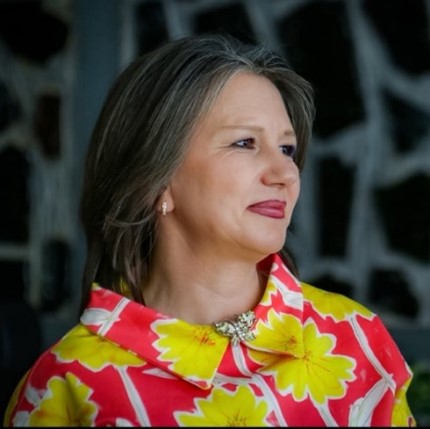
Fahriye Kamber was born in 1976 in Momchilgrad and lives in Kardzhali. She is the daughter of renowned artist Kamber Kamber and has been connected to art since early childhood. Every step in her education brought her closer to her dream of becoming a painter. She graduated from the Vocational High School in Kardzhali (1995) and later earned a Master’s degree in Design, Technology and Textile Engineering from the Technical University in Gabrovo (2000). She is the founder and manager of the fashion studio “KAMBERA.”
Since 1998, she has been actively present on the art scene. She has participated in plein airs and group exhibitions in numerous cities across Bulgaria (Gabrovo, Pleven, Burgas, Razgrad, Kardzhali, Vratsa, Plovdiv, Krumovgrad) and in Turkey (Bursa, Edirne, Konya).
Favourite quote: “Love is art, and art is love.”
The artist and the story behind her paintings
I was born in the Kardzhali region and have lived here in southern Bulgaria all my life, except during my student years. My parents and ancestors are also from this region. My connection to my roots, my family, and my homeland is very deep — it is part of who I am and how I perceive the world.
In my art, I try to express hope, love, and lightness — to convey the positive energy I carry within. Sometimes I express it through colour, other times through form. There is always music playing in my studio. I love poetry and dance — both modern and sport. I also love nature — the connection with it, as well as with people and the environment around me, influences me deeply and often finds its way into my paintings.
During plein airs, I feel a strong impact from everything that surrounds me. That was also the case with the two paintings Hope I and Hope II. I painted them at the same time. Initially, they were created on commission, but something did not go as planned — the paintings took their own path and turned out in my own way. I was deeply affected by the earthquake in southern Türkiye in February 2023 — an experience that left a mark. I titled the works with the word hope because I believe that we all carry hope within us — for ourselves, for others, for the whole world.
Fahriye Kamber
Product has been added to cart