Ertan Alev: The City Dreamed in Music and Haze
“Sofia–Istanbul: bridge of art. Artworks with Stories”, an exhibition by...

A compendium for arts and antiques enthusiast
“Sofia–Istanbul: bridge of art. Artworks with Stories”,
an exhibition by Enakor Auction House
4 Dec 2025 – 3 Jan 2026 at the Union of Bulgarian Artists Gallery, 6 Shipka St.
Ertan Alev has a distinctly recognisable artistic hand, shaped by both visual and acoustic sensitivity. His watercolours evoke a world in which colours often resonate softly, yet with inner intensity. The internal sound does not stem from imitation, but from the direct experience of music as a driving force behind the image. Alev always paints to music. Among his favourite choices are Erik Satie, Chopin, Astor Piazzolla, Turkish popular music, chansons. The influence of music on his painting is unmistakable: it guides the movement of the hand, the choice and layering of colour, the creation of rhythm and pause. Music is the hidden architecture and emotional inspiration behind his works.
His watercolours are airy not only in technique but also in essence. The translucent layers, delicate gradations, and soft contours create a resonant atmosphere that vibrates like air after music. Sound, in its physical nature, is a wave travelling through air – and in Alev’s work, this scientific fact transformes into a poetic visual meaning. The airiness of the image becomes sound; colour becomes resonance. Perhaps this could explain the art-therapeutic impact of many of his works.
Art as a bridge between cultures
One of the key themes in the exhibition “Sofia–Istanbul: Bridge of Art” is the cultural-historical interweaving and coexistence typical of the Balkans and Asia Minor. In Ertan Alev’s watercolours, this theme finds a delicate yet profound artistic expression. Without any insistence, the artist builds an atmosphere of contemplation and quiet memory, in which diverse cultural layers blend naturally. His favourite subjects, which he often develops into entire series, include the landscapes of the two cities – Istanbul and Sofia – Islamic and Orthodox architecture, picturesque villages with characteristic Balkan houses from the Ottoman era, as well as small towns in both Bulgaria and Turkey, sometimes with an archaic feel and sometimes with a more modern appearance.
Istanbul – A City of Interwoven Cultures

The Istanbul landscapes present the city as a living symbol of cultural layerings. In them, Islamic, Orthodox, and Catholic motifs are interwoven within a shared atmosphere of mist, dream, and memory. As the artist tells us: “I’ve been to almost all the Ottoman palaces, villas, and hunting lodges, Orthodox and Catholic churches, including those that were turned into mosques after Constantinople fell. Nothing modern in the city impresses me; I love the Old Istanbul.“
The different architectural monuments coexist not as opposites, but as harmoniously complementary presences. The Hagia Sophia — Byzantine in origin and a functioning mosque today — becomes an architectural image of cultural transition and a visual knot of historical memory, whose presence can be felt even when it is not at the forefront. Nearby, the Blue Mosque often appears, while in the distance, other mosques with minarets emerge, outlined in soft light. Among these emblematic silhouettes, the Galata Tower — a favourite subject for the artist — stands out. Genoese in origin, it evokes the memory of Western European presence in the city and enriches the palette of cultural strata.
Ertan includes these elements not as landmarks, but as signs of coexisting memory, woven into the structure of the landscape. He refers to Istanbul by its Greek name — „The City“ (Η Πόλη) — a crossroads of identities, of past and present, of East and West, and an emblem of the interwoven history of the Balkans and Anatolia, a bridge between Europe and Asia.
The City Dissolves into Haze
Alev’s Istanbul is not a city to be looked at, but one to be remembered. The landscapes of the City are composed of aerial substance, saturated with cultural memory, nostalgia, and inner vision. In the seven watercolours from this series, the artist leads us through a city-state, a city-myth, a city-dream – with hushed breath, without fanfare, yet with a slow and profound light.
Many of the Istanbul landscapes unfold through this kind of silhouette: a background of domes, minarets, and towers dissolved into the sky. Their shapes are not geometric but blurred and diffused, like reflections in memory. Nothing is sharp, nothing literal – everything appears dreamt through a veil of colour, air, and light. The architectural outlines do not impose structure, but seep into the fabric of the composition like emotional shadow. These are not paintings of Istanbul – they are memories about it. The city is not displayed, but is conveyed through the mind, like a glance back from the heart of the person who is leaving it, but not abandoning it. Istanbul in Ertan Alev’s watercolours is not merely painted – it is breathed in, dreamt, and recalled as a beloved place where cultures meet and together create a new fabric of light, sound, and memory.
The bridge — a key metaphor in the exhibition’s concept — takes centre stage in the painting “Istanbul – Dreamed”. The figures standing on a bridge with their backs to the viewer and their faces towards the mosque and the sunset create another bridge — between the viewer and the image. Standing parallel to them, the viewer becomes one of them. The people on the bridge act as mediators for us, and together we become participants in a shared cultural contemplation and transmission of memory.

The Orthodox Temple – Ascension
The image of the Orthodox temple is presented as an architectural dominant that rises above the earthly world, becoming a spiritual accent. There is nothing else in the composition to distract the eye – the church is also a semantic centre, built in warm colours, imbued with weight and stability. It creates the feeling of a huge ship in an ascending movement from right to left, above the snow-white earthen surface and the airy blue shadows of the centuries-old trees. This watercolour is a counterpoint to the urban landscapes, but it retains the same inner concentration and sensory sensitivity that permeate Ertan’s overall style.
The Colours of Sofia – The City Today
The Sofia landscape entitled “The Colours of Sofia” introduces the theme of contemporary urban culture. The composition presents modern architectural forms, vivid and dense colour fields, and optical dynamics that bring the watercolour close to the aesthetics of contemporary art forms. It occupies an important thematic place in the exhibition – as a landscape of Sofia, as a bridge to the present, and to the new urban generations. This is not a watercolour of monuments, churches, or picturesque façades of the past. It is the counterpoint of today’s capital – captured as the tense movement of a crowd, as a rhythm of colour and sound forming a heavy structural density; as the cutting contrast between the dance of dazzling morning light and impenetrable darkness. Alev does not paint the Bulgarian capital from the outside, but as he senses it from within – as a dense fabric of rapid pulse, light footsteps, bright light, and deep violet haze.
The River as Bridge and the Sea as Vastness
In the cycle of almost monochromatic Danube landscapes – including the watercolours “Along the Danube at Silistra” – the background is softened by mist: the river does not divide, but veils its boundary with gentle light. In this melancholic atmosphere of silence and stillness, the boats appear motionless – suspended in their own stillness. And it is precisely within this motionless state that time is felt – the time of Silistra, of the river, of the slow stories told by the water.
Here, the focus is on the river as a path and connective space. In some compositions, we see a solitary boat, in others – groups of boats with sails. In all of them, the boats may be interpreted as mobile bridges: temporary links, ferries, travelling connections between shores, people, and cultures. It is no coincidence that one of Ertan’s watercolors bears the title “The River Connects Us”—a meaning that flows through the entire cycle.

In contrast to the river, the sea in Alev’s watercolours becomes a space of boundlessness and play. In “Sea Boats”, the composition pulses with warm, saturated colours – reds, yellows, violets, and ultramarines that evoke vibrant life and movement, filled with light, freedom, and rhythm. Here, the boats do not connect two shores – they connect worlds: they float through openness, through the unbounded, as if following a musical line without beginning or end. Compositions such as “The Boats of Baron Munchausen” become tales of adventure, and the images of boats turn into symbols of fantasy – bridges between imagination and reality. In this way, the sea theme expands upon the river: if the Danube connects, the sea liberates and invites passage into other worlds.
Dancing Flowers and a Pumpkin
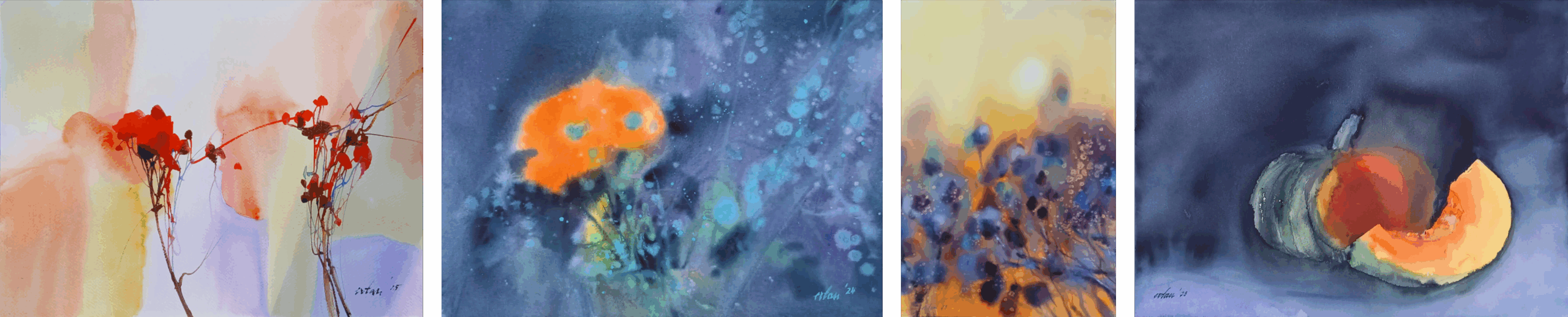
In another series, Ertan Alev paints flowers – often while listening to music by Piazzolla. “Libertango – Red” is an explosion of sensual energy, in which the melody seems to pour out through the brush. The red here is dance, tension, breath, rhythm – pulsing between notes and petals. The background is light and airy, in soft shades of yellow, peach, and pale lilac – almost transparent, like a breath between two tango phrases. On this transparent backdrop, two vivid flower stems erupt, like two passions both joined and apart. The lines connecting them resemble musical threads – tense and vibrating. The red line outlines the arms of a dancing couple. Their movement has the typical visual expressiveness of tango: the left stem leans forward and “pulls,” while the right one bends backward in theatrical hesitation. The flowers are shown as alive, dynamic, alluring – just like the tango itself. They are not still life, but motion – almost a love scene, in which each curve and splash is an improvisation within the dance.
In “Libertango – Orange”, the pair is in the denser phase of the dance – body to body, petal to petal. Behind them pulses a cosmic ballet of violet-blue haze – an orchestra of distant sounds, throbbing droplets, the sigh of time and space. Ertan translates the tango not into image, but into atmosphere – movement suspended in air. He captures the tango’s characteristic alternation of distance and pull, and transposes it through the forms and rhythms of the botanical world. These images carry an elegant eroticism – one that does not impose itself but is deeply felt: seduction, embrace, motion, and intimacy. The tenderness here is a refined form of the erotic.
A counterpoint to the many poetic or melancholic images in Ertan Alev’s watercolours is a magnificent still-life presence. After the dance of flowers, what remains is the pumpkin – quiet, warm, grounded. The final word belongs to life. A symbol of autumn, of abundance and home comfort, it is both a wink at the everyday life and a retreat from the ethereal. Playful and earthy, this presence closes the cycle with a sense of wholeness and honesty towards life in all its forms – from music to food, from sound to taste. Moreover, perhaps the bridge here is something else: the taste as the sense that connects people beyond cultures, languages and religions. Tikvenik – the traditional Balkan pumpkin pastry, as the curator jokingly notes – is one of the region’s most beloved gourmet inventions. Even someone who is not fond of pumpkins might desire one, when seen through Ertan’s brush.
Ertan Alev is among the most vivid representatives of one of the central themes of the exhibition – the intertwining of ethno-cultural traditions and the relation to cultural-historical heritage in the contemporary context of exchanges across the Balkans and Asia Minor. In his watercolours, this interwoven world is not declared but experienced – as atmosphere, as light, as a state of cultural memory through time and space. Istanbul, Sofia, Silistra, the sea and the river appear not merely as landscapes, but as dense time-spaces of shared history. The architecture, the bridge, the boat, the river, the bird, the mist and the light are visual and symbolic mediators of this experience—bringing together perspectives, times, and cultures. Through his musical sensitivity, the intertwining of sound, melody, form, and colour, and his ability to represent music visually (an ability known in neuroscience as ideasthesia), Ertan also engages with the themes of the senses, perception and the arts as bridges. Moreover, through the quiet presence of taste and food – such as the pumpkin – his art reaches the sensory bridge that connects people across differences. In his work, bridges are not objects but experiences—between the inner and the outer, between personal nostalgia and cultural polyphony.
In addition to representing the main themes of the exhibition and being of high artistic quality, the drawings are available at very affordable prices. Therefore, not only collectors, but also every art lover could warm their home with these musical, light-filled, ethereal memories and visions by the much- appreciated watercolour master Ertan Alev.
Rossitsa Gicheva-Meimari, PhD
Senior Assistant Professor in the Art History and Culture Studies Section and member of the Bulgarian-European Cultural Dialogues Centre at New Bulgarian University
Biography of the artist

Ertan Alev was born in 1985 in the city of Silistra. He lives and works in Bulgaria. He holds a degree in Tourism from Burgas State University. Since 2020, he has been working in the field of watercolour. He is a member of the Bulgarian branch of the International Watercolour Society – IWS Bulgaria.
Alev participates in national exhibitions and international watercolour festivals, including those in Bologna and Urbino (Italy), Sèret (France), Istanbul and Izmir (Turkey), Thessaloniki (Greece), Rybnik (Poland), Bratislava (Slovakia), Ajdovščina (Slovenia), Lviv (Ukraine), Chicago (USA), Hualien (Taiwan), Baku (Azerbaijan), Niigata and Kobe (Japan), Qingdao (China), Quito (Ecuador), among others.
His paintings are held in private collections in Bulgaria, France, the United States, Spain, Sweden, Hungary, Finland, Austria, Turkey, Germany, and other countries.
Awards:
– Sponsors’ Award at the 9th International Biennale The Art of Miniature, Rousse Art Gallery, Bulgaria, 2023
– Second Prize at the Finesse International Watercolour Festival, IWS Poland, 2024
– Merit Award at the International Watercolour Competition, IWS Singapore, 2024
Ertan’s Story of His Istanbul
My favourite site in the City is the Genoese Tower. I have visited almost all the Ottoman palaces, villas and hunting lodges, as well as Orthodox and Catholic churches – including those that were converted into mosques after the fall of Constantinople. Nothing contemporary in the city impresses me – I love the Old Istanbul.
I still remember the panoramic view from a tiny window in a small lodge within the Yıldız Palace complex. At the time, it had not yet been restored, and I was the only visitor that day. The staff were stunned that I had come all the way from Bulgaria: “Millions of locals show no interest, and yet you come here in the sweltering July heat!” They did not charge me an entrance fee and let me roam freely around the palace.
Eventually, the caretaker – carrying a huge bunch of old keys – met me and took me to the small villa known as Cihannüma Köşkü (the Pavilion with the Panorama). He unlocked it just for me and asked me not to take photographs, as the villa was not open to visitors.
The name of the köşk comes from Persian and means “seeing the world.” From its small window, one can enjoy the finest view of the Bosphorus, the Golden Horn, and the Sea of Marmara. It was a favourite spot of Sultan Abdülhamid II, who was afraid to live in Dolmabahçe Palace because it lay right on the Bosphorus shore – easily accessible by sea – and also because the sultan suffered from rheumatism.
I climbed to the upper floor and saw nineteenth-century Istanbul.
Product has been added to cart