Behçet Danacı: τhe poetry of stone and sculpted painting
“Sofia–Istanbul: bridge of art. Artworks with Stories”,an exhibition by Enakor...

A compendium for arts and antiques enthusiast
“Sofia–Istanbul: bridge of art. Artworks with Stories”,
an exhibition by Enakor Auction House
4 Dec 2025 – 3 Jan 2026 at the Union of Bulgarian Artists Gallery, 6 Shipka St.
Trained as a sculptor, Behçet Danacı carries his plastic thinking into painting as well, seeking volume, depth, and resistance of the material. His works do not tell a story, yet they radiate tension – between figure and fragment, between inner image and tangible substance. This is an art of wounded matter – restrained, heavy, and silent, but bearing a powerful sculptural charge.
Crafted from river stone with minimal intervention, “Maiden” is a sculpture that emerges from the inner logic of the material itself. The artist does not impose upon the stone but reads it, uncovering a latent form within and gently releasing it with measured gestures. The overall shape is simplified and compact—resembling a rectangle with rounded edges—while the human image is sparingly, yet distinctly, drawn from within. The profile is elongated and taut: the forehead and nose form an almost straight line, the cheekbones protrude smoothly, and the eyes are large, almond-shaped, and closed. The surface of the head transitions from smooth to rough, suggesting a headscarf or another traditional element. The lips are firm and markedly protruding—a gesture that may appear inviting or resistant, depending on the viewer’s perspective.
The head is presented almost like an idol—devoid of individuality, yet filled with human presence. Its rough headscarf is not an ethnographic detail, but a sign of protection, of inwardness, of inner strength carried within. Modest in appearance, the sculpture bears an iconic quality. There is something primordial in it—evocative of Chalcolithic female idols from the Balkans, the Aegean, and Asia Minor. The restraint of form and the preserved texture of the river stone create the impression that the figure was not sculpted, but liberated—as if it had always been there.
We see a universal image of the feminine: of belonging, of presence without possession. This is not the portrait of a particular maiden, but the embodiment of femininity as memory. It appears as a form that has survived in the stone—an echo of cultural memory, an emblem of tenderness, resilience, and fusion with the natural. The transition between the natural and the human is the very fabric upon which this work is built—between stone and sculpture, between matter and memory.
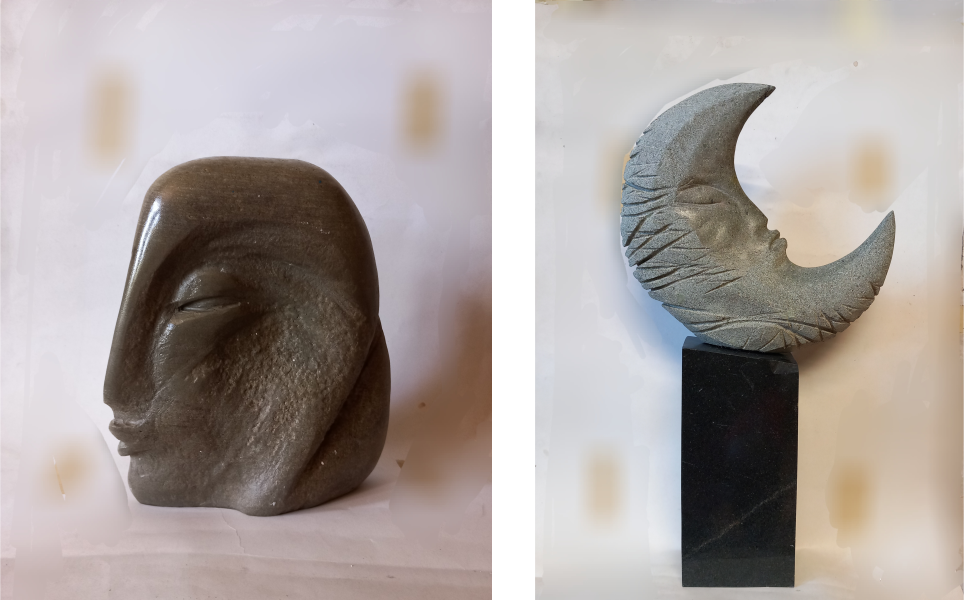
The second stone sculpture, titled “Poetry in Moonlight”, explores the theme of human presence beyond the body. Its shape follows the curve of a crescent moon – elongated, tilted, and slightly sharpened – which does not simply frame but merges with a human profile carved into its inner space. This, too, is a face without a body, yet it is a fragment that contains a whole. The female image has closed eyes, a serene and contemplative expression, and a gentle tilt – as if dreaming. The hair is engraved with parallel strokes that convey movement and rhythm – like rays, like breath, like verses.
The restraint of form echoes “Maiden”, where presence is likewise rendered through a fragment. Yet this fragment is not a remnant, but an emblem: it is shaped as a symbol of the feminine, the poetic, the contemplative. The face is the Moon itself – fused with night, with memory, with the cyclical nature of time and light. The sculpture embodies the cultural association between the Moon and the feminine principle – one that does not conquer, but illuminates; that does not gaze, but dreams; that does not speak, but poetically remains silent. In Poetry in Moonlight, the body disappears, replaced by the night. And the bright part of the darkness – the lunar face – remains to shine wordlessly. Thus, the sculpture becomes not only an image, but a poem – as tangible as stone, yet as elusive as the feeling of something beautiful that touches us without a name.
Of course, the crescent is also the symbol of Islam, featured in the emblem of the Republic of Turkey, including its national flag. It is entirely possible that Behçet Danacı consciously embedded this meaning in the work. It would be a powerful gesture of aesthetic freedom to intertwine the symbol of Islam, poetry, and the image of a woman – especially given the religious restrictions on depicting the human form and the unequal position of women in many Islamic cultures. Danacı’s courage, boldness, and freedom of thought deserve to be recognised.
In “Fairytale Vision”, the canvas is dense, rich in texture, and layered in its sensations. At first glance, the composition appears abstract, yet it quickly begins to reveal figurative forms. One of the two main vertical blue-white bands, accompanied by a delicate red line, evokes the sense of a furrow, a path, or a slit of light through which the vision passes. It divides the canvas into two halves – dark and light, dense and ethereal, day and night. The texture of the paint is deliberately dynamic, with scratches, build-ups, and gleams that resemble fossilised plants or traces of something already lived. The tonal palette blends muted greens, greys, and purples with accents of white, blue, and red – the colours of memory, of movement through different layers of perception.
Among the emerging images, the most clearly discernible is a bird, facing right, perched on a slender branch – drawn with a restrained line, its presence both real and dreamlike. Just behind it, as if in its inner gaze, a female profile appears – ephemeral, transparent, almost imperceptible, built of shadow and light. Before her stands another head – vague, amorphous, male or female, a face or a reflection. These forms seem to be sculpted from mist. In the upper centre of the canvas, the head of an animal appears – possibly the same bird, but magnified, with a wide eye and a cut-off beak. Between them, all runs the vertical line of rupture – a channel of the vision. It separates and connects – like a crack between worlds or a path through different layers of memory.
The entire painting is constructed like a dream-memory – with overlays, semi-transparencies, and textures that resemble imprints in stone. It has no centre, no compositional closure, but moves through fragments: shadow, line, head, and wing. Each element is at once real and dissolving. There are traces of nature, of myth, of something familiar yet unrecognisable. The forms are not literal, but inhabitable – the viewer can “populate” them with personal images and associations.
This painting is an example of an inner landscape – not a place, but a state. The vision is fairytale-like because it is true in its elusiveness – like those dreams that leave a trace, but not a memory. Moreover, the bird is not a silent bystander between the inner landscape and the outer world – it is a messenger, a witness, a bearer of memory.
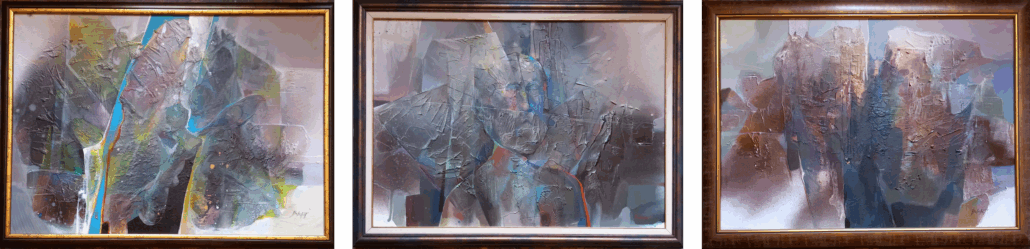
The figure in “Pressed Thoughts” resembles a bust – a torso and head in three-quarter view, with clearly defined features, a beard, round glasses, and a jacket. The male image appears to be carved from stone, though not as a finished sculpture, but as a figure still struggling to break free from the material. Its shape is simultaneously well-defined and fractured. Grooves, cuts, and incisions run across the face, body, and background, creating a sense of pressure, rupture, and fossilised pain.
Sharp geometric forms – resembling stone blocks – pierce the head and body. One of them, drawn across the forehead and eyes, resembles a wedge driven into thought itself. Another penetrates the back. This is not merely a figure within space – it is in conflict with space. The stone from which the man is “hewn” does not allow him to emerge. This face does not bear silence, but thought – constrained, compressed, and split apart.
The colours are muted, with glimmers of blue and red – like energies striving to break through, yet finding no outlet. A red line descending along the right side is the only pronounced gesture – a nerve, a sting, or a wound running through the entire figure. “Pressed Thoughts” is an image of an inner sculpture – of thought imprisoned in matter. It is not a simple portrait, but a tense interaction between spirit and substance, between the desire to express and the impossibility of release.
Despite the title “Figuroid”, there is no figure in the literal sense here. Rather, there is an attempt to preserve a human presence within the field of abstraction – a male and a female silhouette on the left side of the canvas, but rendered as trace, as shadow, as imprint, rather than as a clearly defined image. The composition is built from layered masses of colour and relief paste, evoking eroded stone, rusted metal, or a fossilised body.
A vertical dark core in the centre suggests the presence of an axis, around which layers have accumulated – as if some image had tried to rise but was buried beneath matter. Warm brown and ochre tones blend with cool greys and bluish highlights, creating an impression of the organic and the inorganic coexisting. This “figure-like” form is more like the remnant of a body – or the illusion of a body that never fully came into being.
The artist’s strong sculptural thinking is especially evident here: the painting is not a pictorial surface, but a relief object, where paint is treated as a plastic material, not merely as colour. “Figuroid” is a threshold concept – between sculpture and painting, between figure and formlessness, between the human and the natural, between memory and erasure.
Though visually and technically diverse, the works of Behçet Danacı are united by sculptural thinking – a way of constructing image through matter, weight, and absence. There is no narrative in them, yet there is deep inner tension – the images are fragmentary, semi-recognisable, as if “unearthed” from the depths of dream or memory. They place the artist within the exhibition’s thematic strands devoted to the inner landscapes of memory, to the mythical and the dreamlike, as well as to the tactile and sculptural senses – touch, pressure, weight – the senses of the sculptor. At the same time, the presence of the bird links him to the theme of the bird as a bridge – a messenger, a voice, or an inner calling. In this sense, Danacı stands at the threshold between seeing and touching, between form and absence – and it is precisely this that makes his presence feel so organically aligned with the exhibition’s concept. This is art that does not tell stories, but liberates them from matter – as images that still remember the weight of stone.
Rossitsa Gicheva-Meimari, PhD
Senior Assistant Professor in the Art History and Culture Studies Section and member of the Bulgarian-European Cultural Dialogues Centre at New Bulgarian University
Biography of the artist
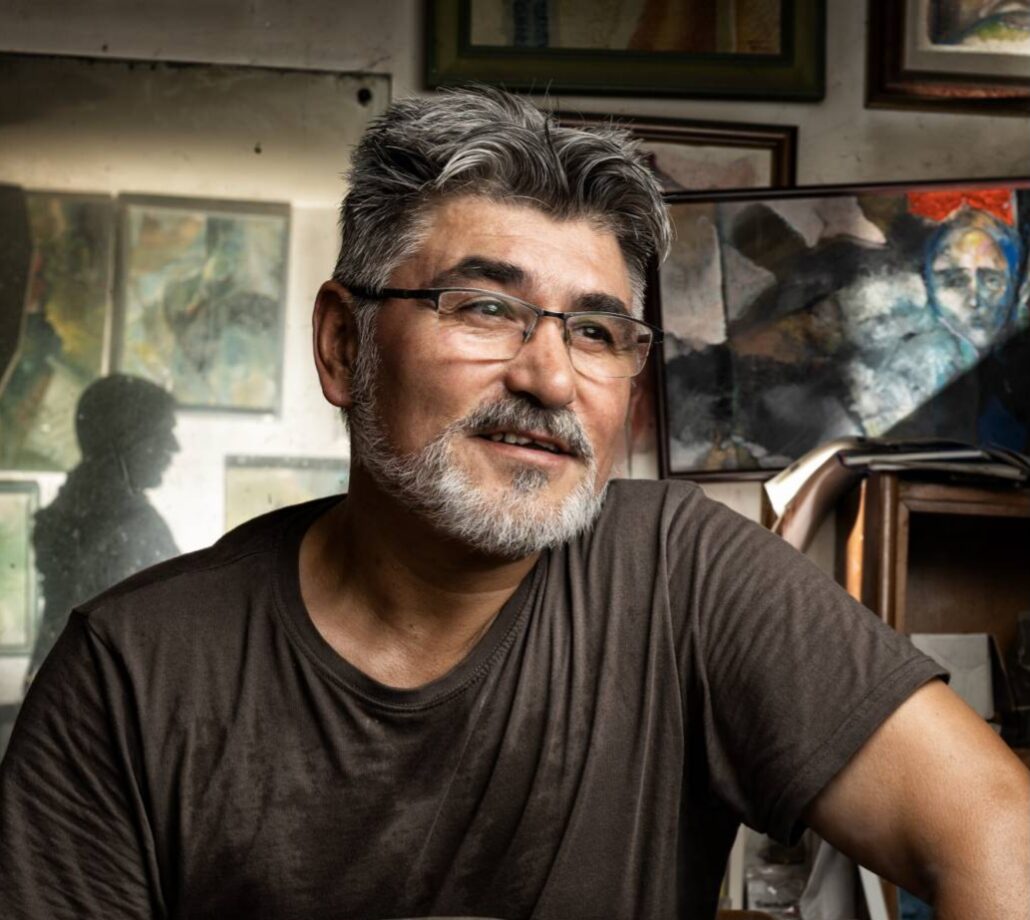
Behçet Danacı was born in 1971 in the village of Yasenkovo, Shumen region. In 1990, he completed his secondary education at the Technical School of Stone Processing in Kunino, and in 1998 graduated from the University of Shumen “Ep. Konstantin of Preslav” with a degree in Art Education, specialising in sculpture.
He is a member of the Union of Bulgarian Artists (UBA) and the Society of Shumen Artists. To date, he has held fourteen solo exhibitions in Shumen, Burgas, Sofia, Istanbul, and elsewhere, and has participated in numerous group exhibitions, including shows in Izmir and Ankara (2004–2006), and collective exhibitions organised by the UBA Shumen branch. He has created around 60 monumental sculptures in cities such as Shumen, Samuil, Veliki Preslav, Pliska, among others.
Danacı also takes part in sculpture symposia and plein air workshops. He works with silicone figures and is the author of several art installations and decorative murals. Currently, he teaches at the “Prof. Dr Asen Zlatarov” Vocational School of Chemical Technologies and Design in Novi Pazar. He lives and works in Shumen.
Awards:
1999, Varna – sculpture The Colours of the Rainbow; 2009, Veliko Tarnovo – bronze medal (sculpture); 2010, Plovdiv – gold medal; 2011 – Neofit Rilski Award; 2014, Plovdiv – gold medal; 2015, Plovdiv – gold medal; and others.
Stories behind the Works
“Pressed Thoughts”
The idea for this piece emerged from a creative discussion with fellow artists about portraiture, which inspired me to create a portrait of one of the renowned and respected painters from Shumen. The concept was not to produce a conventional portrait, but rather to embed the figure within a composition that expresses character, emotion, inner life, presence, and the status of a dominant personality. The work has never been exhibited, not even to the person portrayed, despite my initial intention to do so.
On My Art
The primary means of expression in my work – and the expected mode of perception – lies in the texture. Through it, I aim to generate movement in colour (through light and shadow) and to create depth in the composition’s details. This approach arises intuitively and dominates my practice, driven by my identity as a sculptor.
I draw inspiration and enthusiasm from nearly all art forms, though music, architecture, and traditional crafts are especially influential. Ancient art, in essence, remains a fundamental model for every sculptor.
Another particular aspect of my work is my reluctance to assign titles to the pieces. I believe titles can limit and manipulate perception. Through my art, I aim to open a space for the imagination and for individual interpretation.
Behçet Danacı
Product has been added to cart