Ayhan Çetin: Painter of the Contemporary City
“Sofia–Istanbul: bridge of art. Artworks with Stories”,an exhibition by Enakor...

A compendium for arts and antiques enthusiast
“Sofia–Istanbul: bridge of art. Artworks with Stories”,
an exhibition by Enakor Auction House
4 Dec 2025 – 3 Jan 2026 at the Union of Bulgarian Artists Gallery, 6 Shipka St.
The central theme in Ayhan Çetin’s painting is the city — the contemporary, densely populated, multi-layered city that oscillates between memory and the present. Most often, it is Istanbul — with its districts, harbours, bridges, and crowds — yet the imagery is not limited to it. In some compositions, the city becomes abstracted, almost mythical, assembled from fragments of memory and emotion. It is not measured in streets or squares, but in tremors, displacements, shadows and lines — like a ghostly imprint of a once-lived landscape. In this city, light emanates from the past, and perspective turns not outward but inward — towards the viewer, towards their own sense of place.
Composed with jagged, flickering strokes and rhythmically repeated lines, Çetin’s paintings generate a sense of vibration — like the murmur of a crowd or the pulse of traffic. The city is never static; it moves, rises, collapses, and reorganises itself — from a modular construction (“Lego Kent”), through a concrete fabric (“Üstyapı”), to a nostalgic restoration of the lost (“Kent Nostaljisi”). Each successive series marks a transformation — from the city-as-construct, through the city-as-skeleton, to the city-as-memory. Without abandoning the city’s form, the artist alters its nature — from material to symbolic. The city is no longer a place of dwelling, but a place of remembering. In these works, nostalgia is not sentimentality, but an act of resistance against forgetting. Architecture becomes an emotional landscape; paint becomes a substance of memory.
In his more recent works, Ayhan Çetin turns his gaze to the memory of the city — to nostalgia as a form of sensitivity and an ethics of perception. “Looking at old photographs always evokes a deeper and sadder feeling”, notes the curatorial text of his exhibition “Kent Nostaljisi” at Soyut Gallery (2023). The starting point in these paintings are the “old urban visuals”, which Çetin reworks into a “mobile form of narrative” — visual reconstructions of longing for the past. This vibrant, flickering language of urban memory — in faded sepia tones and fluid gestures — is clearly present in the paintings included in the exhibition „Sofia–Istanbul: Bridge of Art“.
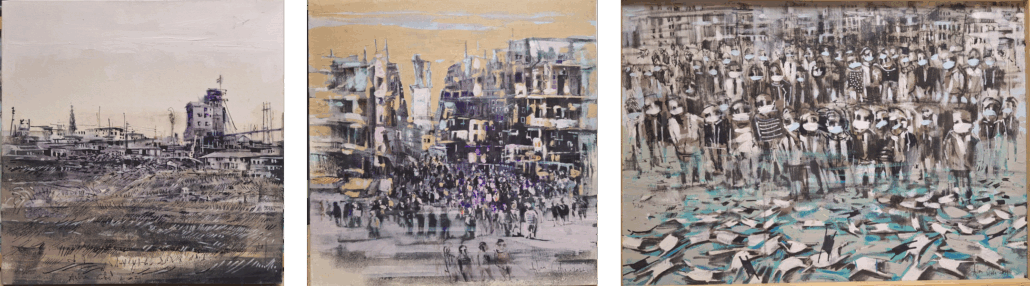
In the three canvases „Untitled“ from 2021–2022, Çetin already outlines the direction that will later develop in “Kent Nostaljisi”. The monochrome palette, leaning towards purples and browns, evokes the impression of faded photographs — memories in which the city unfolds simultaneously as document and emotion. The first work presents an industrial landscape caught in a half-destroyed structure — a metaphor for the city’s abandoned memory. The second places the viewer at the centre of a lively square, where the crowd pulses like the “living fabric” of the past. The third — with its masked figures — captures a very recent historical moment, turning the present into a future nostalgia.
In all three, Çetin uses his characteristic rhythmic stroke to turn the city into a story of longing for lost time. These are early testaments to the sensibility that the “Kent Nostaljisi” curatorial text describes as “visualisations of the yearning for the past” — a nostalgia born from the very dynamics of urban memory.
„Untitled 1“ represents a quiet suburban landscape — low buildings, sparse architecture, empty streets, and a glimpse of sky. This is not the city centre, but its periphery — the place where urban density thins out and a kind of timelessness begins. There are no people, no movement, no sound — only a faint haze, as if time has dissolved into silence. The painting evokes a sense of transience, of border, of pause. It carries no drama, but rather stillness — and perhaps a faint, dulled memory of something once.
In „Untitled 2“, a crowd fills the street in an everyday urban scene — some carry flags, others walk side by side, seemingly towards a common goal. Possible interpretations range between a demonstration, a procession, a protest, or a festive parade — yet in all cases, the painting conveys the energy of a gathering, of a human community in motion. Τhe emphasis is on the collective — on the rhythm of the group body occupying the city. The artist offers no explicit judgment, but the composition leaves us with a question: what is the cause?
„Untitled 3“ shows an urban scene with a crowd of people wearing surgical masks, standing before a ground covered in countless other masks. We do not know whether these masks were discarded, thrown away, or left behind. Interpretation can follow many paths. On one level, the painting suggests protest against the restrictions of the Covid pandemic — against the loss of face, voice, and freedom.
Yet the curatorial reading insists on another possibility: “people with masks standing before masks without people.” Whether intentional or not, this formula becomes a deeply striking visual metaphor — a stark, meaning-laden gesture. The masks without people remain after those who did not survive. Before them stand the survivors — with their masks, with their responsibility, with their silent respect. The crowd is not protesting, but mourning. They wear masks not out of obedience, but out of memory and care. This is not a protest, but a vigil — for the millions who perished, most of whom could have been saved. It is not chaos, but a monument — nameless, yet clear. Life is possible only when we accept that we are not alone, and that the lives of others depend on us.
Ayhan Çetin takes part in the exhibition as a painter of the city — not only of the metropolis of Istanbul, but of the universal contemporary city as a cultural and emotional construct. In his works, the city becomes a site of remembrance — composed of shadows and visual traces that revive the sense of human presence and absence, of lost time. Here, the theme of the city is not connected to its urbanistic reality, but to its symbolic and sensory charge — to the way we experience and remember it. In this sense, Çetin contributes to the exhibition’s concept through several key bridges: a bridge between past and present, built out of memory; a bridge between local and global experience of the city; and a bridge between visual and emotional knowledge, one that turns architecture into a poetry of time.
Rossitsa Gicheva-Meimari, PhD
Senior Assistant Professor in the Art History and Culture Studies Section and member of the Bulgarian-European Cultural Dialogues Centre at New Bulgarian University
Biography of the artist
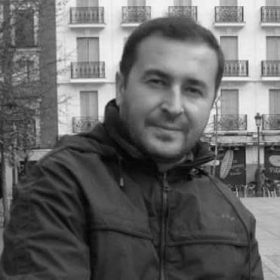
Ayhan Çetin was born in 1978 in Kardzhali, Bulgaria. He graduated from the Işılay Saygın Fine Arts High School in Izmir in 1997 and obtained his Bachelor’s degree in Painting from the Faculty of Fine Arts at Anadolu University in 2001. In 2004, he completed his Master’s degree in Painting at the Institute of Social Sciences of the same university, and in 2011, he earned the Sanatta Yeterlik degree (equivalent to a Doctorate in Fine Arts) at the Institute of Fine Arts of Marmara University. Since 2024, he has been Professor at the Department of Basic Art Education in the Faculty of Fine Arts at Trakya University.
Ayhan Çetin has received numerous national and international distinctions. In 2013, he was awarded the Third Prize for Young Artist of the Year in the RH Pozitif competition in Istanbul. In 2015 and 2016, he received gold medals from the Société Nationale des Beaux-Arts (SNBA) in Paris, as well as a silver medal from the same institution in 2015. In 2016, he won an Achievement Award at the 3rd International Biennial of Miniature Paper Graphics in Novi Pazar, Serbia. In 2018, he received two Awards for Artistic Achievement — one from the Art Colony Association in Kavadarci (North Macedonia) and one from the Cultural Directorate of Bosnia and Herzegovina within the framework of the 5th International Art Competition. In 2021, he was honoured with the Art Pilgrimage Positive Energy Art Pakasana Award, as well as an Achievement Award from the 1st International Visual Arts Biennial of Bandırma University.
He has held solo exhibitions in Izmir, Istanbul, Ankara, Edirne, and Antakya (Turkey), in Novi Pazar (Serbia), and in Skopje and Kavadarci (North Macedonia).
He has participated in group exhibitions in Ankara, Istanbul, Izmir, Antakya, Shumen, and Bandırma (Turkey); in Paris (France); Novi Pazar (Serbia); Skopje, Kavadarci, and Prilep (North Macedonia); Monastir (Tunisia); Moldova; and Bosnia and Herzegovina.
Çetin is represented in numerous public and private collections in Turkey, Tunisia, Serbia, North Macedonia, Moldova, and France. Among them are the Osman İnci Museum, the Museum of Contemporary Art in Novi Pazar, the Municipality of Eskişehir, the Kent Belgesi Museum, the Süleymanpaşa Museum, the Museum of the Republican University, as well as the collections of DYO Yaşar Holding, RH Pozitif Art, Artsuites Gallery (Bodrum), among others.
Product has been added to cart