İsmet Çavuşoğlu: musical abstractions of the ancient and the contemporary city
“Sofia–Istanbul: bridge of art. Artworks with Stories”,an exhibition by Enakor...

A compendium for arts and antiques enthusiast
“Sofia–Istanbul: bridge of art. Artworks with Stories”,
an exhibition by Enakor Auction House
4 Dec 2025 – 3 Jan 2026 at the Union of Bulgarian Artists Gallery, 6 Shipka St., 2А
İsmet Çavuşoğlu is an artist with a rich cultural and academic path that bridges three contexts – Bulgaria, Turkey, and the United States. Born in Bulgaria, he studied painting in Sofia. He completed his higher art education and taught in Turkey, where he earned the title of Professor. Today, he lives and works in Boston. His paintings bear the traces of this multidirectional journey – they are a point of convergence for influences, time layers, and cultural strata. In the exhibition “Sofia–Istanbul: bridge of art”, Çavuşoğlu is, in himself, an artistic bridge – between Bulgaria and Turkey, between the Balkans and America, between East and West, between the personal and the universal.
His art does not strive for descriptiveness, but for inner rhythm. In his compositions, everything is music and memory – space is arranged like a musical score, colours resonate, and time does not pass but seeps through the lines. This is visual art built on the logic of sound: each brushstroke, each colour, and each structure carries acoustic value. His works bear the marks of musical-visual synaesthesia – an artistic sensitivity in which the senses and perceptions intertwine, and images are experienced as sounds, rhythms, and emotional states.
In the paintings presented, the artist moves between different landscapes: ancient sanctuaries, seaports, contemporary metropolises. What unites them is not merely the theme but also the approach – in each composition, he captures the deep memory of a place and translates it through a musical structure. Whether depicting ancient Epidaurus, Eleusis, or the urban rhythm of Boston, Çavuşoğlu paints the world as a sonic-visual body – a living, pulsating world in which colours and forms speak through music.
Ancient Cities and Settlements
In the paintings “Epidaurus, Greece” and “Green Composition”, İsmet Çavuşoğlu unfolds narrow vertical structures where space is arranged like music and time seeps through the layers of paint. Both compositions are not mere landscapes, but reconstructions of living places of memory – where antiquity is not the past, but a pulsing part of the present.
In “Epidaurus, Greece”, the ancient sanctuary is perceived as a structure of sounds and traces – amphitheatre, temples, and colonnades emerge through overlays of lines and textures, evoking simultaneously architectural drawings, sound waves, and geological strata. Above them, the sky flows down like a fog of memories – time does not fall but permeates. At the bottom, horizontal textured lines form an underground layer that recalls temporal strata – both geological and cultural, like the sediment of memory.
The entire painting conveys the impression of a musicalised landscape-monument, in which architecture is a fixed note, the earth speaks through lines, and time flows through the crumbling light. It is both an image of a place and music of ruins, captured through the artist’s intertwined perceptions. The composition becomes a visual score of cultural memory, renewed through artistic re-expression. It resonates like a visual archaeological echo, linking contemporary rhythm with ancient memory. Çavuşoğlu introduces the bridge between epochs not through precise reconstruction, but through texture and trace – like the remnant of a dream or a memory.
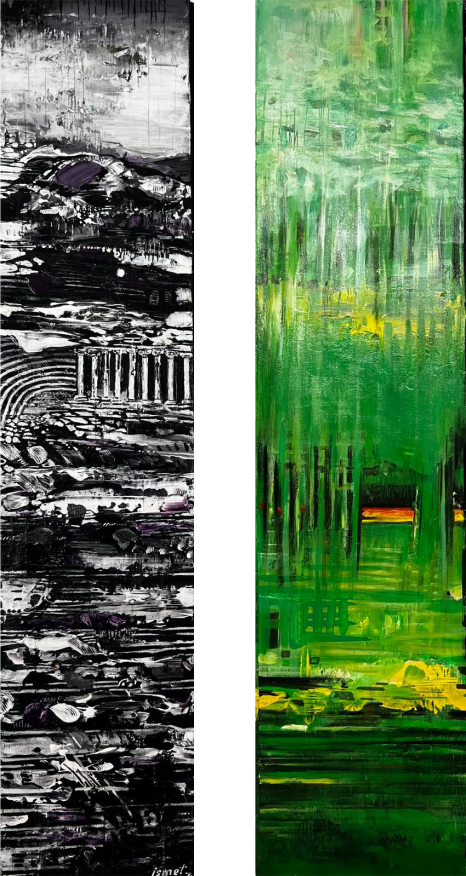
“Green Composition” represents two real yet distinct landscapes in terms of time and place – both embedded in nature, both ancient. In the upper part of the composition, in the distance, one sees remnants of ancient dwellings resembling stilt houses over water, along with the outlines of an island – a probable memory of a coastal settlement dissolved into time and light. In the lower part, closer to the viewer, another ancient site unfolds – with a yellow cave, accessible by steps, nestled among trees and structures. The setting evokes Eleusis – with the sanctuary of Demeter and the cave of Pluto, conceived as an entrance to the underworld.
The two realms are clearly divided by an orange-yellow horizontal band – like a boundary between dimensions, between near and far, upper and lower, daylight and subterranean. Yet the vertical, flowing brushstrokes – as if soaked in light or rain – connect the two worlds, creating a sense of organic wholeness and smooth transition, the kind that can occur only in a mythological or musical reality, like glissandi that bridge separate worlds.
The Modern City by the Sea
In the paintings “Rhythm of Blue” and “Different Composition”, İsmet Çavuşoğlu constructs the image of a maritime and harbour city not through depiction, but through motion, rhythm, and atmosphere. This is a city immersed in colour and sound, dissolved into waves, boats, and blue. There is a tangible sense of connection between water and culture, between nature and human rhythm, between individuality and collective motion. The city is both real and metaphorical – a space of transition, exchange, and musically dispersed memory.
“Rhythm of Blue” presents the aquatic space as a living score – the sea is unravelled into separate lines, waves, and colour strikes, which flow and layer like musical phrases. The absence of fixed perspective creates a sensation of swimming through rhythm, while the dripping verticals of light and colour evoke harbour mist or urban humidity. This is a painting of a scattered yet vibrant harbour, where blue, red, and ochre patches flicker like boats, reflections, and sounds woven into a shared pulse. Here, blue is not a background – it is the main character, setting the tempo and mood of the seaside city.
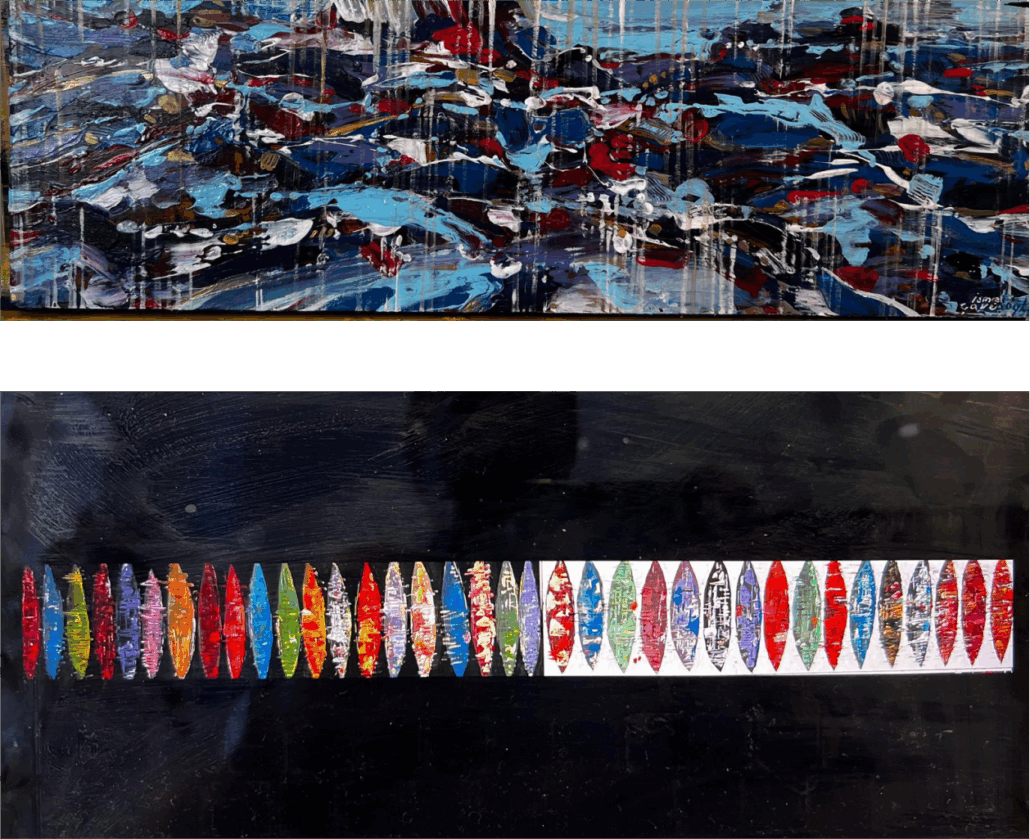
In “Different Composition”, the harbour city appears as a row of boats, rhythmically arranged like a visual musical scale. Each boat differs in colour, internal texture, and aura – as if carrying a distinct story, cargo, memory, or cultural identity. The row of boats can be read both as a bridge between differences and as a visually translated musical harmony, where individuality is not lost but assembled into a whole.
This strong and memorable painting unfolds a multilayered metaphor. İsmet Çavuşoğlu constructs a powerful visual symbol: the boat as a vessel of transition – between shores, between eras, between cultures. The gentle curves and warm colours create a sense of dream and stillness – as though the boats are not sailing on water, but floating on time. Here, they are not modes of transport, but carriers of memories and emotions, shifting the viewer’s world into another rhythm.
The boats are not scattered or in motion, but arranged in a rhythmic, almost orchestrated structure – like a static bridge built of individual vessels. The boats are arranged so that half of them rest on a light background, and the other half – on a dark one, as if crossing the threshold between day and night, between illuminated memory and the shadow of forgetting, between beginning and end. Thus, their visual arrangement becomes a visual symbol: the boats stand as bearers of cultural memory passing through time and difference – and at the same time, they mark the rhythm of life, like notes in a musical bar.
In this context, they are also perceived as visual elements within the polychromatic score of the city – a bridge between East and West, between the visible and the invisible, or between beginning and end. This composition – a synthesis of order, rhythm, and symbolic depth – stands out as one of the visual focal points of the exhibition, not only because of the image of the boat as a moving bridge, but also because of the modern visual language with which it conveys contemporary urban sensitivity, linking cultures and times, senses and perceptions.
The City of Skyscrapers
The culture of the contemporary metropolis is also distinctly present in İsmet Çavuşoğlu’s compositions – both in the structured architectural lines and in the urban vibration. In these works, the landscape as a bridge to the world is realised through fields of colour and musical abstraction. In the paintings “Vibrations”, “Rhythm of Yellow”, “Rhythm of Red”, and “Rhythm of Colours”, Çavuşoğlu creates an abstract representation of the modern American city – as it might be sensed through sound, light, and rhythm, rather than depicted through form.
This is the city not as a localised landscape, but as a vertical architecture of impulses. These paintings resonate with an inner rhythmic logic – each form is like a sound, and the composition functions as a score. There are no horizons, streets, or perspectives; instead, verticals, vibrations, and modulated colours express not only the shape of the city, but its tempo, energy, and voice. Colours resonate and flow into different emotional tones: yellow and red pulsate, blue and green vibrate, orange radiates warmth like the sound of a viola. This is not merely a visual language, but an interweaving of the arts – where music becomes a bridge between the senses, between the viewer and the image. In this rhythmic city, light resonates, colours speak, and space becomes both visual and acoustic.
Among the four paintings, “Vibrations” is the most ethereal and pulsating – with semi-dissolved verticals through which the city is felt as a reflection, as a vibration in the air or a sound coming from afar. Compared to the others, this work evokes the strongest sense of mist, distance, and transparency – as if we are looking through a screen or a mirrored facade. If “Rhythm of Red” conveys the city’s dense bodily mass and blazing lights, “Vibrations” expresses its energetic envelope – its invisible sound, its urban breath.
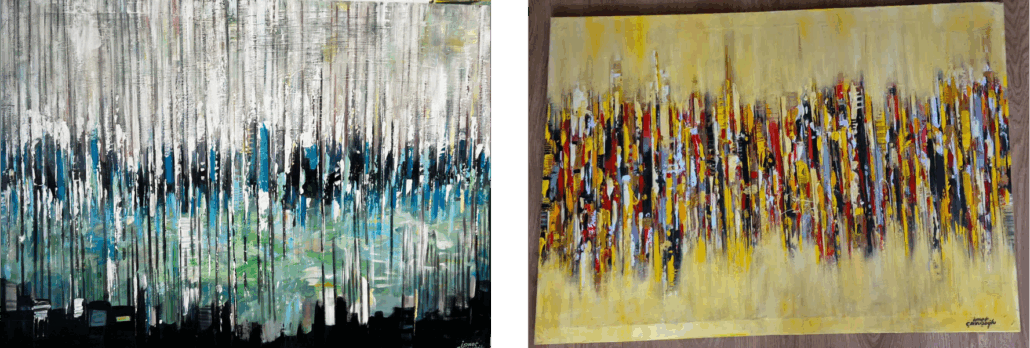
“Rhythm of Yellow” is the most structurally rhythmic of the four – with clearly organised vertical strokes on a light background. While “Vibrations” pulses from within, “Rhythm of Yellow” trembles on the surface, like a visual metronome. The yellow background radiates a warm but relatively neutral atmosphere, within which red, black, and white create a musical beat – an urban pulse in the golden hour. Unlike the denser “Rhythm of Red”, this composition carries a sense of lightness and balance – as though we are looking at a facade of pulsing windows, synchronised in a luminous dance with the midday sun. “Rhythm of Red” is the most saturated, most material, and most expressive of the four. Here, the city becomes corporeal – composed of densely packed verticals and horizontals that form a massive, vivid architectural structure. Compared to the other works, this one evokes the most powerful sense of skyscraper rhythm, physical density, and contrasting intensity. The colours are more aggressive – red, yellow, black – and together they create an image of an urban night, where light and noise turn into a visual rumble. Windows, arches, and facades interlace in an abstract architecture, in which the city becomes an emotional landscape. Human presence is implied – one can feel the existence of the modern individual, their movement through space, their memory embedded in buildings. Here, the city is not a backdrop but a cultural subject with which the artist engages in dialogue.
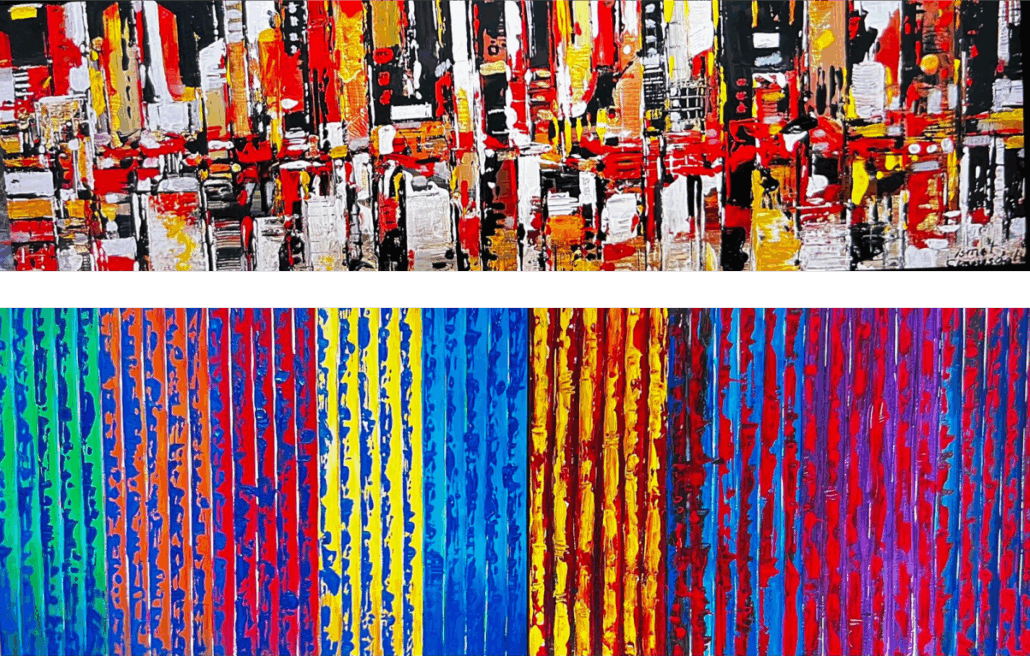
“Rhythm of Colours” differs from the others through its complete abstraction and pure colour modulation. While the other paintings hint at architecture, facades, and urban structures, here only the musical remains – vertical bands of colour that resonate like tonal columns. Compared to “Rhythm of Yellow” and “Rhythm of Red”, there is no narrative or spatial indication – the composition resembles a spectrogram of city sound translated into colour. This is the city as tonal scale, as a choir of hues in which the senses dissolve into one another.
The Bridges of Çavuşoğlu
İsmet Çavuşoğlu’s strongest bridge is abstraction. For him, it is not an escape from reality but a distillation of it – purified, concentrated, and infused with memory. The abstract structures in his paintings do not conceal; they reveal – offering multiple readings and translating images from the personal into the universal. In this sense, abstraction becomes a universal bridge to others – a passage through senses, perceptions, the intertwining of the arts, through experience and synthesis.
His abstraction is also an acoustic experience. His compositions resonate – not only visually but also internally – like a jazz improvisation between form and colour. Curves, contrasts, and overlays unfold like musical phrases: at times subdued and contemplative, at others – bold and expressive. Colour is not merely decorative – it holds tonal value, becomes timbre, emotion, vibration. Çavuşoğlu’s abstraction does not distance the viewer from the world – it attunes them. It creates an inner acoustics in which vision is experienced as sound.
This approach resonates with ideasthetic thinking – in which the idea of musicality is translated into image, and the visual becomes a conduit for rhythm, temporality, and tonality. In this sense, every work can be heard: the compositions are experienced as scores, where silence and strike, stillness and eruption, pause and glissando alternate. In this way, painting becomes a musical bridge – between the viewer and their inner world, and between the urban reality and its emotional memory.
Beyond abstraction, the interweaving of senses, perceptions, and art forms, Çavuşoğlu also fits within other conceptual bridge-themes of the exhibition: the cultural memory of space, the contemporary city, the fragment, the landscape. İsmet Çavuşoğlu’s paintings do not narrate stories – they attune them. They contain no linear plot, but a web of resonances in which memory, sound, form, and colour intertwine into a unified sensitivity. His abstraction is a path – toward the other, and toward the self. Through boats, columns, sounds, and pauses, the artist constructs inner, immaterial bridges. His art is deeply inscribed in the exhibition’s concept as a sensory and cultural passage – from remembrance to contemporaneity, from form to feeling, from visual image to music.
Rossitsa Gicheva-Meimari, PhD
Senior Assistant Professor in the Art History and Culture Studies Section and member of the Bulgarian-European Cultural Dialogues Centre at New Bulgarian University
Biography of the artist
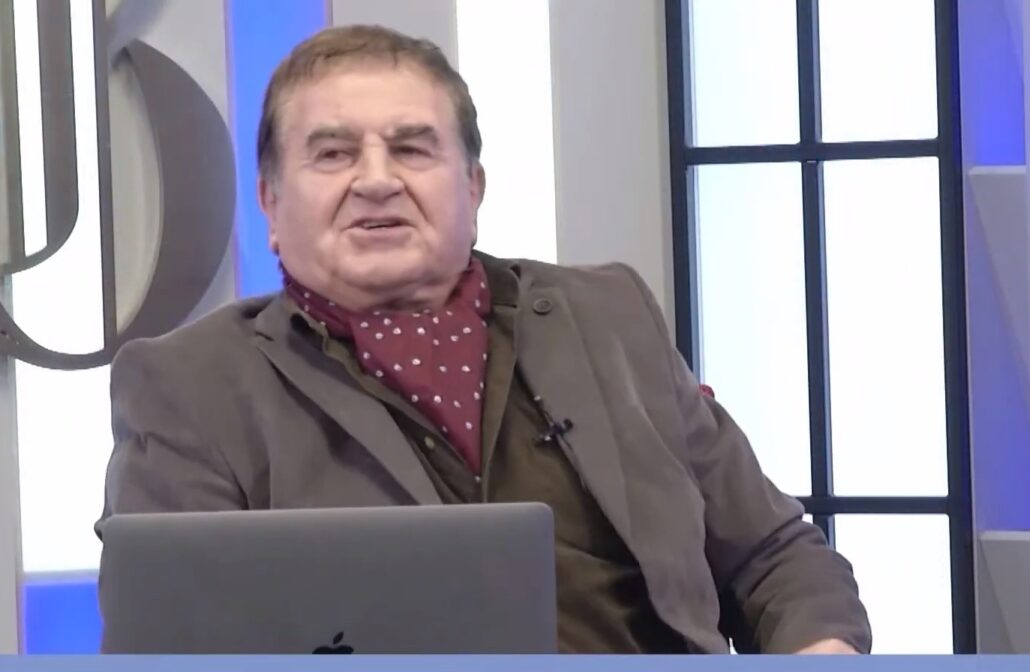
Prof. İsmet Çavuşoğlu was born in 1946 in the village of Cherkovna, in the Targovishte region of Bulgaria. He graduated from the Pedagogical School in Razgrad in 1967. He worked as a teacher in Cherkovna and later at “Hristo Botev” School in Targovishte. After studying painting with professors from the National Academy of Arts in Sofia, he became a member of the Union of Bulgarian Artists (UBA) in 1984. He continued his academic path in Turkey, obtaining a Bachelor’s degree from Anadolu University in 1994, a Master’s degree in 1997, and a Sanatta Yeterlik / Proficiency in Art (equivalent to a PhD in the arts) in 1999 from Mimar Sinan Fine Arts University in Istanbul.
His career has been closely tied to the academic art scene in Turkey. Since 1999, he has been Associate Professor of Painting at Kocaeli University. In 2012, he was appointed Professor and became the founding Dean of the Faculty of Art and Design in Yalova. In 2014, he was appointed Dean of the Faculty of Art and Design at Yalova University. Over the past decade, he has been teaching at Istanbul Gelişim University, where he is a Professor and Dean of the Faculty of Fine Arts.
Çavuşoğlu’s artistic work evolves in the dialogue between the figurative and the abstract – often associated with expressionist painting but marked by a personal language of colour and form. He works with a wide range of techniques including oil painting, watercolour, printmaking, mosaic, fresco, and sgraffito. He is the author of more than 80 solo exhibitions and has participated in over 100 group exhibitions and competitions in Bulgaria, Turkey, and abroad. His works are included in over 850 collections – private, institutional, and museum-based. Beyond the canvas, his art also appears in architectural settings – including around 1,000 square metres of mosaics and 100 square metres of frescoes realised on the campus of Kocaeli University.
He is the recipient of eleven national awards for painting. In his works, colour carries emotional power, and his compositions often combine personal and collective layers of memory – with a profound understanding of art as a process of transformation and a meeting point between cultures.
Alongside his artistic practice, he is also active as a curator and academic. He maintains strong ties with the Bulgarian art scene – particularly in Shumen and Targovishte, where he regularly returns for exhibitions and collaborative initiatives.
Prof. İsmet Çavuşoğlu currently lives and works in Boston, USA.
Reflections on Art and Practice
Sometimes, in order to develop a personal style, an artist combines several styles together. In my own works, there is a tendency in that direction – based on the principle of simultaneity: three or four styles in a single piece. On one canvas, we see different moments – for example, past, present, and future. This is one of the lessons I teach my students: experimentation in art.
I travel the world and observe global trends. Today’s art is incredibly bold – no one stands still. Everyone seeks personal development and applies innovative approaches. I feel that one must change completely. I, too, am constantly evolving. I’ve come to understand that if an artist paints in the same way as they did 20 or 30 years ago, it is as if they’re standing in place. One must transform – but that change should come naturally, from within. There are no longer separate “national” arts – Bulgarian, French, Turkish, and so on – art has become global. Never in history has art been so free.
Art is a marvellous thing – the artist is influenced by nature, by other people, by society and social events – so both the human and the natural are present in our work. Even if art is abstract, we can still sense those same influencing forces within it.
I have never severed my ties with Targovishte or with Bulgaria. I remain a member of the Union of Bulgarian Artists and continue to take part in exhibitions here. I do not feel like a stranger – when I return, I am back in my homeland, my native place. There is great mutual respect among my fellow artists, and we have maintained contact for over 30 years.
İsmet Çavuşoğlu
Quoted in: Ivanova, Ivelina. “An Interview with İsmet Çavuşoğlu”, Palettes of Sixteen Artists, Bulgarian National Radio, Radio Shumen, 17 Oct 2024, https://bnr.bg/shumen/post/102061044/palitri-na-16-hudojnici , Accessed 26 Oct 2025
Product has been added to cart