Seyfettin Shekerov: bronze casts of memory and imagination
“Sofia–Istanbul: bridge of art. Artworks with Stories”, an exhibition by...

A compendium for arts and antiques enthusiast
“Sofia–Istanbul: bridge of art. Artworks with Stories”, an exhibition by Enakor Auction House
4 Dec 2025 – 3 Jan 2026 at the Union of Bulgarian Artists Gallery, 6 Shipka St., 2А
Seyfettin Shekerov creates sculptures in which matter does not merely shape the body, but captures a moment of tension, a surge or a sensual gesture. His animals — bulls, horses, lions, fantastic fish — are charged with kinetic energy, with a force that bursts forth. These sculpted forms inhabit a space between nature and mythology, between the real and the imagined. In his work, bronze is never static — it breathes, pulses, soars or melts. Golden glints, multi-tonal patinas and graceful silhouettes turn each of his figures into a living organism, shaped by will and imagination. These are bodies of desire and yearning, of erupting power, of historical or mythical memory. They possess flesh, but also spirit; weight, but also flight.
The nude female bodies in Seyfettin’s sculptures intertwine history, myth, sensuality and play. They are both classical and timeless, sculpted with love for form – flowing, oval, melting, breathing through their bronze skin. They carry eroticism, yet also an ancient restraint – like idols from another world. Shekerov gives bronze a surface that speaks both to the eyes and to the touch: at times smooth and seductive, at others rough or sharp. His figures do not merely represent the human – they experience it through contact, through flesh, through ritual memory.
A powerful current in Shekerov’s work is his connection to history, archaeology, and the visual language of antiquity – from Thrace, ancient Greece, Byzantium, Bulgaria and the Ottoman Empire. He creates bronze rhyta with deer heads, amphorae, and chalices inspired by the Thracian gold treasure of Panagyurishte and by Christian goldsmithing, blending Christian forms and ornamentation with scenes from ancient Greek mythology. He sculpts his own, personally imagined Greek goddesses, warriors, mythical figures and ritual characters such as whirling dervishes. Shekerov’s art does not recreate antiquity – it weaves it into the present and translates it: from museum silence into contemporary sensuality, from historical or mythical narrative into tactile, plastic embodiment.
“Female Body – Hair”
The bronze sculpture depicts a nude female body in an unusual seated posture. The torso is folded forward, pressed tightly against the knees, as if the figure has curled in on itself. Her arms and long hair fall downwards over her legs. The form is sculpted with a mixture of rounded contours on one side and angular shapes on the other. The body appears soft, melted, cascading down the rectangular pedestal on which it rests. The bronze surface is smooth, with softly polished details that accentuate the curves, the ovals, and the seductive suppleness of flesh.
This figure does not display, but hides; it does not pose, but gathers itself inward. The posture evokes a fruit, a foetus, or a shell – a form folded in to protect its inner self. It is not a body for show, but a body for experience – solitary, introspective, perhaps wounded, or caught in a state of dream. The hair, turned into a bronze curtain, does not decorate but envelops – a protective shell, a continuation of the body, its armour. The body is seductive at first glance, yet a closer look reveals that overt eroticism is absent. What emerges instead is a deep sense of interiority – of femininity as a closed, breathing, self-sufficient form. This body does not seek the gaze, nor connection, but silence. Its self-enclosure turns it into a powerful image of female corporeality – not for the other, but for itself.
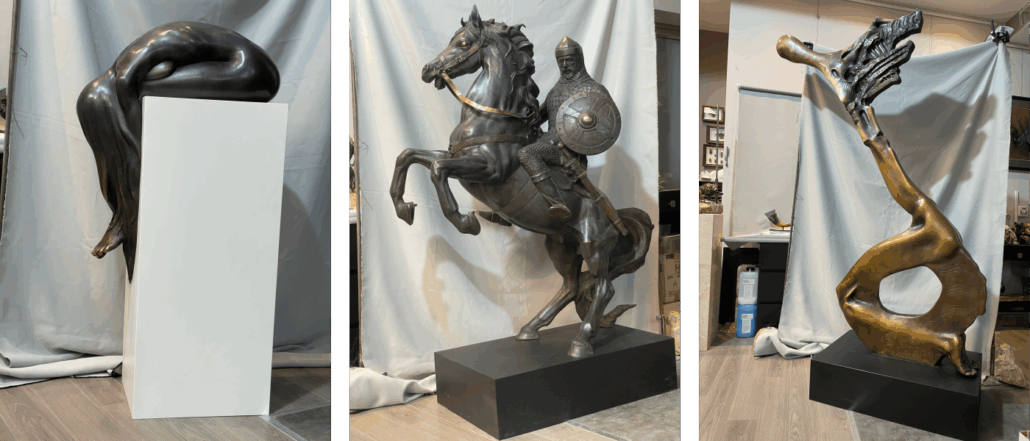
“Horseman – Asparoukhian Warrior”
The armed horseman is portrayed with pronounced realism, in a dynamic moment as the horse rears up. The animal stands on its hind legs, head raised, mouth open, its front hooves lifted off the ground in a gesture of upward thrust. Its body is sculpted with exceptional attention to anatomy and expression – every muscle group is tense, and the pose, the curve of the neck and the dramatic head convey strength, nobility and tension. The warrior wears a mail coat and helmet, holding a round shield with a prominent boss and cross-shaped ornament in his left hand, and the reins in his right. His gaze is cast downwards, with an expression of superiority and triumph – the face of a conqueror in a moment of dominance.
The figure of the Asparoukhian warrior in Shekerov’s sculpture is a mythologeme – an embodiment of martial will, of resolve, of state-building as an act of motion. The horse’s leap and the gaze from above construct the image of a figure who arrives not only to conquer land, but also to inscribe a presence into time itself, to stake a claim on the future. The warrior is a liminal hero – a figure of transition between the nomadic and the settled, between myth and history, between body and political form. The sculpture does not narrate, but affirms – through plastic force, through the muscular energy of the horse, and the concentrated authority in the rider’s face. Here, bronze is not just matter but also condensed memory, fixing the gesture of founding a state. It is precisely in this tension between movement and settlement that the artistic power of the work resides.
“Flight of the Spirit”
In this monumental bronze sculpture with an abstract form, the viewer may discern a key, shaped from the silhouette of a kneeling female body combined with a horse’s – or fantastic animal’s – head. The figure has no arms, but its feet, calves, thighs, back and abdomen are clearly defined. The form is elegant and smooth in its surfaces, drawn upwards and abruptly transforming into a different, textured shape – one that resembles the head of a mythical creature with a mane, perhaps a horse. The upper part of the sculpture evokes the serrated teeth of a key, and the whole figure conveys a sense of vertical thrust, of tension and unfolding. The opening at the base, at the figure’s legs (the key’s handle), gives the shape lightness and accentuates the impression of internal volume and motion. The surface combines polished, smooth zones with rough, incised textures, heightening the contrast between the bodily and organic on the one hand, and the object-like, mythical and abstract on the other.
“Flight of the Spirit” does not depict flight – it expresses it through form: an ascending, tense, metamorphosing movement. The kneeling female body at the base is defiant, like a spring from which an inner thrust is released. The upper part of the sculpture – an elongated, abstract head of a creature with a mane – may be read as the spirit itself: transforming the body, erupting, galloping. The connection between the two – flesh and spirit – creates an unusual “centaur-like” structure, but in reverse: not a human head on an animal’s body, but a female corporeality crowned with a mythical head. This metamorphosis turns the sculpture into a key not only in a literal sense, but also as an idea: a key for passage, for transformation, for unlocking the spirit from its bodily shell. Thus, the “flight” is not movement through space, but through being – an ascent from material nature toward metaphysical possibility.
“Bull”
The bull is one of the central figures in Seyfettin Shekerov’s sculptural universe – not as a biological species, but as a state of matter and spirit, an embodiment of the masculine principle. Each of his bull figures carries a sense of compressed energy – a body heavy with its own power, poised between patience and eruption. In some works, the bull seems besieged by its own skin, which cracks, flows and drips like lava; in others, it is drawn taut in a sudden motion, like a forceful surge. Shekerov constructs these forms through contrasts – between smooth and torn, between bronze and stone, between control and explosion. They are beings of an inner landscape – archetypal and ritual.
The bronze bull in the exhibition is a small sculpture, yet it exudes monumental presence and a fantastic aura. Rather than a creature of wild nature, it appears tamed, ritualistic, almost regal – like a mythical horse adorned for a ceremonial procession. Its body is covered with relief applications and strap-like ornaments with floral motifs, reminiscent of ancient Thracian horse tack. Even its tail is decorated, integrating it into the overall ritual composition. On the bull’s back there appears to be a kind of saddle or portable shrine, adorned with miniature scenes and symbols. To the left of it, one sees a tree growing from an open seashell – an image uniting the origin of life with vertical striving. On the right, human silhouettes are discernible: figures inhabiting the animal’s back as part of its memory. The bull becomes a bearer of scenes, layers and archetypes – a creature that carries a world. The stone pedestal intensifies the sense of solemn stillness – as if this figure has been drawn from a forgotten cult or a dream of antiquity.
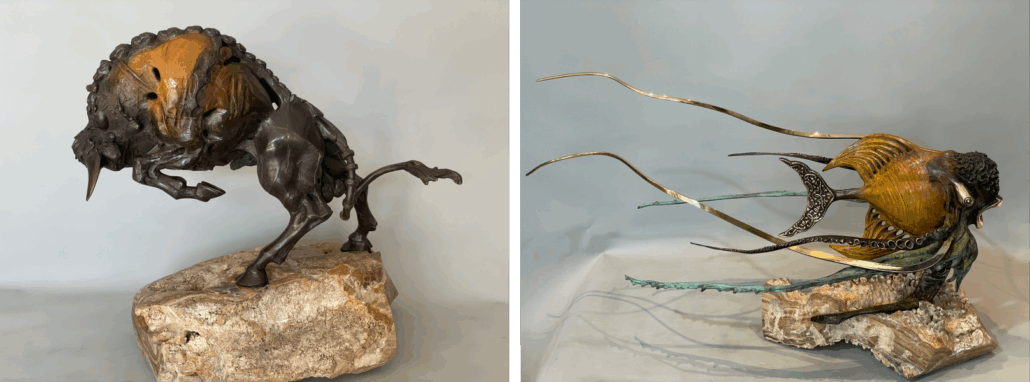
“Fish”
Seyfettin Shekerov’s fantastical fish are creatures of the imagination, yet sculpted with the precision of a naturalist. They emerge not only from the depths of the sea, but also from the play of inner vision, where forms bend, wings and octopus limbs grow, mouths open into smiles, and bronze scales shimmer like in a fairytale. These fish are both ancient and futuristic – beings of an underwater mythology in which reality expands. There is something comical and melancholic about them, like in a dream where the miraculous is possible, but you do not know whether it will frighten you or become your friend.
The fish featured in the exhibition is lavish in form and ornament. It has an exotic body composed of hybrid elements: a tail adorned with motifs resembling Islamic calligraphy and oriental floral patterns; octopus-like tentacles, some of whose suckers are shaped as shells; a head crowned with a “pom-pom” of coral or sea sponge. In this fantastical form there is theatricality, grace, strangeness and humour – as if the sea itself had dreamed up its own mythical creature. Especially striking are the painterly effects of the bronze: the body retains its natural yellow-orange tone, enriched with black and brown surfaces, while each tentacle bears its own texture and colour – glistening golds, green patina, and dark earthy hues. This is no ordinary fish, but an underwater nymph – a figure from a world where biology, myth and ornament merge into one.
Seyfettin’s Bridges
Seyfettin Shekerov’s sculptures pass through many of the conceptual bridges of the exhibition and embody them quite literally, in bronze. In his art we read: cultural-historical memory; the body’s cultural memory; the senses as a bridge through tactility; ritual and myth; animals as archetypes; the plastic abstraction of thought.
In the five sculptures included in the exhibition – from the ritual warrior and the fantastical fish to the abstract flight of the spirit, the tamed bull and the inward-turned female body – the sculptor reveals the thematic and semantic breadth of his plastic thinking. Each form expresses not only a body, but also an inner force, a weight of culture, and an archetypal depth. The woman, the horse, the bulls and the sea creatures are images of transitions – between flesh and spirit, motion and stillness, historical memory and contemporary sensibility. His matter thinks through gravity, tension, and touch. Shekerov’s work enters the exhibition as a bronze bridge through which myths, bodies and rituals cross into our present – not to be repeated, but to be experienced anew, in an entirely different way.
Rossitsa Gicheva-Meimari, PhD
Senior Assistant Professor in the Art History and Culture Studies Section and member of the Bulgarian-European Cultural Dialogues Centre at New Bulgarian University
Biography of the artist
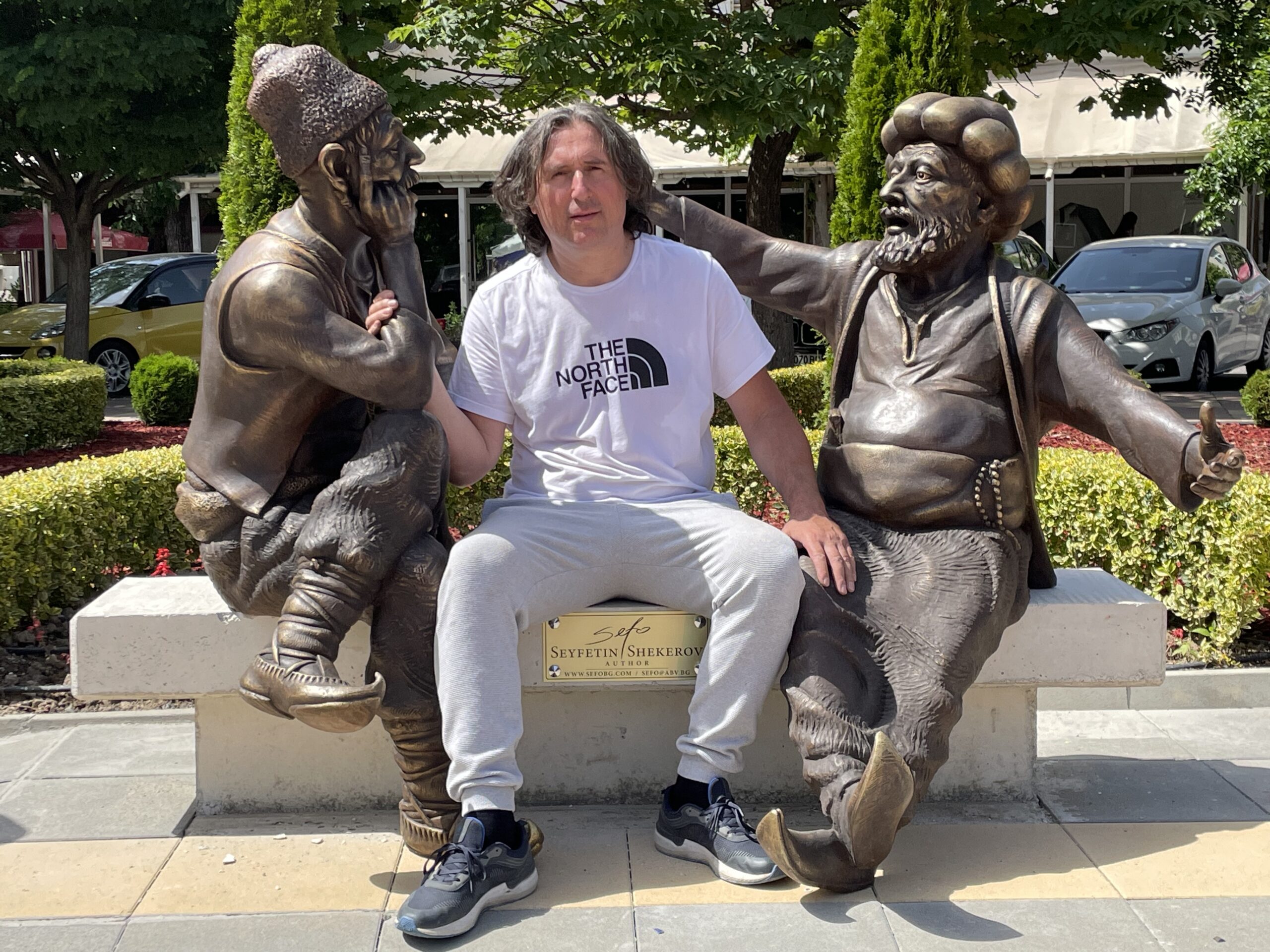
Seyfettin Shekerov (Sefo) was born on 29 August 1971 in the city of Sliven. In 1990, he graduated from the High School of Fine Arts in Sliven. In 1992, he was admitted to the National Academy of Arts in Sofia, specialising in “sculpture”, and graduated in 1998.
He has presented his works in the galleries “Astri”, “Sredets”, “Minerva”, “Lik”, “Tower” and “UBA Shipka 6” in Sofia, as well as in galleries in Plovdiv, Burgas, Sliven, Nessebar, Varna, Yambol and Momchilgrad. His exhibitions have also been held in Bratislava (Slovakia), Vienna (Austria), Budapest (Hungary), Ankara and Istanbul (Turkey), Izmir (Turkey), Kuwait, Oman and Strumica (North Macedonia).
He is the author of monumental sculptures: “Composition” at the Imperial Hotel, Sliven; “Orpheus” at the Orpheus Hotel, Devin; “Composition” at the National Guard Unit, Sofia; “Horseman” and “Exarch Joseph” in Lovech; “Mermaid” in Burgas; “Hristo Botev” in Devin; “Zhivko Stalev” in Sofia; “Eternal Flame” in Kaolinovo; “Ship” in Muscat, Oman. He is the creator of the sculpture “Eternal Flame”, dedicated to the events of May 1989, part of the so-called “Revival Process” in the municipality of Kaolinovo.
He is also the author of many sculptures presented as awards – “Investor of the Year”, the national award “Konstantin Konstantinov”, the award for the festival “Triumph of the Spirit”, organised by the “Start” Foundation for children with disabilities; and “Cyril and Methodius”, presented by the Ministry of Education to schools over 100 years old. He is co-author of the television award “Golden Antenna”.
His works are held by collectors and companies from Germany, the United Kingdom, France, Japan, South Korea, the United States, Turkey, Bulgaria and others.
Story behind the works and the artist
“I have never sought the easy path, and I’ve never been afraid of what’s difficult. I am hardworking. I cannot just sit and stare at the stars. If I rest for three days, by the second day I am already creating something. Even as a student, my classmates used to say: ‘Why sculpture of all things? Do you know how hard it is? Why not choose something else?’ However, I love my profession. I mastered quite a few techniques even during my student years, and I have learned something from everyone. At this point, I have closed the circle – I do everything myself, from clay to stone, carrying out the whole process in my studio.
Many young people left the country. I stayed because I was full of optimism – for Bulgaria, and for a young person’s prospects here. It really is very difficult, but I decided to stay in my homeland.
I love making all kinds of things. However, I am especially drawn to the animal world – bulls, horses… Mythology also attracts me deeply. For about ten years now, I have been making fish, and they give me immense pleasure. They are fascinating, and I try to make them even more varied and unnatural. But then I watch National Geographic and realise there are creatures out there that are even more unnatural than mine.”
In: Sevda Dyukyandzhi, “In the Studio of Sculptor Seyfettin Shekerov – Sefo”, BNR – https://bnr.bg/radiobulgaria/post/101545272/v-atelieto-na-skulptora-seifetin-shekerov-sefo Accessed 31 August 2025
Product has been added to cart