Valentin Asenov – Hakala: scores of dwelling
“Sofia–Istanbul: bridge of art. Artworks with Stories”,an exhibition by Enakor...

A compendium for arts and antiques enthusiast
“Sofia–Istanbul: bridge of art. Artworks with Stories”,
an exhibition by Enakor Auction House
4 Dec 2025 – 3 Jan 2026 at the Union of Bulgarian Artists Gallery, 6 Shipka St., 2А
In the abstract, vividly colourful acrylic paintings of Valentin Asenov – Hakala, there is no singular gaze. What we find instead is a gaze fragmented into pieces — as if the world were seen through shattered glass, magnifying, shrinking, displacing and tearing apart the visual field. His canvases do not represent the world; they construct it — from fragments peeled off from lived experience, shards of time and memory, elements that once were something, but no longer are. This is not ruin, but a new kind of construction, built according to the laws of internal rhythm. Every line breathes like a valve, every patch of colour pulses as if it pours out sound. The line is both structure and hesitation; the colour is both light and the shadow of a memory. This is painting that does not aim to narrate, but to inhabit the experienced — to gather it into a new body of rhythm, form and light.
The fragments are not remnants, but active elements, each with its own field of tension — like nerve endings of a living surface, or like the memory of someone who does not recount chronologically, but structurally. Hakala’s style is not narrative, yet it carries a biography — not through plot, but through the structure of seeing. As if the artist himself were a fragment, and the painting an attempt to stitch himself back into a world torn apart, reassembled from within with the threads of sensation.
The gaze does not move in perspective, but along vectors — from one square patch to another, from contour to texture, from density to dispersion. Looking here is not a walk through space, but a movement through sensations — with leaps, hesitations, and returns. Each painting creates a visual map of sensations — not a geographical one, but an empathic one. Instead of buildings, he constructs spaces — inner rooms of memory, where bright, vibrating colours act as walls and tables with fruit, bottles, and squares evoke a sense of seemingly ordinary, yet inwardly extraordinary dwelling. The geometric forms are not cold — they are infused with living colour, line, and shape. Each area is like a room, filled with quiet objects that do not speak but are fully present. Each form is inhabited, each texture remembered.
The combination of small, precise, almost architectural elements with broad brushstrokes and generalised zones creates a rhythm of inhalation and exhalation — not only of colour, but also of memory. It pulses in the painting — with pauses, with beats, with long lines and sudden crossings. There is no narrative, but there is a structure of stories — like layers of time laid one upon another. There is no plot, but there is a path of light that passes through lines, fragments, and absences. Seeing unfolds along axes, within an inner coordinate system, where each direction is an attempt to inhabit the experienced. Even the name of the village Obitel, where the artist was born, is not just a geographical fact, but also an inner architecture of the painting — dwelling, abode, a shelter for memory.
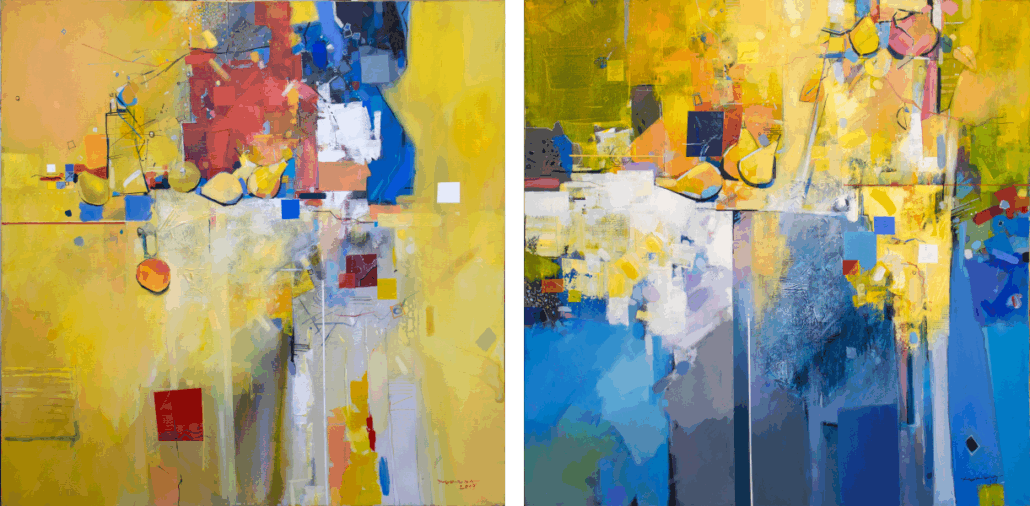
In “Obitel” and “Summer in Obitel”, the still life appears in the upper part of the painting — as if the fruit rests upon a high table, while everything beneath it opens into an inner world. The pears and the peach, outlined with a soft line, create the illusion of ordinary life, of a season, of home. But beneath them, the painting descends in layers, in sediments of light, in lines of submersion. The yellow flows into blue, like summer descending into memory. In one composition, the light is more abstract; in the other, more tender and fruit-like. Yet both contain a tension between the upper zone of the object and the lower zone of experience — between what remains and what flows away. Thus, “Obitel” is not merely a geographic location, but a state of memory, whose light comes from within.
The idea for the diptych was born under the shade of an old pear tree, whose slender branches gently emerge into the upper halves of the canvases. The real pear tree was planted decades ago by the artist’s father in the yard of their family house. Every summer, the family spends several weeks there, gathering beneath its branches for morning coffee, for an aperitif in the evening, for dinners with friends or conversations with neighbours. And when it rains, the water flows from the gutter straight into the roots — as if the house itself waters the tree that keeps its memories. “I have memories with my parents under this pear tree,” says Hakala. “We’ve sat in its shade, made preserves, strung tobacco.” The paintings carry the warmth of that place — ordinary, personal, and cherished. According to his mother, the pear tree still bears fruit, thanks to the water that flows from the gutter into its roots. These paintings resemble that old tree — something that continues to live from the inner moisture of memory.
In “Still Life”, the bottle forms the central axis — transparent, as if woven from light, more memory than object. Around it, small square fragments are scattered like tablecloths, pieces of a table, of a meal, of summer. This is a still life that does not arrange objects, but scatters their memory, turning it into a colourful, dynamic structure.
In the painting, music and still life meet within the very structure of the image. At first glance, we see only patches, lines and abstract forms — but looking closer, next to the yellow bottle, we discover a fragment of a brass wind instrument, with its characteristic buttons. Moreover, between it and the bottle — a fragment of a guitar or another string instrument. These objects carry an inner sound energy that pulses beyond their form.
Hakala’s paintings are experienced like musical compositions — with rhythm, contrast, texture, intensity and pause, just as in music. The space is organised like a score: some areas sound loud and saturated, others remain muted, almost silent. As he confirms: “I’m drawn to composition, to rhythm, to the contrast between dark and light, between warm and cool. I sense and seek where to place the different patches, lines, textures, forms. In some places I leave things more open, in others I condense, layer, fragment, or generalise.”
Thus, “Still Life” opens a sensory bridge between sight and hearing, between music and visual image — not through illustration of music, but through structural analogy that is directly experienced. Hakala’s hues, forms, lines and textures do not simply shine — they resonate in tonalities, rhythms, in the acoustics of colour.
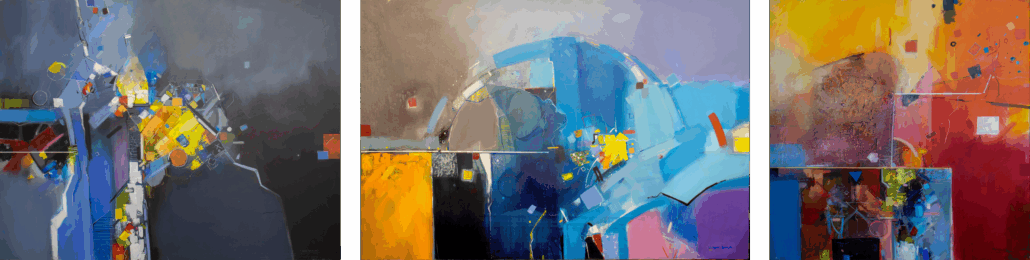
In “Depths”, the composition resembles a topography of the unconscious. The large blue arch evokes the feeling of a dome or an ocean into whose interior the gaze slowly sinks. There, among darkened layers, yellow and red fragments gleam. The left side of the painting holds the weight of the earthly, while the right side opens space toward the infinite. This is painting as immersion — into memory, into silence, into that invisible substance which holds us from within.
The recognisable image here is a child’s house — schematic, outlined with simple lines, as if lifted from every child’s first drawing. Beside it glows a colourful mosaic of small squares that could be seen as a board game, or as gardens seen from a bird’s-eye view. In the depths beneath the blue arch, these images emerge as fragments of memory — between play and remembrance, between home and world. They shine in the dark waters of the unconscious like persistent signs of dwelling.
There is sound in this abstract depth as well. Around the childlike house, in the right half of the composition, the artist has included fragments of string instruments — stretched strings, perhaps of guitars, which seem to echo from memory. On one of the instrument forms, a tuning fork is clearly drawn, outlined in solid black geometric lines. As in other paintings of his, the musical element here is not illustrative but structural — revealed through the inner organisation of space, the vibration of lines, and the pulsation of colour. “Depths” is not merely a painting to be seen, but a score to be experienced — with the inner senses of sight and hearing.
“Fragments” is a painting in which the layers of time are sliced open like in an archaeological cross-section. The upper left part resembles terrain photographed by a drone — with sedimented, rust-coloured earth tones, woven from textures that evoke the feeling of excavation. It is as if the artist cuts through the soil to uncover the hidden structures of existence — those that cannot be narrated, only revealed. Below, in the darker area, these same layers transform into a map of geometries, fragments and networks that recall both urban planning and the internal anatomy of memory.
The colour shift from earthy to fiery — from ochre and rust to vivid red — creates the sense of memory being rekindled, awakened from the depths. The movement between the upper and lower fields feels like a passage through layers of time — from a quiet past lying dormant, toward a present that has begun to pulse. The title “Fragments” is not just a reference to painted sections. It points to fragments of a world that does not seek restoration, but illumination — in its displacements, ruptures, and inner light.
The Bridges of Hakala
In the exhibition, the works of Valentin Asenov – Hakala trace a unique line of connection — not through narrative or landscape, but through an inner architecture of memory. In his paintings, the fragment is not a breakdown but a building block of experience. The fruit and bottles in the still lifes do not depict a table; they retain their taste as remnants of time. The fragments of musical instruments construct melodies. The light is not background — it is memory. Dwelling is not a place — it is a state. In this sense, his paintings build a bridge not across space, but across time — from the present gaze toward what was once lived. Through the tastes, aromas, and fragments that are recalled, his art creates a bridge between human experiences — those we understand without translation, because we sense them with the same human senses.
The musical rhythm that pulses through the structure of many of his works opens yet another sensory channel for perception — that of hearing. Even when no instruments are depicted, the composition is experienced as a musical score, in which lines resound, forms breathe, and colours vibrate. This inner hearing is not merely sensory — it is ideasthetic: it leads to a full experience in which music and painting intertwine as equal languages of one and the same art. In this way, Hakala’s art unites not only the senses and perceptions, but also the arts themselves — painting, sound, the movement of the brush — turning them into a bridge between the inner and the outer, between memory and the present, between the visible and the invisible.
Rossitsa Gicheva-Meimari, PhD
Senior Assistant Professor in the Art History and Culture Studies Section and member of the Bulgarian-European Cultural Dialogues Centre at New Bulgarian University
Biography of the artist
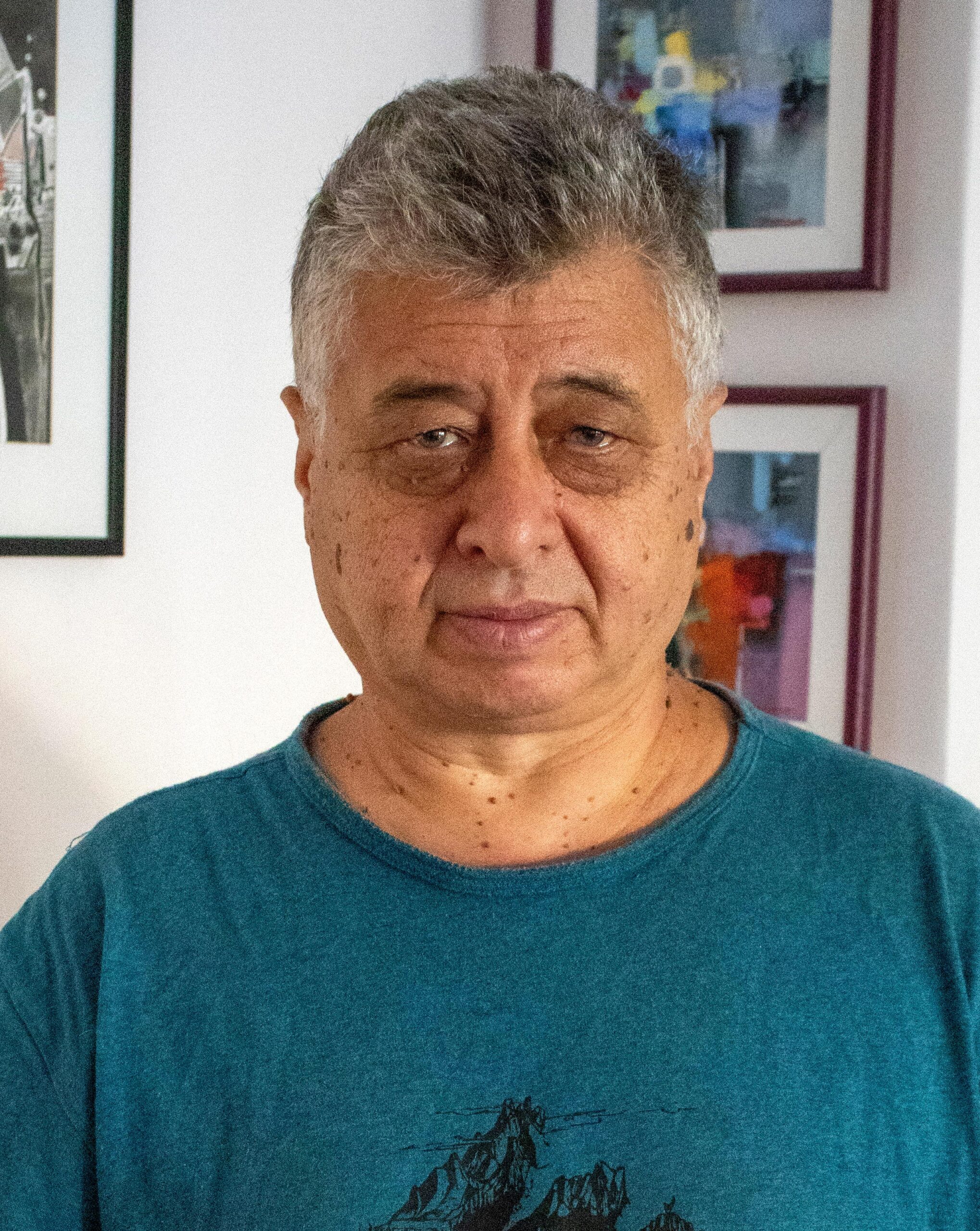
Valentin Asenov, known by the nickname Hakala, was born on 22 December 1961 in the village of Obitel, Targovishte region. His birth name is Hikmet Zekeriev Aliosmanov. His official name is Valentin Zdravkov Asenov.
In 1981, he graduated from the High School of Fine Arts in Kazanlak. In 1987, he completed a degree in Painting at Sts. Cyril and Methodius University of Veliko Tarnovo. Since 1988, he has participated in numerous national and regional exhibitions, including the National Art Exhibitions, the International Painting Triennial – Sofia (1996), and group shows both in Bulgaria and abroad. He has held over fifteen solo exhibitions in Pleven, Sofia, Varna, Plovdiv, and Kazanlak.
Between 1998 and 2003, he exhibited at the Prannerstrasse Gallery in Munich and at ART Fair – Frankfurt, as well as in group shows at Galerie Meisterstück, Germany. He has taken part in many artist residencies and plein air workshops both in Bulgaria and internationally. His works are part of the collections of the Bulgarian Ministry of Culture, the Art Gallery in Pleven, and numerous private collectors in Bulgaria, Germany, Turkey, the United States, Spain, and the United Kingdom.
From 2015 to 2023, he served as Chair of the Pleven branch of the Union of Bulgarian Artists. He currently teaches painting and drawing at the National School of Arts “Panayot Pipkov” in Pleven. He lives and works in Pleven.
Awards and Nominations: Painting Award of “Anubis” Publishing House, Veliko Tarnovo (2005); Diploma for overall presentation, Fifth Biennial of Small Forms (2010); Award of Sts. Cyril and Methodius University, Veliko Tarnovo (2011); Nomination for Painting, National Exhibition of Artist-Educators (2011); Nomination for Painting, Allianz Bulgaria National Competition (2015); “St. Pimen Zografski” Award, Pleven (2019); Honorary Plaque of the Municipality of Pleven (2022).
Story Behind the Works
It’s difficult for an artist to explain their own paintings — at least that’s how I see it. The paintings “Summer in Obitel” and “Obitel” are connected to my childhood home. We spend a few weeks every summer in the village of Obitel, where my family house is. In addition to maintaining it, we also use that time to relax. We set up a table and chairs under the pear tree, an umbrella, a swing — it becomes a very cosy place. That’s where we have our morning coffee, an aperitif in the evening, or dinner. Neighbours and guests often join us.
The idea for these paintings came from that setting. At first, in the sketch, I had included human figures, a table, and a chair— but as I worked, I decided the painting would have more impact without these specific objects. What remained were the fruits as more tangible forms, along with the composition, colour scheme, and textures.
My father planted the pear tree. Some of its branches have dried, but it still bears fruit. My mother used to say the tree would have long since dried out if it weren’t for the rainwater that runs from the gutter straight into its roots — that’s what keeps it alive. I have many memories with my parents under that tree — sitting in its shade, doing all kinds of things: making preserves, stringing tobacco, and so on.
That is why these paintings are especially dear to me.
Valentin Asenov – Hakala
Product has been added to cart