Mesrour Sabit: the living bridges of the landscape
“Sofia–Istanbul: bridge of art. Artworks with Stories”,an exhibition by Enakor...

A compendium for arts and antiques enthusiast
“Sofia–Istanbul: bridge of art. Artworks with Stories”,
an exhibition by Enakor Auction House
4 Dec 2025 – 3 Jan 2026 at the Union of Bulgarian Artists Gallery, 6 Shipka St.
In the work of Mesrour Sabit, the landscape unfolds as a stage of transitions – between seasons and hours of the day, between light and dusk, between exhaustion and renewal. The four paintings included in the exhibition compose a quiet narrative – beginning with a stone bridge at dawn, passing through fields of wheat and sunflowers after rain, and ending in the misty stillness of winter. Each of them carries not only light, but also moisture, smoke, the scent of earth and the breath of stone – a material sensuousness that speaks in a soft voice and evokes human presence, even when it is not visible.
In the landscape “Morning”, the sixteenth-century Ottoman bridge near the village of Bulgarene, in the Pleven region, is portrayed not merely as an architectural structure, but as a centre of meaning. Its stone silhouette, with five arches – the central one the widest – establishes a visual rhythm, almost musical, around which the entire painting is composed. This bridge connects not only two banks, but also two temporal layers: past and present. The stone has absorbed footsteps, voices, horses’ hooves, dreams. The water beneath is not merely a reflection, but a second world – slightly displaced, not fully mirrored, as if sharing its own version of the morning. The arches resemble the ribs of a living being – the body of the bridge lies like a sleeping giant between the banks, and the light awakens it not with a cry, but with a caress.
The colour palette is warm and fresh, yet possesses a luminous transparency that recalls the effect of watercolour – despite the use of oil paint. Short, flickering brushstrokes introduce an impressionistic vibration into the water and the trees. The soft golden-pink light filtering through the arches is a light of memory – it illuminates not only the stone walls, the water and the air, but also the viewer’s consciousness. The trees are not background, but companions and witnesses, and something in the way the painting breathes brings it close to a symbolist vision – where the landscape does not describe a place, but expresses an ancient presence.
The painting radiates calm, resilience and quiet wisdom – a cultural code of Balkan memory that neither forgets, nor abandons, nor hurries. On one hand, the real bridge depicted in Morning is a symbol of memory that has not been destroyed, but continues to connect. On the other, it is a bridge built over and around the light – not only holding it, but also conveying its very essence: warmth, recollection, contemplation. Its arches, together with their reflections, form circular portals of light, inviting not only physical crossing, but also a metaphysical one – from the outer world into inner vision.

Mesrour Sabit: Morning, 2025, oil on canvas; After the Harvest, 2025, oil on canvas; Winter, watercolour on paper; Dusk, 2025, watercolour on paper
“After the Harvest” is not a pastoral landscape, but a painting with tangible density – made of clods of earth, straw, moisture and road. Its surface is not smooth, but layered and sharp, with distinct brushstrokes that recall cut wheat stalks, still prickly after the reaping. This is a landscape of gratitude – not triumphant, but quiet and full. The land has given what it had; the human has done their work, and exhaled in relief. To the left, in the shadow of the frame, the sunflowers are still bowed from thirst – as if to remind us that not everything comes easily. This painting captures the moment before the rain, when the field still bears the marks of drought and strain, but is ready at last to rest. In this sense, “After the Harvest” is also a landscape of compassion – for all that endures and survives, without noise or complaint, with warm solidarity towards the earth.
The sunflowers in “Dusk” are the same ones the artist saw after the rain. Bent and exhausted in the previous painting, here they have risen – not defiantly, but gently, with full bodies. This is the field “after mercy” – heard, watered, revived. The watercolour technique brings a sense of high humidity and soft colour gradations, through which light does not reflect, but passes – as emotion passes through thought, without disturbing it.
The sunflower field is not a decorative motif, but a gathering of living beings – a community of survivors who together carry the memory of thirst, and now stand – alive, wet, and ready for another day. Some of them face us – not looking, but present. It is a mutual recognition through shared experience between painting and viewer. In the distance, the hill breathes in purple, while the sky slowly retreats into ochre and pink. The day is coming to its end, but is in no hurry. “Dusk” is not a landscape of exultation, but of trust – in time, in the mercy of rain, in the viewer who sees. The scene might also be read as a metaphor for the shared fate of the Balkans – a land turned towards light, yet taught to live with dusk as well.
“Winter” by Mesrour is a strange kind of winter. Its snow does not creak but smokes. Moisture rises from the ground like breath from the lips of a silent person, and the light – thinned, milky – comes not from the sun, but as if from memory. Everything in this “Winter” is a sigh released into the cold. If this is winter, it is not an enemy, but a sleeping woman with her hands resting on the river. At the heart of the composition lies the river – not flowing, but breathing. The ice does not cut or bind, but rests like a thin veil upon the river’s breath. This is a careful winter – restrained and courteous. The watercolour is saturated with liquid softness and smoky transitions, dissolving the contours to the edge of dream. The landscape is silent with fatigue. It is a silence filled with memory, in which warmth has only just been – like smoke in a room, after someone has left. The colours are almost non-colours – blues, greys, yellowish shadows – gliding like thoughts that do not wish to be heard, only understood. “Winter” does not look at the viewer – it remembers them.
Mesrour Sabit’s landscapes, as presented in this exhibition, embody some of the most essential Balkan bridges. First, one of his paintings represents a real bridge – and the river itself as a bridge. His river sometimes divides, sometimes reflects, but usually allows passage – like a smoky memory of a journey, a boundary that does not separate but invites crossing. Second, the landscape becomes a vessel of cultural memory – a bridge towards a world and many worlds, between nature and culture, between town and village. Third, Mesrour is a master of bridges between silence and memory.
His paintings carry the ethical presence of a human being who lives with the earth, with time, and with their own boundaries. These works do not build a bridge between Sofia and Istanbul through symbols, but through sensations and experiences – shared vital moisture, patience, resilience, and sensory closeness. The Ottoman stone bridge over the Osăm River is not simply a witness of the past, but a living body over which light still passes. Within his paintings, we sense a particular Balkan disposition – the ability to live at once in bright sunlight and in twilight, in joy and in hardship, without one cancelling the other. Sabit sees the Balkans as a land taught by the cycle. His paintings preserve that experience – resilience through change, constancy in the passage of time.
Rossitsa Gicheva-Meimari, PhD
Senior Assistant Professor in the Art History and Culture Studies Section and member of the Bulgarian-European Cultural Dialogues Centre at New Bulgarian University
Biography of the artist
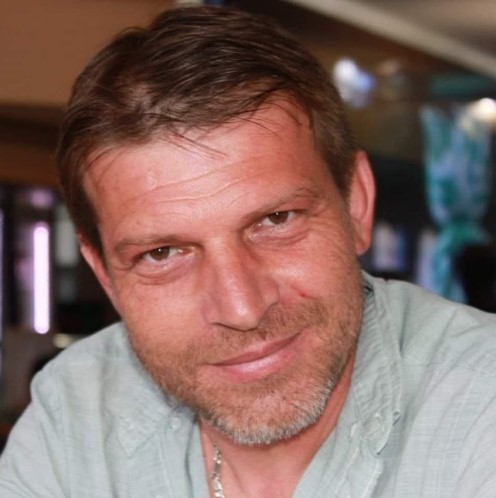
Mesrour Sabit was born in 1977 in the town of Isperih, Bulgaria. He graduated from Sts. Cyril and Methodius University of Veliko Tarnovo in 2005. He lives and works in Veliko Tarnovo.
Solo exhibitions in: Isperih; Istanbul; Burgas (Nesi Gallery); Sofia (Astri Gallery); Sevlievo (Vidima Gallery); Varna (Papillon Gallery); Sofia (Thea Alba Gallery).
Awards
2007 – Award of the Ministry of Culture, Painting Section, at the 18th International Biennial of Humour and Satire in Gabrovo
2012 – Two nominations at the “Friends of the Sea” Biennial in Burgas
Story behind the artworks
I was travelling to my home region – the Loudogorie. The harvest was over, and firebreaks had been ploughed around the fields. One field bordered a block of sunflowers, bowed under the heat and drought.
I returned home. That evening, a long and nourishing rain began – it lasted all night. Two days later, I passed the same place again and stopped. The sunflowers were standing tall and refreshed, as if content with the rain, and the wheat had been harvested just in time. Mesrour Sabit
Product has been added to cart