Yağmur Stankulov: Memento mori and the final light
“Sofia–Istanbul: bridge of art. Artworks with Stories”, an exhibition by...

A compendium for arts and antiques enthusiast
“Sofia–Istanbul: bridge of art. Artworks with Stories”,
an exhibition by Enakor Auction House
4 Dec 2025 – 3 Jan 2026 at the Union of Bulgarian Artists Gallery, 6 Shipka St.
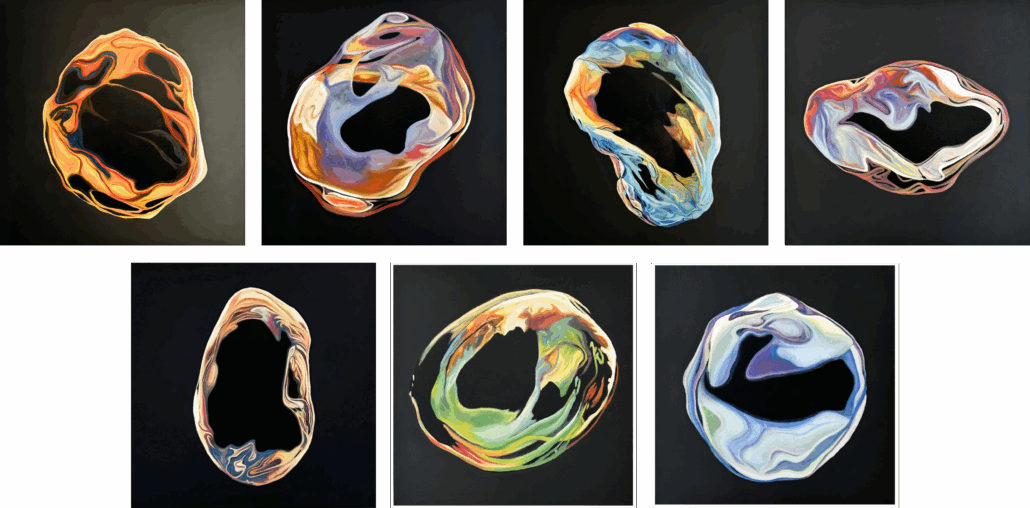
Soap Bubbles as the Final Glimmer of Life
The series by Yağmur Stankulov bears the title “Memento mori” – the well-known Latin phrase meaning “Remember death!”, or more precisely, “Remember that you are mortal.” In ancient Rome, these words were whispered into the ear of a triumphant general to protect him from arrogance and self-delusion. Stankulov explains the idea behind her paintings:
“My works offer artistic reminders of the inevitability of death and invite the viewer to reflect on the transience of their own existence. The idea of memento mori is present in the soft edges of the colourful reflections on the soap bubbles and in the flat blackness of the matte background. The soap bubbles are reflections of the world around us – images drawn from each person’s consciousness, awaiting the moment when the bubble will break.”
Set against a black background, outside of time and space, Stankulov creates her series of soap bubbles – just like the ones we remember from childhood. In them, there is something naively beautiful – just like life itself, which laughs even as it breaks. Each painting has a tactile rhythm: you want to touch it, you can almost hear within yourself that delicate pop that has not happened yet. It feels as if you are present at the final second of something wonderful – and at the same time, at the first second of the silence that follows. However, from the artist’s own words we understand that these bubbles are not toys of forgetting, but gestures of memory returned – in which the world reflects itself one last time, colourful, tender, and fragile. Like in the final moments of life, when one feels like a child again – these bubbles appear at the boundary between memory and vanishing, between the first breath and the final gaze.
Mind, Body and Digitality in the Image of the Bubble
Each bubble is a world of its own – with a winding, iridescent surface full of colours, reflecting what is already vanishing. Their contours resemble organic matter – they look like cerebral cortices, membranes, envelopes or nuclei. They resemble living cells that quiver, pulse and stretch like a breath still undecided whether to come in or go out. The colours unfold in a rhythm – from burning orange and red, through green, gold, azure blue and white, to purples, violets and deep indigo – as if the bubble captures light from the entire spectrum, just before it disappears. The coloured membranes around the black core create a topography of sensitivity, in which absence lies at the centre.
These paintings can also be seen as visualisations of the intellect – the dark interior as a space of silence, and the surrounding colours as neuronal waves of sensation, perception, intuition, and memory – as if silence here has an acoustic form, like the echo of a sound that was never heard. In this way, they resemble scientific models of the invisible – whether brain maps, MR scans, or hypothetical visualisations of artificial intelligence. Thus, the “bubble” becomes not only a metaphor for life, but also an image of the inner person – the one who experiences, understands, remembers, and prepares to let go.
Although created using the traditional technique of oil painting, Yağmur’s bubbles somehow also belong to the world of new technologies. Their surfaces are smooth and free of brushstrokes, resembling virtual objects or digital simulations – something that could exist equally in reality and in a screen-based universe. Their large scale, the macro gaze upon an ephemeral synthetic structure, and the smooth matte finish bring them closer to an elegant form of digital visual aesthetics. They are bodies poised on the boundary between painting and screen, between the breath of the hand and the weightlessness of the virtual image.
Inner Landscapes and the Luminous End
When gazing into the curved surfaces of the bubbles, the eye begins to discern something else – landscapes within the reflections, like dreams of memory. The colour overtones, shadows and contours evoke mountains, cliffs, forests, rivers, seas, waterfalls, golden or green fields, sand, fire, skies, sunsets, horizons, even homes – yet not external ones, but inner landscapes of life. They are fragments of memory – from places we have passed through, and from those we recognise without ever having been there. Just as a soap bubble reflects everything around it, so do Yağmur’s paintings reflect lived worlds – the intimate landscapes of the self, where the personal and the universal merge into a single virtual image of life.
In these paintings, the soap bubble is not merely a symbol of fragility. It is a form of existence – as exquisite as it is fleeting. At the centre of each bubble lies an inner void, a sign of what each of us carries within: death as part of being – quiet and constant, yet not threatening. This inner black emptiness is something other than fear – it is silence, rest, sleep. That moment when life withdraws, yet the colours still shine along its walls.
The Black Hole and Death as Transformation
Seen from a distance, these paintings evoke something else as well – the astrophysical black hole that humanity recently managed to photograph. The black centre, surrounded by a pulsating halo – the accretion disc around the all-consuming – turns each of the works into a cosmic image, where the gravity of meaning draws everything toward itself. In the bubbles, we may also glimpse an allusion to the subatomic world – to the nuclei of particles, where matter bends under the force of energy. In this convergence of microcosm and macrocosm, Yağmur’s bubbles emerge as emblems of the outermost boundaries – in both physical reality and lived experience. These are the ultimate zones, beyond which our perceptions dissolve, and meaning begins to radiate in a new way. In both astrophysics and in Yağmur’s art, what cannot be seen is what matters most. The bubble is a threshold surface between matter, energy, between what is, and what has already vanished.
Astrophysics once believed the black hole to be a place of total disappearance. Nevertheless, today we know that it not only absorbs – it also emits, however faintly. The same can be said of death – it not only takes, it also leaves behind a trace. When a person’s life ends, their deeds do not vanish. What is created remains – as a text, as a painting, as a student carrying the spark onward. The person dies, but their radiation continues – in what they gave to others, in the traces of meaning they left in the world. Similarly, Yağmur Stankulov’s bubbles are not made to disappear, but to carry something forward. In its colour, in its form, in the moment before it breaks – there is a message for the future. Just as science today rethinks the black hole – not as an end, but as a point of transformation – so does Stankulov portray death not as destruction, but as a threshold of meaning, through which light continues.
A Gentle Memento Mori and the Feminine Care for the End
This art understands death – and does not fear it. On the contrary, it pays it a gentle tribute. The symbol of the soap bubble comes from the vanitas genre of Baroque European art, where it served as a reminder of life’s fragility and transience. However, in Yağmur’s work, this motif is reborn – it becomes a colourful child’s bubble, not burdened with fear, but inviting contemplation. The bubble remains a symbol of the limit, but now it is light, delicate, and filled with colour and radiance. It is her way of saying memento mori – remember you are mortal – not with dread, but with stillness, with beauty, with tenderness, and even a wink.
In the left corner of Memento mori IV, the viewer may discern a seated female figure – subtly outlined, like a body in sleep, like a memory of presence. Moreover, even when she is not visibly there, the woman is present – in the colours, in the care, in that quiet cultural memory that does not shout, but softly whispers of impermanence. This is a woman’s knowledge and understanding of the end – an end tended to, like a flower watched over until its final unfolding. Yağmur’s bubble may be seen as a feminine symbol – a tender womb of the moment, where life is held just a little longer, before it departs in beauty.
A Bridge Between Worlds and Generations
Yağmur Stankulov’s abstract works enter the exhibition as a bridge between life and death, between memory and the dissolution of form, between childhood and the final gaze. However, they are also a bridge between microcosm and macrocosm, the visible and the invisible, the concrete form and the abstract sensation. Her shapes are elusive enough to dwell on the edge between a world and its mirror – that fleeting reflection which exists only in the moment before it falls apart. Her soap bubbles will break, but they will say farewell with grace and meaning.
As one of the youngest participants in the exhibition, Yağmur Stankulov brings the voice of a new generation – artists raised with digital culture, global visual languages, and the altered sensory rhythm of contemporary urban life. Her abstract paintings, though created with traditional techniques in oil, carry the sensibility of the screen-bound world – a world of reflected realities, smooth transitions, matte surfaces, and sudden bursts of colour. A contemplative spirit akin to the Baroque lives in them – yet also a visual economy close to the language of the virtual. In this way, Yağmur offers a new path in contemporary art – one in which personal experience and global aesthetic code meet on the surface of the same fragility.
Rossitsa Gicheva-Meimari, PhD
Senior Assistant Professor in the Art History and Culture Studies Section and member of the Bulgarian-European Cultural Dialogues Centre at New Bulgarian University
Biography of the artist
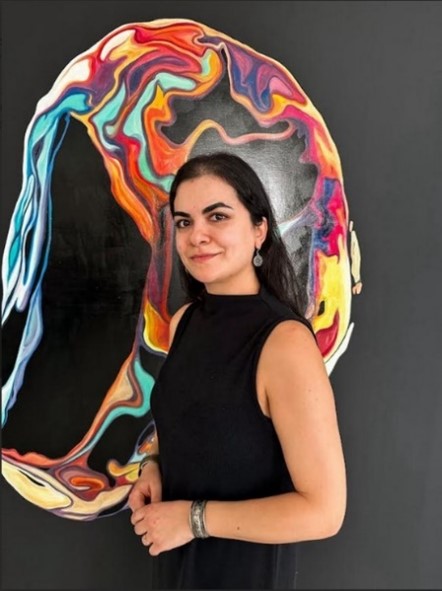
Yağmur Stankulov was born on 29 May 1990 in Istanbul, Turkey. Between 2007 and 2011, she studied painting at Çanakkale Onsekiz Mart University, Turkey, where she completed her Bachelor’s degree. In 2010–2011, she specialised in painting at the National Academy of Art in Sofia through the Erasmus programme, in Studio No. 5 led by Professor Bozhidar Boyadzhiev. In 2024, she completed her Master’s degree in painting at the same academy, again in Studio No. 5 under Prof. Boyadzhiev. Since 2020, she has been a member of the Union of Bulgarian Artists.
She has held solo exhibitions in Sofia (Art Lab Gallery), Istanbul (La Vision Gallery), and in an online format as part of the international project “Art Initiatives – Global and Local.” She has also organised performances and installations in Paris (Bulgarian Cultural Institute), Venice, Naples, and Florence (Fine Art Academies), as well as in Istanbul (Mimar Sinan Fine Arts University). She has participated in group exhibitions in Sofia (Rayko Alexiev Gallery, Contrast Gallery, National Palace of Culture, Sofia Arsenal – Museum of Contemporary Art), Samokov (Prof. Vassil Zakhariev Art Gallery), Nova Zagora (Roussi Karabiberov Gallery), Izmir (IKCU Art Gallery), Istanbul (Mixer Arts Gallery), and Çanakkale (in the studio of Cenk Beyhan).
The Story Behind the Works
“Memento mori” is a well-known Latin phrase that can be translated as “Remember that you must die” or “Remember that you are mortal.” In Ancient Rome, when a general – even Caesar himself – returned victorious and entered the city, a triumphal procession was held in his honour. While the crowds cheered him with joyous acclaim, a specially appointed servant would whisper “Memento mori” in his ear, to remind him that he was mortal.
In the 16th and 17th centuries, the idea of “Memento mori” found expression in the artistic genre known as vanitas, which used symbols to remind us of the transience of life and its inevitable end. Still-life paintings in this tradition typically featured rotting fruit, overturned glasses of wine, skulls, and at times, images of soap bubbles. Because of their fragile nature, soap bubbles have often been seen as a symbol of life’s impermanence.
My paintings offer visual reminders of the inevitability of death and invite the viewer to contemplate the transience of their own existence. The concept of “Memento mori” is present in the soft boundaries of the colourful reflections on the soap bubbles, and in the uniform blackness of the matte background. The soap bubbles are reflections of the world around us – images drawn from each person’s consciousness, awaiting the moment when the bubble will break.
Yağmur Stankulov
Product has been added to cart